

“The confidence that I have in my taste, and my ability to express what I feel has proven helpful for artists.”
A music producer turns a song idea into a finished record. They shape the sound, build or arrange the parts, guide the artist through recording, and see the song through mixing, mastering and release. In a home studio, one producer often does every one of those jobs alone, on a laptop.
Ask what a music producer does and you’ll mostly read about a job at a big studio: booking session players, watching the budget, running the room. That job is real. But if you’re reading this with a laptop and an hour after work, it isn’t yours.
Yours is a chain of small decisions, and it starts the moment you open an empty project. This guide walks that chain in the order Mix Elite teaches it, with the decision each stage asks of you and the exact FL Studio moves. It also shares what Max, the founder of Mix Elite, keeps seeing “after going through hundreds of projects one-on-one” with students in Mix Elite Academy.
Table of Contents
What is a music producer?
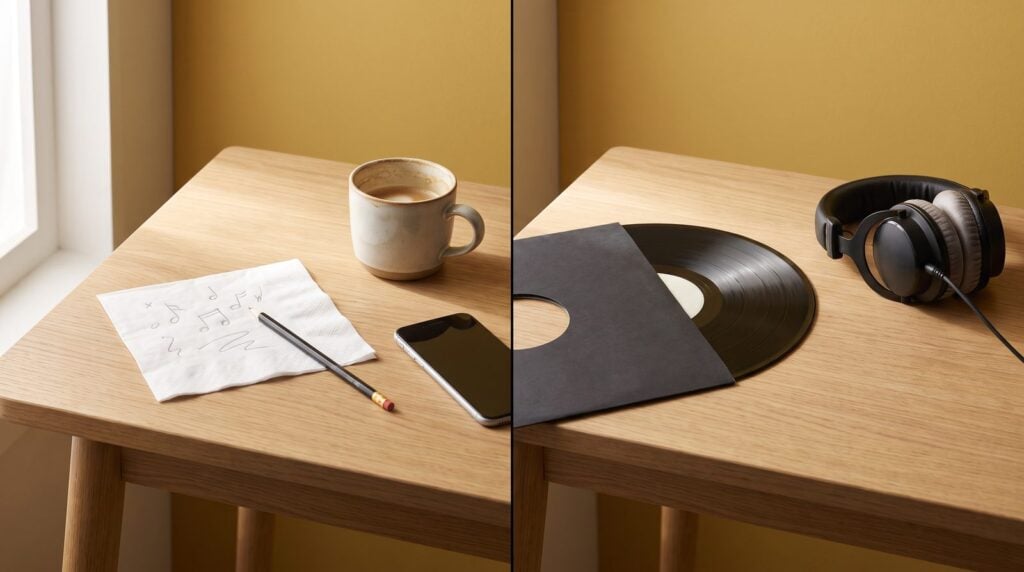
A music producer, also called a record producer, is the person in charge of how a recording turns out. Think of a film director, who doesn’t have to hold the camera but makes every call about the final film. On a big record, that means leading a team: the artist, a recording engineer, session musicians, a mix engineer and a mastering engineer. In a bedroom studio, the producer usually is the whole team.
Some famous producers barely touch the gear. In the quote at the top of this page, Rick Rubin, who co-founded Def Jam, answers a simple question from 60 Minutes: what is he actually paid for? His answer is taste, and the confidence to act on it. You’ll also hear “production” used for the instrumental itself. When people say a song has great production, they mean the beat, the sounds and the arrangement behind the vocal.
What does a music producer do, step by step?
A music producer takes a song through six jobs: writing the idea, producing the parts, arranging them, mixing, mastering and releasing. On a big record, each job can have its own specialist. At home, one producer usually does all six, and each one comes down to a decision only the producer can make.
Early in Mix Elite’s free 4.5-hour FL Studio course, Max walks through this workflow from the first idea to the release. It’s the order the work really happens in, so it’s the clearest way to see the job.
Here’s the whole course if you want to follow along. The workflow comes up in the first ten minutes.
1. Ideas: chords, melodies and sounds
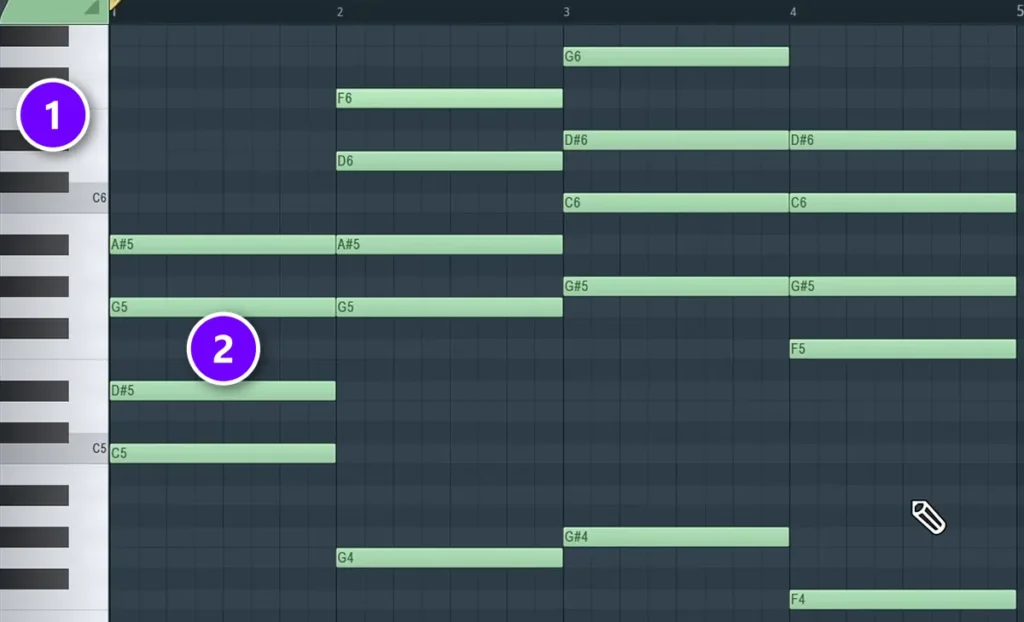
The decision: is this idea worth finishing? Every song starts as something small, like a chord progression, a melody, a sound that inspires you or a few lines of lyrics. Max sketches on a plain piano first. “I like to use a piano to come up with some ideas and then we can always replace it with any synthesizer you like,” he says. That keeps your attention on the notes.
In FL Studio this happens in the Piano Roll. The keyboard on the left (1) shows which note each row plays, and notes stacked in the same spot make a chord (2). This loop from the free course is four chords, one per bar, and its melody started as something Max played by accident on his computer keyboard. To stay in key, right-click the Piano Roll’s snap to scale button and choose your scale.
This stage carries more weight than beginners expect. In Mix Elite’s beginner mixing mistakes video, Max says people blame the mix when the real problem is the writing. “One wrong note playing, bad chord progression, cheesy melody, and no amount of side chaining and correct reverb settings will fix this,” he warns.
2. Production: drums, bass and extra layers
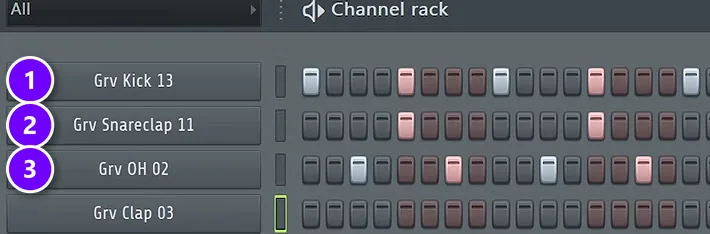
The decision: which sounds, and how few? Next you add bass, drums, percussion and extra layers around the idea. Max calls it giving the idea “more arms and legs.” It’s where a loop starts to feel like music. Drums usually live in FL Studio’s Channel Rack, where each row is one sound and each box is a step you click on or off. In this house beat, the kick (1) plays on every beat, the clap (2) lands on beats 2 and 4, and the open hi-hat (3) fills the gaps between the kicks.
Sound choice matters as much as the pattern. Max’s rule is “gold in equals gold out,” and it’s literal. Better samples give you a better song before you’ve added a single effect. To audition them, drag a sample onto a channel, then press Shift + the up or down arrow in the browser while the song plays, and the sample swaps in place.
Then stop adding. Max compares an overloaded track to a photograph. “If everything is in focus, nothing is the subject,” he says. Every layer you add makes the others harder to hear.
3. Arrangement: turning a loop into a song
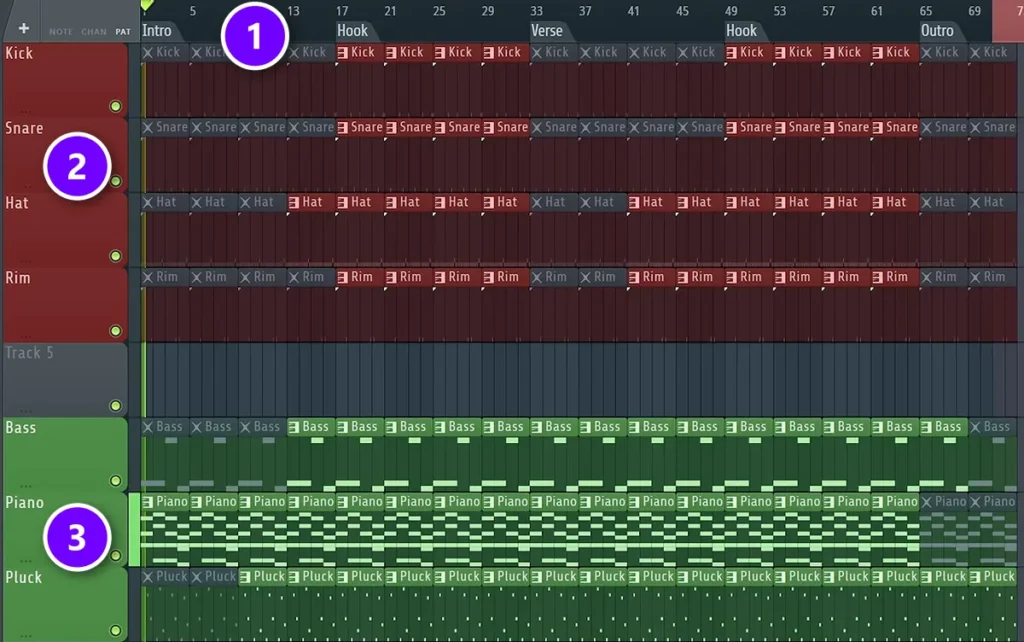
The decision: what plays when? A loop isn’t a song yet. The producer has to lay it out over time, with an intro, verses, hooks or drops, a breakdown and an outro. In FL Studio, arranging happens in the Playlist. The sections are marked across the top (1), the drums sit on the red tracks (2), and the instruments on the green ones (3). Clips with an X are muted, so each section only plays the parts it needs.
Max doesn’t work this out from nothing, and he says you shouldn’t either. In his words, “having a reference track is one of the most powerful strategies to level up quickly,” so use one. A reference track is a song you love in the same style. Here’s the method from the free course.
- Create a new arrangement from the arrow next to the Arrangement name, so your current one stays safe.
- Drag the reference song into the Playlist and move its track to the top with Shift and the mouse wheel.
- Match the tempo. Search for the song’s BPM, or use FL Studio’s Tempo Tapper while it plays.
- Listen through and press Alt + T to drop a marker wherever anything changes. Name each one, like “intro, plucks” or “hook, all drums.”
- Mute the reference, copy your patterns across the song, and build each section from your own notes.
Max prefers adding parts in to cutting them out. “I would personally stay in the concept of additive arrangement,” he says. Stuck? His advice is short: “if you’re stuck on arrangement, 90% of the time you just need to get started,” and a reference track is the fastest start. If your loops never turn into songs, this guide on how to finish a song shows the way past them.
4. Mixing: making every part fit
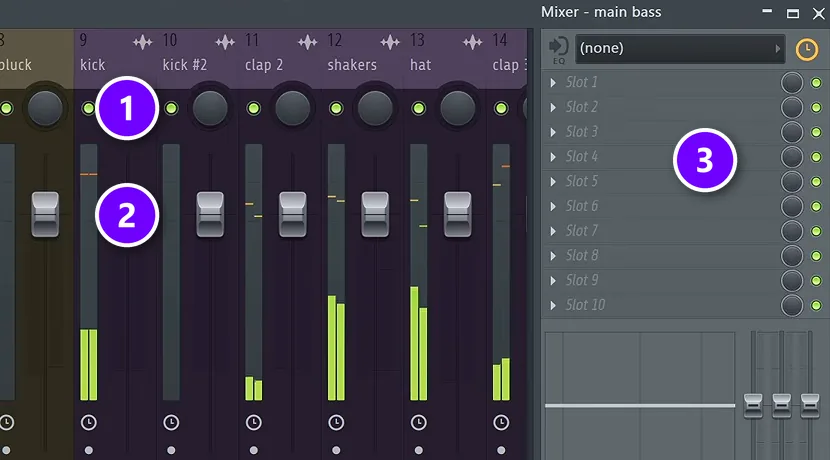
The decision: what’s too loud, and what’s in the way? Mixing is where every sound gets balanced, cleaned up and given its own space. Max calls it the most time-consuming and technical step, about 5 to 10 hours for an average song. In the Mixer, each sound gets its own track (1) with its own volume fader (2), and the slots on the right (3) hold that track’s effects.
Two moves save beginners hours. First, take the limiter off your master track. Max calls leaving it on “the mistake of mistakes.” Second, link your channels to the mixer with Ctrl + L so nothing gets lost. Then turn things down before anything else. “I always start with attenuating sounds that feel way too loud,” Max says. After volume come EQ, dynamics and space, the rest of Mix Elite’s Holy Quad formula.
And go back to the point about writing. Max says “the arrangement of your instruments is 90% of the mix,” so a track that feels cluttered is often a writing problem, not a plugin problem. Our guide on how to mix a song walks through the whole process.
5. Mastering: the final polish
The decision: is this ready for strangers to hear? Once the mix sounds right, you export it as one audio file and polish it in a fresh project. Max calls it “the final 5% of preparing your track for the release,” and it’s short. Because you get so used to your own song, it’s sometimes handed to a professional with fresh ears.
The free course keeps the moves small: low-cut below 30 Hz, cut above 18 kHz, and no EQ move bigger than about 2 dB. Want bigger moves? Then you’ve found a mix problem. The more you change on the master, Max says, “the more likely you need to actually go back to the mix.” Then test it on headphones, laptops, in different cars and on Bluetooth speakers. This guide on what mastering is explains the rest.
6. Release: getting the song heard
The decision: put it out, or keep polishing? If you have a label or a manager, they take care of much of the publishing and promotion. Without one, you can release on Spotify and YouTube yourself. Our guide on how to release music shows you how.
What does a music producer do beyond making beats?
Beyond the beat, a producer is responsible for the whole song: the vocal and the performance, the arrangement, the final sound and the call on when it’s finished. A beatmaker builds the instrumental. An audio engineer handles the technical side of recording and mixing.
A beatmaker can be a producer, but not every producer makes beats. A record producer might never program a drum pattern and still shape every part of a song by deciding which take to keep and which part to cut. At home you’ll be all three, which is why beginners feel swamped. Wearing one hat at a time helps, and that’s how Max learned too. “Believe it or not, I’ve been making music for a very long time before I even started to look into the mixer,” he says.
The part nobody mentions is how much pros reuse. Max says “pro artists are very often literally reusing their whole projects, just exchanging their instruments, inserts, harmonies, and melodies,” and he’s blunt about beginners who won’t. “Your goal is to finish your music,” he says. “You’re not Taylor Swift yet.”
What kinds of music producers are there?
“Music producer” covers several different jobs, and many producers combine a few. If you’re starting at home, you’re almost certainly the first or third one here.
- Beatmaker. Makes instrumentals and usually sells or leases them online. Many hip-hop and trap producers start here.
- Record producer. The classic role. Leads an artist’s song or album, runs the sessions and signs off on the final sound.
- Artist-producer. Writes, produces and releases their own music, like most electronic producers and DJs.
- Songwriter-producer. Writes the song and builds the track around it, often with a topliner, who writes the vocal melody and lyrics.
- Mix or mastering engineer. Specialists who take finished parts and balance them, or give the final mix its last polish.
- Executive producer. Oversees the project and the budget rather than the sound.
What does a producer do in the studio with an artist?
A record producer brings people together to make the music, then uses technology to record, edit and finalize it. With a singer or a band, that makes the job part coach, part director and part project manager. Before recording, they choose songs, keys and tempos. During it, they get the best performance and decide which takes to keep. After it, they pick the final takes and see the song through mixing and mastering, on time and on budget.
The most useful studio habit is simple, and Max’s version is firm. “Make sure to always record a couple of takes, even if you think that this one was perfect,” he says. The producer is the one in the room who makes that happen. Here’s how he turns those takes into one vocal, from the free course:
- Use the Playlist’s slice tool to cut the takes into parts, and keep only the best of each, deleting or muting the rest.
- Slice out long silent parts too, so you don’t keep background noise from the microphone.
- Hover over the clip’s corner until you see the pinch hand, then drag to fade the edges and avoid clicks.
- Even out the takes. Their distance from the mic and their energy will differ, so automate the volume until they match, or use the sample’s gain control when you’re working with a vocalist remotely.
What skills does a music producer need?
You don’t need a degree or perfect pitch. Going by what Max keeps telling beginners, these six matter most, and each one has a simple way to practice.
- Ears and taste. Compare your song with one you love, in the same style. In his free plugins video, Max calls referencing “the most important mixing tip.”
- Enough theory to stay in key. Your songs mostly use seven notes, and FL Studio’s Piano Roll helpers can show you which seven.
- Speed in one DAW. “Very often your creative mind is limited by how fast your hands can actually control your DAW,” Max says. Learn the shortcuts and start from a template.
- Mixing basics. Volume, EQ, dynamics and space, the four parts of the Holy Quad, Mix Elite’s mixing formula.
- Finishing. Decide when a song is done and move on. Max’s fastest route is to remake songs you love, because “the better producer I talk with, the more they’re remaking tracks regularly.”
- Not quitting. Max calls “giving up too early” by far the worst mistake. It beats every technical one.
Notice that playing an instrument isn’t on the list. Max is clear about this: “Spoiler alert: you also don’t need any real instrument,” because every instrument you can think of comes as a virtual one inside your DAW.
Which skills should a beginner learn first?
Learn them in the order a song gets made, one at a time: first the four main windows of your DAW, then simple chords in one key, then drums and turning a loop into a song, and mixing last. That way each new skill lands in a real song instead of piling up as theory.
What tools do music producers use?
Less than you’d think. Max names just two essentials, a computer and a pair of headphones. Beyond those, he says, “everything else is totally optional,” at least at first. Your current computer will likely be fine for the first months.
- Computer. When you upgrade, Max says to look for the highest single-core speed, at least an Intel 13th gen i5 or an M-series Mac, 16 GB of RAM and an SSD.
- Headphones with a flat sound. No boosted bass or treble, so your songs also sound right on car stereos, laptops and earbuds.
- A DAW. The one program that runs everything. Mix Elite recommends starting in FL Studio.
- Optional extras. An audio interface and a microphone for vocals or guitar, and a MIDI keyboard, though your computer keyboard can play notes too.
- Studio monitors, if you want them. Max says 5-inch monitors suit an average room and about $300 buys a pair you’ll keep for 10 years or more. Placement matters even more than the gear, and even an old mattress against the wall helps with low-end buildup.
FL Studio has a free trial with every instrument, effect and feature and no time limit. If you buy it later, Max’s pick is the Producer Edition, which he calls “the best bang for your buck.” It’s the one most people need.
One catch: the FL Studio trial can’t reopen saved projects. Export your song as a WAV or MP3 before you close it.
How do music producers get paid?
There’s no single salary for producers, because most of them aren’t employees. The money usually comes from a mix of fees per song or project, royalties (a share producers call “points”), beat sales and leases, their own releases, and related work like mixing for others, sample packs or teaching. Pay varies a lot, and plenty of producers start part-time next to a regular job. Treat your first songs as practice, not income.
How do you become a music producer as a beginner?
Follow the same order as the job. Finish one simple song from start to finish, then do it again. Here’s a path that fits around work and about 45 minutes a night.
- Download the free FL Studio trial and use the headphones you already own.
- Learn the four main windows: the Channel Rack, the Piano Roll, the Playlist and the Mixer.
- Make one short song through the six stages above. Max says 2 minutes is enough for a track like his course example. Our guide on how to produce music shows every click.
- Pick a reference track and copy its structure, using the marker method above.
- Remake a song you love as closely as you can, then another one.
- Get feedback from someone who knows what to listen for, release the song, and start the next one.
How do you learn music production with only an hour a night?
Give every session one small job from the producer’s workflow, in order, instead of jumping between random tutorials: chords one night, drums the next, then the arrangement and the mix. Stick to one DAW and one reference track, and keep each song short so you actually finish it.
A set path helps most when time is short. Mix Elite’s free 4.5-hour FL Studio course is split into parts that each build on the one before. Mix Elite’s 7-Day Music Producer Course is planned around about 45 minutes a day, with one finished track at the end of the week.
Worried you’re starting too late? You’re not. Here’s why it isn’t too late to learn music production, even if you’re 40 or older.
THE 7-DAY MUSIC PRODUCER COURSE
Do the whole producer job once, in 7 days
The 7-Day course walks you through every stage above in order, one step a day: setup, chords and melodies, drums and arranging, mixing, vocals, mastering and release. Each day takes about 45 minutes, and every sound and template you need is handed to you. It’s taught in FL Studio (the free trial works), and on day 7 a pro gives you personal feedback on your track. It’s $27, and you get 60 days to decide if it was worth it.
When you’re ready to learn it properly, this guide compares the best online music production courses and schools for beginners.
Frequently asked questions
What does a music producer do in simple terms?
A music producer is responsible for how a song turns out. They help shape the idea, build or arrange the music, guide the recording, and make sure the song gets mixed, mastered and released. At home, one producer often does every step alone in a program like FL Studio.
What does a music producer do beyond making beats?
A beatmaker builds the instrumental. A producer is responsible for the whole song beyond the beat: the vocal and the performance, the arrangement, the mix and master, and the release. In practice that means deciding which take to keep, which part to cut and when the song is finished. Many beatmakers do all of this too, and in hip-hop the two words often describe the same person.
Which music production skills should a beginner learn first?
Learn them in the order a song gets made: the four main windows of your DAW, then simple chords in one key, then drums and arranging a loop into a song, and mixing last. Work on one skill at a time and finish short songs, so every new skill lands in a real track.
How can you learn music production with only an hour a night?
Give each session one job from the producer’s workflow, like chords one night and drums the next, instead of jumping between random tutorials. Stick to one DAW, compare your song with a reference track, and keep songs short so you finish them. A set plan helps most: Mix Elite’s 7-Day Music Producer Course is built around about 45 minutes a day.
Do you need to play an instrument to be a music producer?
No. Max, the founder of Mix Elite, says you don’t need any real instrument, because every instrument you can think of comes as a virtual one inside your DAW, and you can play it with a mouse or your computer keyboard. A little theory, like staying in one scale and building simple chords, helps a lot, and you can learn it while you make songs.