
“Some of us are turtles; we crawl and struggle along, and we haven’t maybe figured it out by the time we’re 30. But the turtles have to keep on walking.”
No. It isn’t too late to learn music production at 30, 40 or even 60: you don’t need to play an instrument or read music, and adults keep learning new skills like this. What you need is a small, steady habit, like 45 minutes a night, aimed at finishing one simple song at a time.
You’re 38, the kids are finally asleep, and you just watched a teenager build a beat in a YouTube short that sounds ready for the radio. Then the old thought shows up. Everyone who’s good at this started at 12, so you’d be starting from zero, 25 years behind.
So is it too late to learn music production, or is that just the fear talking? Here’s the honest version: what really gets harder after 30, what gets easier, what the research says, who started late and still made great music, and a plan that fits into 45 minutes a night.
Table of Contents
Is it too late to learn music production at 30, 40 or 50?
No, and the honest answer depends more on your goal than on your age. If you want to make songs you’re proud of, play them for friends and maybe put them on Spotify, there’s no birthday where that stops being possible. If your plan is to become a teenage prodigy or a touring festival DJ by next summer, starting at 45 makes that a lot harder. That was never a likely plan at any age, though.
Part of why it feels late is your feed. You see the 19-year-olds who got good, never the ones who gave up, and never the 45-year-old who makes music after work for the fun of it. Here’s what each decade really looks like.
Starting at 30
At 30 you likely have decades of music ahead of you. Even at 45 minutes a night, five nights a week, you’d put in close to 200 hours a year. That’s enough to finish a lot of songs and get properly good at this.
Learning music production at 40
At 40 the problem is rarely your brain. It’s your calendar. Your evenings are short and you’re tired, so you need a plan that gets one small thing done each night, not a vague goal to “get better at music”. The plan further down is built for exactly that.
Starting at 50, 60 or later
Some of the most encouraging stories below start right here. One man began mixing at 57 or 58 while he was still selling brake pads for a living, and another taught himself to make beats in his mid-60s. The practical things to watch are your ears and your patience, so keep the volume moderate and lean on your biggest advantage: decades of knowing what good music sounds like.
What gets harder when you start later
It would be dishonest to say age changes nothing. These are the real costs, and none of them is a deal-breaker.
- Less free time. A teenager can spend four hours a day on beats. You get 45 minutes after the dishes, which is the biggest difference of all and the reason the plan below is built around short nights.
- Perfect pitch is mostly off the table. Naming a note by ear with nothing to compare it to is strongly tied to music training in early childhood (more on that below). You don’t need it to produce: FL Studio shows every note on screen, and its scale helper keeps you in key.
- Your ears are getting older too. Hearing fades slowly for many people as they age, and years of loud noise add to it, says the US National Institute on Deafness and Other Communication Disorders. Keep your volume lower than feels natural, which is Max’s advice for long sessions anyway, and compare your mixes with songs you love.
- You’re used to being good at things. At work you’re the one people ask. Here your first songs will sound like first songs, and that stings adults more than kids. Judge yourself by songs finished, not by how they compare to the radio.
What’s easier when you start as an adult
Adults also bring real advantages, and most of them matter more than raw hours.
- Taste. You’ve listened closely to music for 20 or 30 years. You already know what a great chorus feels like, and that’s half of making one.
- Habits. You get up for work and pay your bills on time. A 45-minute habit is a smaller version of something you already do every day.
- Cheap tools. A computer and a decent pair of headphones now do what used to need a whole studio. Max says it plainly at the start of his free 4.5-hour course: “That’s all the necessary hardware you need to make music. Believe it or not, everything else is totally optional.”
- No pressure. Music doesn’t have to pay your rent, so you can make exactly what you like.
What does the research say about learning music as an adult?
Nobody has studied 40-year-olds learning FL Studio, so be careful with anyone who claims proof either way. Here’s what the closest real research says, and where it stops.
- Adult brains still adapt to music practice. In a classic 1995 study, adults who didn’t play an instrument practiced a simple one-hand piano exercise for 2 hours a day. Within 5 days, the brain areas that control their finger muscles had grown on brain maps (Pascual-Leone and colleagues). That isn’t the same as becoming a musician, but it shows an adult brain still changes with practice.
- Spacing practice out helps, at least with simple skills. In a small 2012 study, musicians learning a short keyboard pattern only got more accurate at their second session when the sessions were 24 hours apart (Simmons). A larger review found spacing helps most with simple tasks and barely at all with the most complex ones (Donovan and Radosevich), so it suits the repeatable basics: shortcuts, drum patterns and chord shapes.
- Sleep may help practice stick. In a 2002 study, people typed a practiced finger pattern about 20% faster after a night’s sleep, while the same hours awake didn’t help (Walker and colleagues). A later review questions how big that effect really is (Pan and Rickard), so treat it as a maybe. Either way, practicing in the evening is no handicap.
- Perfect pitch is the real exception. In a survey of over 600 musicians, 40% of those who started training by age 4 reported perfect pitch, against 3% of those who started at 9 or later (Baharloo and colleagues). It’s rare anyway, fewer than 1 in 10,000 people by one estimate (Diana Deutsch).
- There’s no magic number of hours. A large 2014 review found that practice explained about 21% of the differences in music performance between people (Macnamara and colleagues). Anders Ericsson, whose research inspired the famous 10,000-hour rule, later wrote with Robert Pool that “there is nothing special or magical about ten thousand hours” (Salon).
Put together, the research doesn’t say age makes no difference. It says the difference is smaller than the fear, and that regular practice, the part you control, still works for adults.
Music producers and artists who started late
Plenty of musicians got going in their 30s or later, and the ones most like you kept a day job and built the music around it. Every fact below links to where it was reported.
- Tom Scholz. Boston’s guitarist and producer was a 29-year-old product design engineer at Polaroid when the band’s first album came out. He had taught himself to record in a basement studio, and he didn’t leave the day job until Boston was headlining arenas (MIT Technology Review).
- Bill Withers. After nine years in the Navy, the man behind “Ain’t No Sunshine” worked in an airplane-parts factory and learned guitar between shifts. His first album came out when he was 32, while he still had that job (NPR).
- Sharon Jones. She worked as an armed guard for Wells Fargo and as a corrections officer at Rikers Island, and she was 40 before she made her first record. She went on to front the Dap-Kings (NPR).
- Hans-Joachim Roedelius. He was a physiotherapist with no musical training when he started making music in 1968, at 33 or 34. He went on to make pioneering electronic music with Cluster and Harmonia (Red Bull Music Academy).
- Ka. The Brooklyn rapper, who produced his own albums, spent 20 years with the New York fire department and rose to captain. He came back to recording in the 2000s and released his first solo album, Iron Works, in 2008, at about 36 (NBC News).
It isn’t only famous names, either. These three are producers who started late without any spotlight at all:
- Nick Hayes, “The Last DJ”. He did a little DJing after school, then spent decades selling brake pads. At 57 or 58 he bought a pair of DJ decks and started to mix. At 67 he was making hard techno and performing it from home to a big online audience (MusicRadar).
- Arthur Dubois. When doctors told him to stay home, the Chicago grandfather taught himself music production. At 72 he had been making his own beats for six years (CBS News).
- John Readshaw. After decades in banking and finance, and calling himself “certainly not a musician”, he graduated from a sound production diploma at 68 (RMIT University).
And if you need one last nudge, Charles Bradley released his debut album, No Time for Dreaming, at 62. None of these people had a shortcut. They simply kept going at an age when plenty of people would have called it too late.
Do you need to play an instrument or know music theory?
No. It’s one of the biggest worries adult beginners have, and Max answers it a few minutes later in the same course: “Spoiler alert: you also don’t need any real instrument… And no, you don’t have to be able to play any instrument at all.” Every instrument you can think of exists as a virtual instrument inside your music software.
Music theory works the same way. FL Studio can light up the notes that fit, so you can write chords and melodies that sound right before you know what a scale is. You’ll pick up the theory along the way.
Let FL Studio show you the right notes
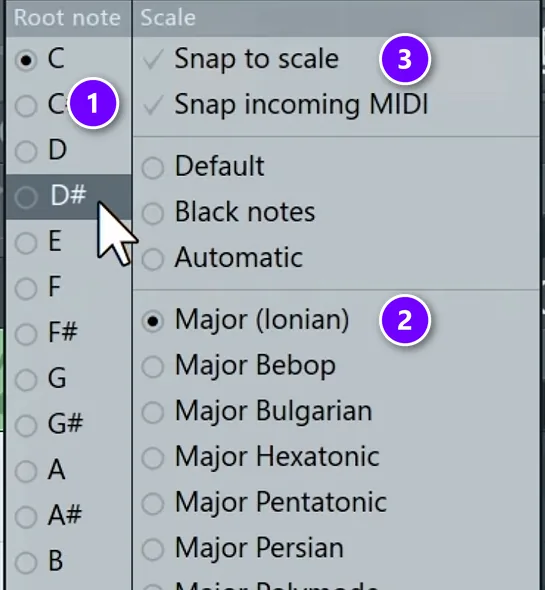
In the Piano Roll, right-click the small note icon in the toolbar to open this menu. Pick a root note (1) and a scale such as Major (2), and the notes that fit get highlighted. Left-click the same icon to turn on Snap to scale (3), so every note you draw lands in key.
Play melodies on your computer keyboard
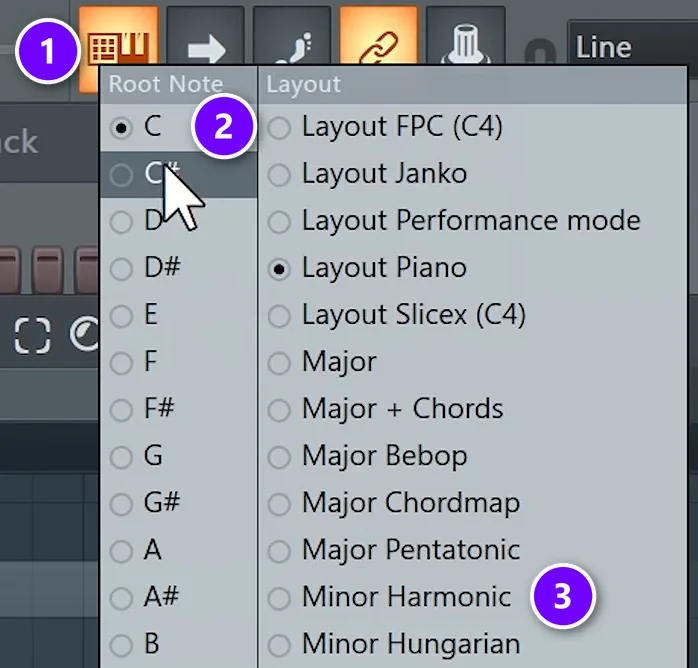
No MIDI keyboard? Right-click the typing keyboard to piano keyboard button (1) and choose the same root note (2) and scale (3) as your chords. Now your letter keys only play notes that fit, so you can hunt for a melody by ear. Max found the melody in his own course demo this way, partly by accident.
How to learn music production in 45 minutes a night
The plan follows the same order Max teaches in his free 4.5-hour course (the video at the top of this page) and in our step-by-step guide to producing music: take one small song from start to finish, then do it again. Every night has one job, and every night looks like this.
Week 1: make a loop you like
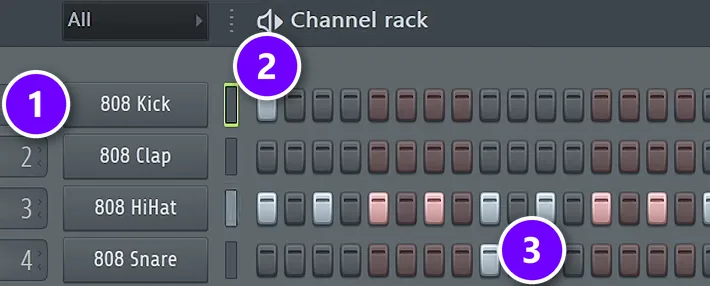
Night 1 is a 2-bar drum loop in the Channel Rack. Each row is one sound, like the 808 Kick (1). Left-click a grey step to switch it on (2), right-click to switch it off, and press Space to hear the loop. Max’s pattern puts the kick on the first step, a snare on beat 3 (3) and hi-hats on every other step.
- Night 1: install FL Studio from Image-Line’s download page and make a 2-bar drum loop in the Channel Rack.
- Night 2: write four chords in the Piano Roll with the scale helper on.
- Night 3: add a bassline that follows the lowest note of each chord.
- Night 4: find a melody on your typing keyboard.
- Night 5: swap any sound you don’t like, then stop for the week.
Free trial catch: FL Studio’s trial has every feature and no time limit, but it can’t reopen a saved project. While you’re on the trial, treat each night as its own small experiment and export it before you close FL Studio. To build one song across several nights, from week 2 on, you’ll need a paid edition.
Week 2: turn the loop into a 2-minute song
Pick one genre you love and one song in that style to use as a reference track. Max calls a reference track one of the fastest ways to level up, because it hands you a proven map of where each part starts and stops.
Copy your loop across the Playlist, then take parts away to build an intro, a verse and a breakdown. Max suggests about 2 minutes for a first song, which is long enough to feel real and short enough to finish. Our guide on how to finish a song walks through it step by step.
Week 3: balance it and keep the mix simple
Turn each sound up or down until nothing buries the melody, then stop. Don’t worry about advanced mixing yet. Max says, “Believe it or not, I’ve been making music for a very long time before I even started to look into the mixer.”
Week 4: export it and play it for one person
Export a WAV or MP3, play it to one person you trust, and write down what they say. Then start song number two the next night. It goes faster, because you already know where everything is.
Is a month per song slow? Compared with a full-time student, sure. But one simple, finished song a month is 12 songs a year, and every finished song teaches you more than a folder full of loops.
How long until you’re actually good?
It depends on what you mean by good. Most beginners can make a simple beat within the first week or two of short evening sessions and finish a rough first song within a month. Songs you’d happily play for friends usually take a few months, and the deep skills, like mixes that sound great on every speaker, take years for everyone at any age.
Max calls FL Studio easy to start and hard to master, and that’s true of the whole craft. For a stage by stage breakdown, read how long it takes to learn FL Studio.
How to avoid wasting money and quitting again
The second big fear is the expensive one: you buy gear or a course, life gets busy, and it gathers dust. These habits stop that from happening.
- Buy no gear at first. Use the computer and headphones you already have, and test the waters with FL Studio’s free trial. When you know you’ll keep going, Max’s advice is to buy the Producer Edition and spend what you save on learning.
- Follow one path in order. Random tutorials are how adults quit: you learn one trick a night and never finish anything.
- Book the same 45 minutes every night. A fixed slot, like 9:15 to 10:00, beats waiting until you feel like it.
- Finish small. A 2-minute song you finish beats a 5-minute epic you abandon.
- Let a real person listen. Feedback shows you what to fix next, so you stop guessing.
- Miss a night, never two. One skipped night is life. Two in a row is how a habit dies.
If you’d like a guided path, we compare the options, free ones included, in our guide to the best online music production courses. The free 4.5-hour course at the top of this page is the best free place to start. Once you’ve finished a few songs and want coaching and feedback that keeps going, that’s what Mix Elite Academy is for.
Whatever you pick, start tonight with a 2-bar drum loop. In 45 minutes you’ll have made music, and nobody who hears your songs will ever ask how old you were when you started.
THE 7-DAY MUSIC PRODUCER COURSE
One finished song in 7 days, about 45 minutes a day
The 7-Day course takes you from zero to one finished track: each day you complete one step, in the right order, from setup to mastering and release, with every sound and template handed to you. No prior knowledge is needed, and on day 7 a pro gives you personal feedback on your song. It’s $27, paid once, and if you don’t finish a track you’re proud of, you get every cent back within 60 days.
Frequently asked questions
Is 30 too old to start music production?
No. At 30 you likely have decades of music ahead of you, and a computer, headphones and a free DAW trial are enough to start. At 45 minutes a night, five nights a week, you’d practice close to 200 hours a year. What decides how good you get is how many songs you finish and how much honest feedback you hear, not the age you started.
Can I learn music production at 40 with a full-time job and kids?
Yes. Most adult beginners have a job and a family, so the trick is a small fixed slot, like 45 minutes after the kids are in bed, with one clear task each night: a drum loop, then chords, then a melody. Short, regular sessions work well for learning the basics, and one simple finished song a month adds up to 12 songs a year.
Can you make a living from music production if you start late?
Some people do build paid work after 30, by selling beats, mixing for local artists, writing music for videos or teaching. Nobody can promise income at any age, though, and it usually takes years. Start by learning to finish good songs. If paid work comes later, it grows out of that skill and out of the people who hear your music.
Should I learn piano before music production?
No. You can click notes into FL Studio’s Piano Roll or play them on your computer keyboard, and the scale helper keeps them in key. Max treats a MIDI keyboard as optional, not a first step. If you enjoy piano, learning a few chords will help your songs, but it isn’t something you have to finish before you start producing.
How many hours a week do I need to learn music production?
Three to four hours a week is a solid start: 45 minutes a night on five nights. For simple, repeatable skills like shortcuts and drum patterns, research suggests spreading practice across days works better than cramming the same hours into one weekend. Consistency matters more than the total, so pick a time slot you can keep for months.