
“Be regular and orderly in your life, like a bourgeois, so that you may be violent and original in your work.”
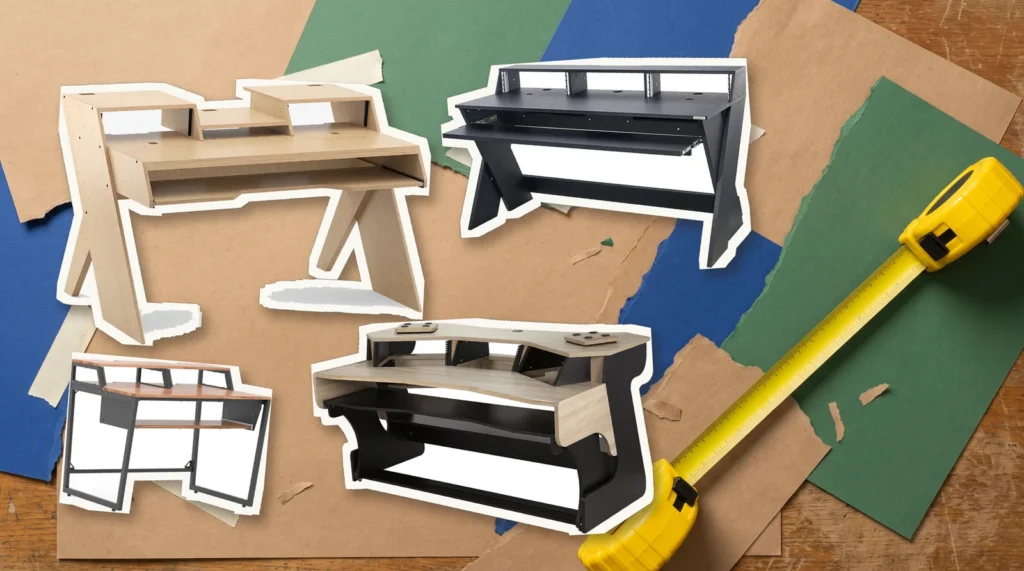
The best studio desk for most home producers is the Glorious Sound Desk Pro ($499 at Thomann’s US store, October 2026): it’s 61 inches wide, with two 3U rack bays, a raised shelf for your speakers and a pull-out tray for keyboards up to 88 keys. On a budget, the Glorious Sound Desk Compact ($259) fits a 61-key keyboard. The premium wood pick is the De-Fi Platform, the former Output Platform ($1,099 at Vintage King).
Most home studios start on a kitchen table or an old computer desk. The speakers sit flat and point at your chest. The MIDI keyboard fights the mouse for space, and the cables hang off the back like spaghetti.
A good music production desk fixes all of that at once. It lifts your speakers to the right height, gives your keyboard its own tray and keeps your gear in reach while you sit in the sweet spot. This guide covers what to look for first, in plain words. Then it walks through 15 desks by type and budget, each with a price checked this month.
Table of Contents
What should you look for in a studio desk?
Look for a desk that puts your speakers at ear level and is deep enough for a proper speaker triangle. It also needs to be wide enough for your screen and keyboard. After that, check for a pull-out keyboard tray, rack spaces if you own rack gear, cable holes and a weight rating that covers all your gear.
Here’s the checklist, in the order it matters for your sound and for your back:
Your body needs the right height too. A normal studio desktop sits around 29 to 31 inches off the floor: the On-Stage WS7500’s is 29 inches, and the Millenium SD-120’s is 30.9. Your forearms should rest flat while you use the mouse. If they don’t, adjust your chair before you blame the desk.
How high should studio monitors be on a desk?
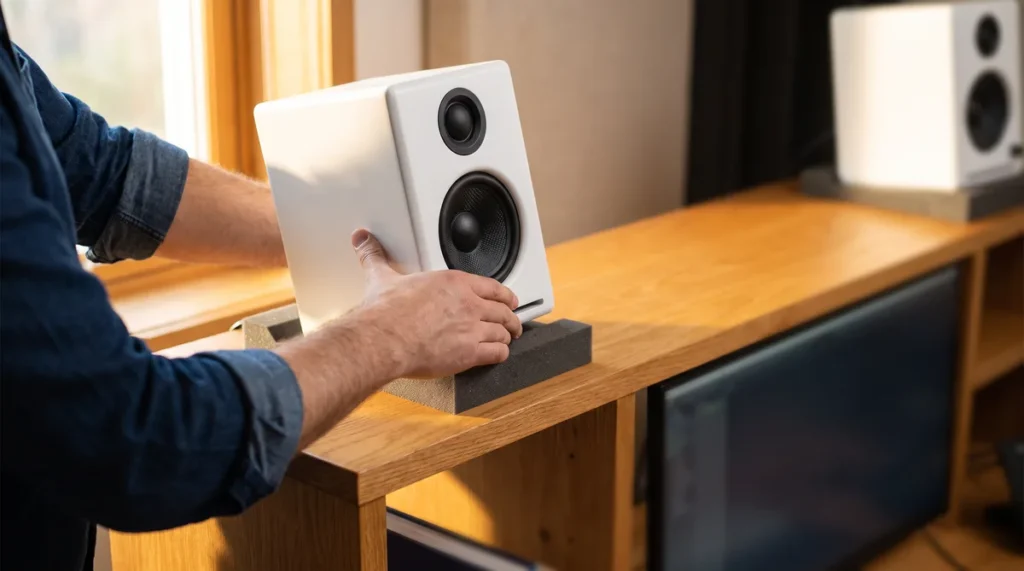
Set your studio monitors so the tweeters, the small speakers on top, sit at the height of your ears. Turn both speakers in toward your head, so your head and the two speakers form a triangle with equal sides. A raised desk shelf, desk stands or foam pads get them up to that height.
Max, the founder of Mix Elite, says it plainly: “With the monitors, however, placement matters even more than the gear itself.” In Mix Elite’s gear video, he gives the two rules that matter most: “Then you tilt your monitors toward your ears with tweeters, those small membranes at your ear level. And finally, your head and the two speakers should form an equal triangle.”
This is where a studio desk earns its money. Most have a raised back shelf, often called a bridge, that lifts the speakers above the desktop. The Monoprice Stage Right’s platform sits 38 inches off the floor, and the On-Stage WS7500’s sits at 37.5 inches. Still too low? Add desk stands or foam isolation pads. Pads also keep the desk from shaking along with the bass.
For the exact spot, use Mix Elite’s free studio monitor placement calculator. You measure your room, type in a few numbers, and it shows where the speakers and your chair should go.
How deep should a studio desk be for your speakers?
A studio desk should be deep enough that the speakers sit about as far from your ears as they are from each other. On a shallow desk, the speakers end up right in your face and the triangle gets tiny. A deeper desk, or one with a raised back shelf, gives you room for a normal-size triangle.
Here’s the simple math. In a triangle with equal sides, if your speakers sit 4 feet apart, your head sits about 3.5 feet back from the line between them. Some of that distance is you and your chair. The rest has to come from the desk, which is why the deeper workstations in this guide make a good triangle easier. Depth buys you sound.
Keep the speakers a little away from the wall too, especially speakers with a bass port on the back. Keep them out of the corners, where the bass builds up. Our home studio guide explains the 38% rule for where your chair should go.
Do beginners need rack space in a studio desk?
Usually not. Most beginner audio interfaces sit on the desk and don’t fit in a rack at all. Rack spaces matter once you own 19-inch rack gear, like a power conditioner, a rack-mount interface or outboard compressors, or when you want a tidy home for that gear later.
Rack gear is measured in rack units, written as U. One unit is 1.75 inches tall, so a 3U bay holds gear up to 5.25 inches tall. The desks in this guide range from no rack at all to 12U, and the size of each bay matters more than the total.
Empty bays aren’t wasted, either. A rack drawer holds cables and adapters, and a rack shelf holds a small desktop interface. Our audio interface guide shows which interfaces are worth buying first, rack-mount or not.
Is a pull-out keyboard tray strong enough for a heavy MIDI keyboard?
A good studio desk tray is, but check two numbers first: the tray’s weight rating and the gap between the tray and the desktop. Trays in this guide are rated from 27.5 to 88 pounds. If your keyboard is heavier or taller than that, use a flat desk with a keyboard stand in front of it.
Weight comes first. Glorious rates its trays at 12.5 kg (27.5 pounds), and Thomann rates the ComboDesk 88 and Millenium SD-120 drawers at 15 kg (33 pounds). Zaor’s Miza X2 Flex tray holds 40 kg (88 pounds). Weighted 88-key keyboards are much heavier than small controllers, so look up your keyboard’s weight before you buy.
Height is the second catch. Knobs, pitch wheels and pads need room to slide under the desktop. Adjustable trays fix this: the Glorious Sound Desk Compact’s shelf mounts at six heights, and the ComboDesk 88’s leaves 3.6 to 5.9 inches of space. Here’s which desks fit which keyboard size:
- 25 to 49 keys: Monoprice Stage Right, Gator Frameworks Elite, Wavebone Star Rover.
- Up to 61 keys: Glorious Sound Desk Compact, plus the wide tray on the Zaor Miza Junior Flex.
- 88 keys: Glorious Sound Desk Pro, Thomann ComboDesk 88, De-Fi Platform, Studio Desk Harmony, Studio Desk Fantom and the Zaor Miza 88 Flex.
Still picking a keyboard? Our MIDI keyboard guide covers 20 controllers, from 25 keys to 88.
How do you choose a studio desk for a keyboard, monitors and two screens?
Measure your gear side by side before you buy. Two screens with a speaker on each side need a wide desk, and the keyboard should go on a tray below so it doesn’t steal the work surface. If the desk is too narrow, put the screens on a monitor arm and the speakers on stands.
Thomann lists the 57.9-inch Zaor Miza 88 Flex as having room for two 30-inch screens, so plan on about 58 inches or more for two big screens. Keep the speakers outside the screens, not behind them, so nothing blocks the sound on its way to your ears. If the screens sit in the middle of the top shelf, the speakers go at the two ends.
The best studio desks for home studios in 2026
These 15 picks sit in five groups: budget desks, producer workstations with rack bays, desks with big keyboard trays, standing desks and desks for small rooms. Inside each group they’re ranked by how well they work for a home producer: speaker height, keyboard space, build and value for the money.
Prices were checked on October 25, 2026. When a maker sells in its own US store, that price comes first. Otherwise the price comes from a US store, named and linked: Thomann’s US store, Vintage King or Amazon. When a store was much cheaper than the maker, you get both. Furniture prices move, so check the link before you buy.
Best budget studio desks under $300
You don’t need to spend much to get your speakers up and your keyboard off the desktop. These four do it for under $300 at the stores listed.
1. Glorious Sound Desk Compact
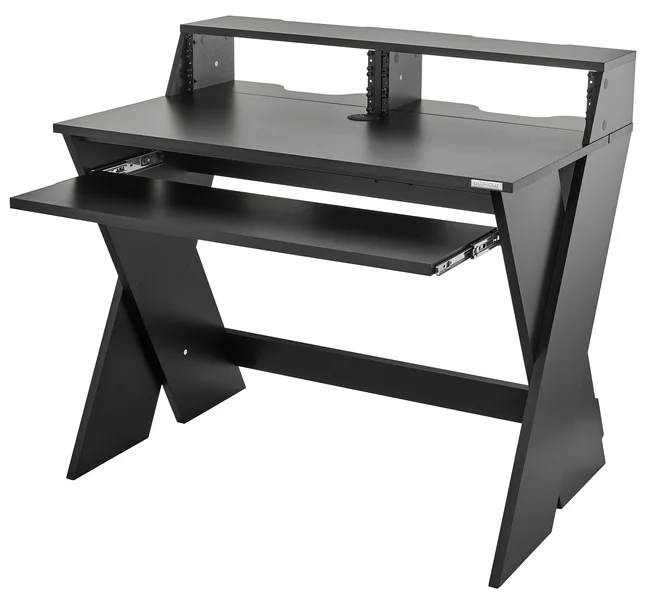
Price: $259 at Thomann’s US store (October 2026).
The Sound Desk Compact is the best budget studio desk because it has features that usually cost twice as much. You get two 3U rack bays on the top shelf, a raised shelf for your speakers and a pull-out tray for keyboards up to 61 keys. The tray mounts at six heights, so taller controllers still slide under.
It’s 40 inches wide and 25.6 inches deep, so it fits a bedroom. Thomann rates the main desk at 35 kg (77 pounds) and the tray at 12.5 kg (27.5 pounds), enough for a pair of 5-inch speakers, a screen and a light controller. Cut-outs in the desk keep cables out of sight. It’s a lot of desk for $259.
Who it’s for: beginners with a 49- or 61-key controller and a first piece of rack gear on the way.
2. On-Stage WS7500
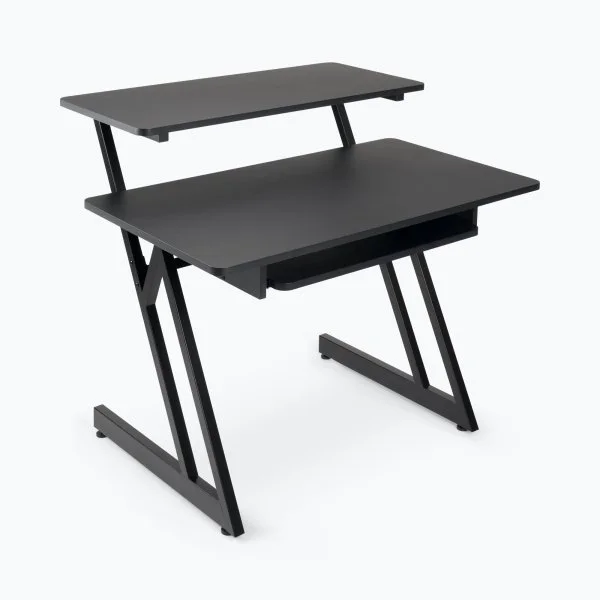
Price: $149 at Thomann’s US store (October 2026). On-Stage’s own US store lists it at $349.95.
The WS7500 is the classic Z-frame studio desk, and at Thomann’s price it’s the cheapest way to get a two-level setup. The upper platform is 17 by 39 inches and sits 37.5 inches off the floor, with room for a screen between two small speakers. The desktop below is 43 inches wide and 24 inches deep.
The slide-out tray is 27 inches wide, which fits a 25-key controller or a computer keyboard. The steel frame holds 175 pounds. On-Stage also sells a matching corner piece (WSC7500B) and a rack cabinet (WSR7500B) for when your setup grows. That price is hard to beat.
Who it’s for: a first real studio desk on a small budget.
3. Millenium SD-120 B StudioDesk
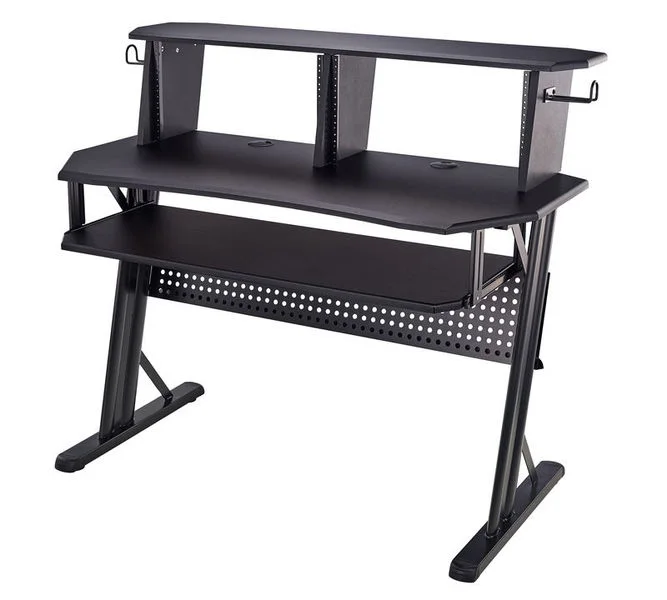
Price: $177 at Thomann’s US store (October 2026).
The SD-120 B packs the most rack space into a budget desk: two 5U bays, ten units in all, built into the top shelf. Millenium is Thomann’s own brand, and this desk is sized for small rooms at 47.2 inches wide and 25.6 inches deep. Ten units for under $200.
The keyboard drawer is 39.6 inches wide and holds 15 kg (33 pounds), and two headphone hooks hang off the sides. The worktop sits 30.9 inches high. The top shelf is 9.4 inches deep, so check that your speakers fit on it.
Who it’s for: producers who already own rack gear and want it within reach for little money.
4. Monoprice Stage Right Recording Studio Desk
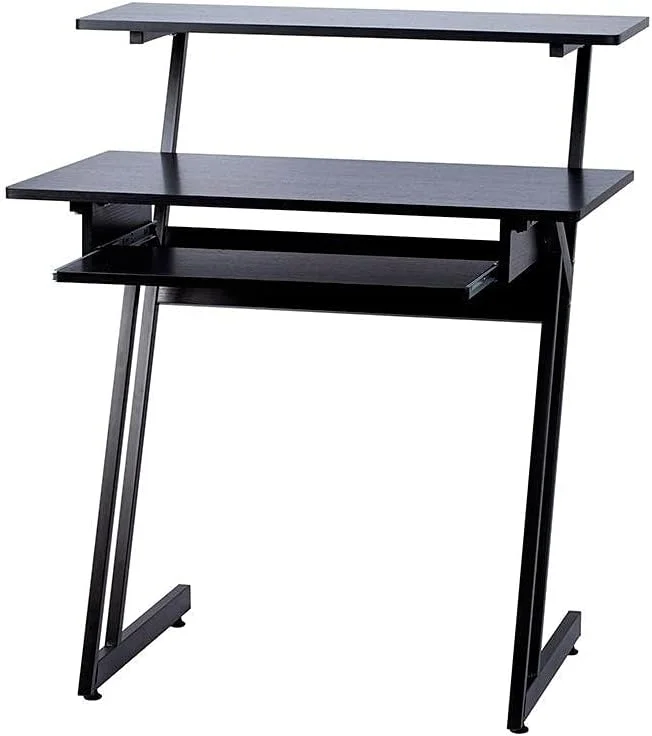
Price: $114.99 at Amazon (October 2026).
This is the smallest and cheapest desk on the list, and it still gets the basics right. It’s 31.5 inches wide and 24 inches deep, with a raised platform 38 inches off the floor. Monoprice says the platform is made for 5-inch speakers at each end, so you can skip speaker stands.
The pull-out tray fits a typical 49-key controller, according to Monoprice, and the frame holds up to 175 pounds. The desk itself weighs only about 30 pounds, so it’s easy to move around.
Who it’s for: small bedrooms, apartments and first setups.
Best producer workstation desks with rack bays
These desks are built around a studio workflow. The speakers sit on a raised bridge, rack gear stays at arm’s length, the keyboard gets its own tray and the cables disappear.
5. Gator Frameworks Elite Series Desk
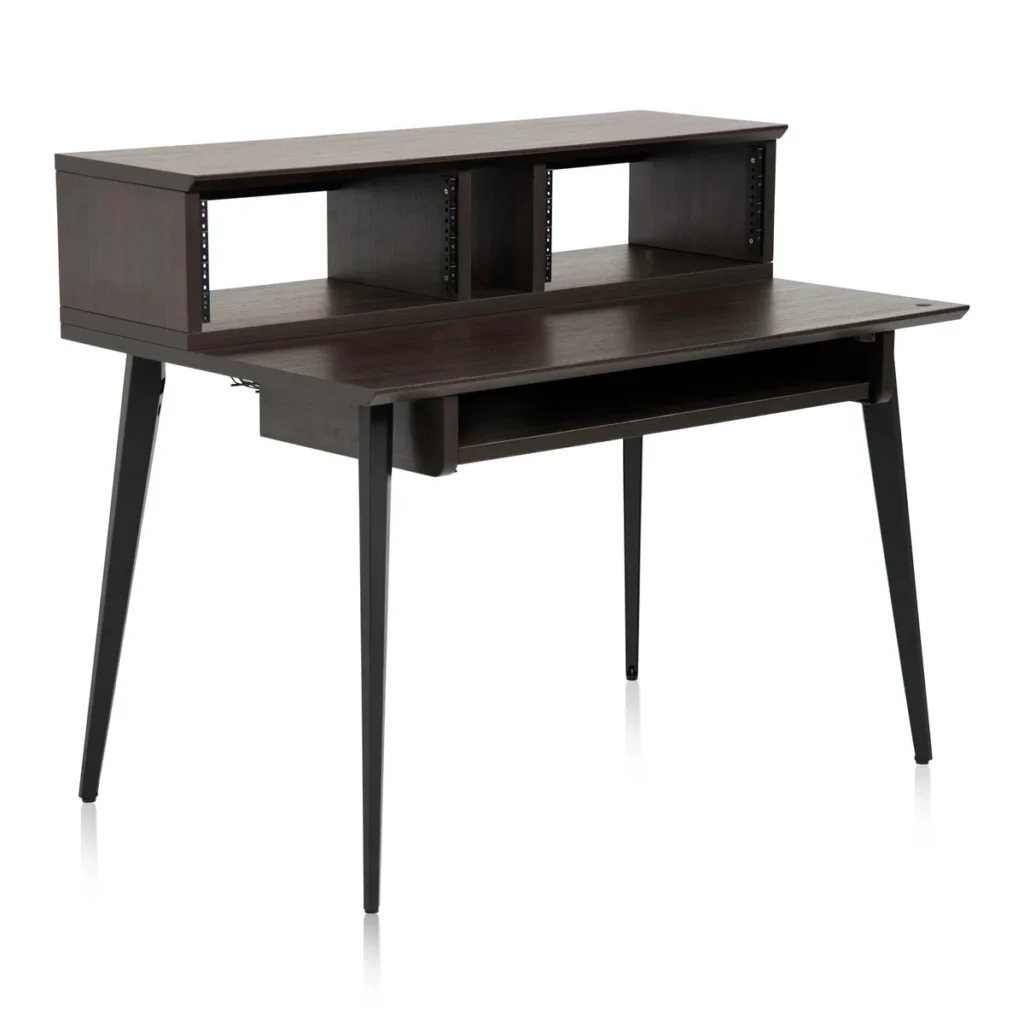
Price: $394 at Thomann’s US store (October 2026), in dark walnut.
The Elite Series Desk is the best-value workstation here. Its upper platform is 47.2 inches long and 14 inches deep, which Gator says is room for a pair of studio monitors and a screen. Below it you get up to eight rack units, as two 4U bays or one 4U bay in the middle, set with movable dividers. That’s plenty for most home studios.
A soft-close tray slides out for a computer keyboard or a 49-key controller. The legs have removable panels so cables run down inside them, and leveling feet fix a wobble on an uneven floor. Gator also sells a matching corner section that turns it into an L-shape.
Who it’s for: producers who want a real workstation without paying workstation prices. See it on Gator’s site.
6. De-Fi Platform (formerly Output Platform)
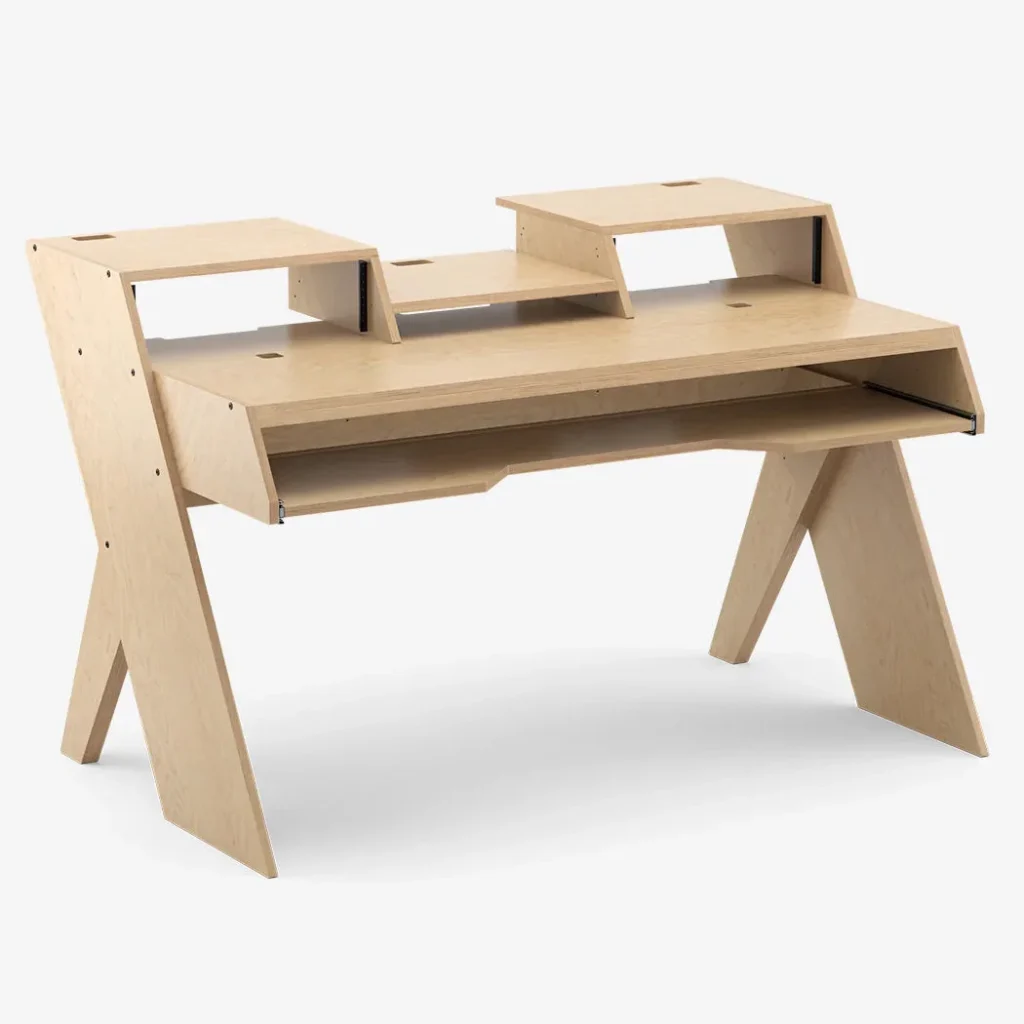
Price: $1,099 at Vintage King (October 2026), in natural birch.
Platform is one of the best-known studio desks around. Output designed it, and De-Fi now builds the updated version. It’s made of birch, 60 inches wide and 38 inches deep, with three pairs of rack ears for up to 9U of gear.
The middle shelf moves between three positions, so your screen can sit lower while the full 3U below it stays usable. The keyboard tray fits most 88-key controllers, says Vintage King, and it mounts at one of two heights. A panel under the desk hides all the cable management. It looks as good as it works.
Who it’s for: producers who want a warm wood desk that holds everything, from an 88-key controller to a rack of gear.
7. Studio Desk Harmony
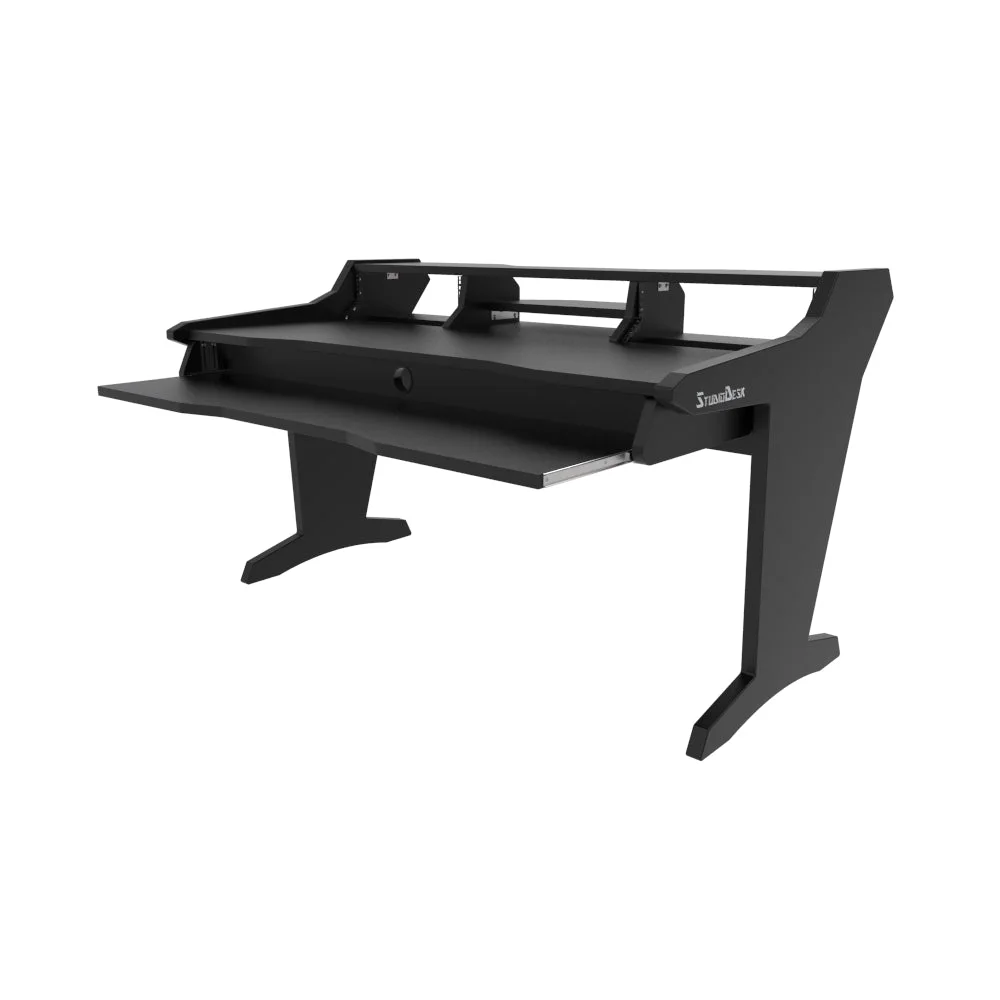
Price: $1,590 on Studio Desk’s US store (October 2026). Thomann’s US store had it for $1,444 the same month.
Harmony is Studio Desk’s lower-priced workstation, with most of the features of its bigger desks. You get two 4U rack bays angled toward you, a top shelf for your speakers and a monitor shelf you can raise or lower. Everything has its place.
The pull-out tray takes keyboards up to 88 keys, as big as 58.7 by 15.7 inches and 6.5 inches tall. It’s a big desk: 65.8 inches wide and 40.3 inches deep, made of 25 mm laminated chipboard, and it weighs 87 kg (192 pounds).
Who it’s for: producers with an 88-key keyboard and some rack gear who want everything in one place.
8. Zaor Miza X2 Flex
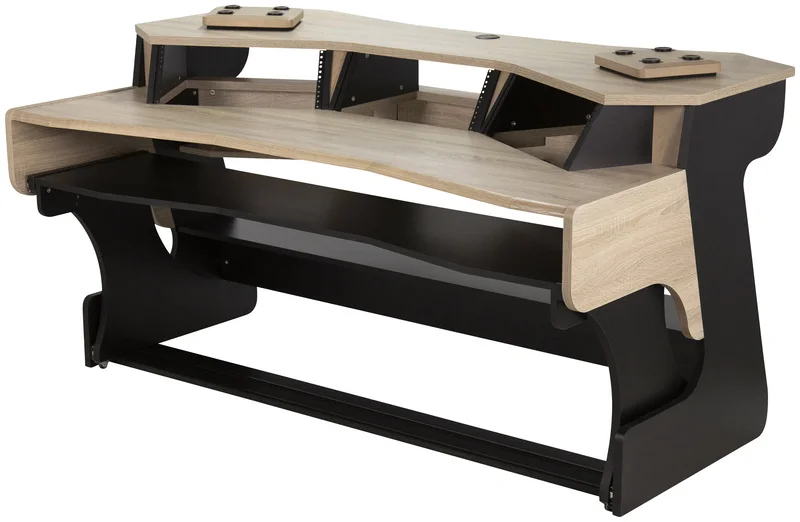
Price: $2,069 at Thomann’s US store (October 2026).
The Miza X2 Flex is the premium pick. It has three 4U rack bays, 12 units in all, angled so the knobs stay in reach. Its speaker shelf comes with IsoAcoustics isolation, so the speakers sit apart from the desk instead of shaking it.
The pull-out shelf rolls on floor castors and moves to eight heights. It takes gear up to 69.3 inches wide and holds 40 kg (88 pounds), the highest tray rating in this guide. There’s a spot for a desktop computer under the tray and a cable compartment at the back. It’s 75.2 inches wide, so measure your wall first.
Who it’s for: a dedicated studio room with a big keyboard and lots of rack gear.
Best studio desks with a keyboard tray for 61 and 88 keys
If you play keys, the tray is the most important part of the desk. These three are built around a wide pull-out tray. For a 25- to 49-key controller, the Monoprice, Gator Frameworks and Wavebone picks fit better.
9. Glorious Sound Desk Pro
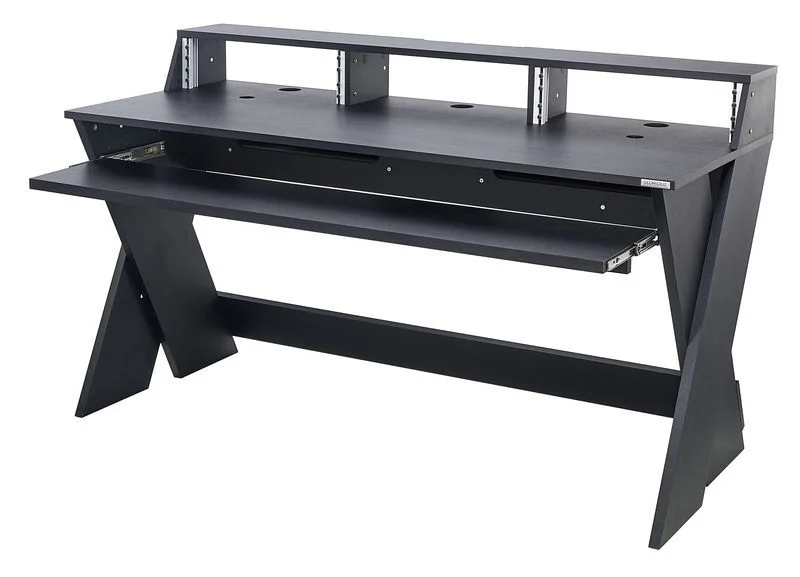
Price: $499 at Thomann’s US store (October 2026).
The Sound Desk Pro is the best studio desk for most home producers. It’s 61 inches wide and 25.6 inches deep, so it fits along a normal bedroom wall but still holds a screen, two speakers and an 88-key keyboard. The extendable tray takes keyboards up to 56 inches wide and mounts at four heights.
Two 3U rack bays sit on the top shelf, and a cable duct inside the desk holds your power strips, reachable from the front and the back. Glorious rates the tray at 12.5 kg (27.5 pounds), the same as the Compact. It’s the one we’d buy first.
Who it’s for: almost everyone with a 61- or 88-key controller.
10. Thomann ComboDesk 88
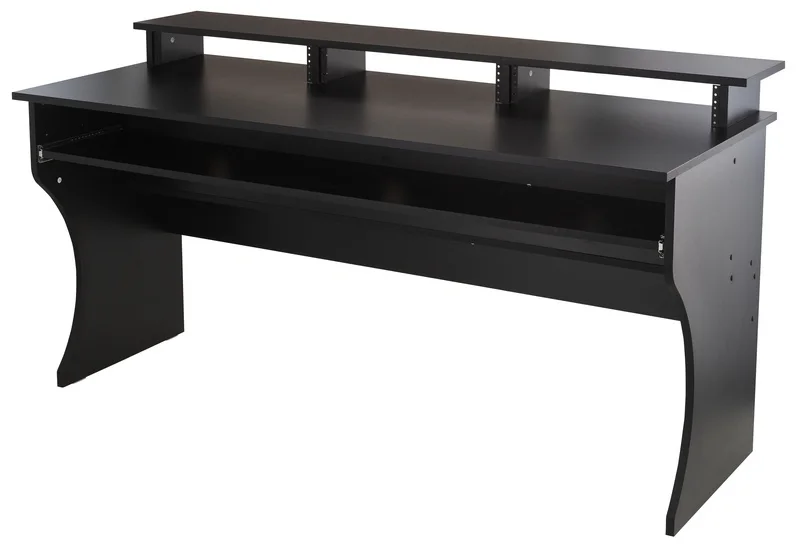
Price: $375 at Thomann’s US store (October 2026).
Designed by Zaor and sold by Thomann, the ComboDesk 88 is the cheapest way to get a full 88-key tray. The pull-out takes a keyboard up to 61.4 inches wide and 5.9 inches tall, and it sits at four heights below the desktop.
The second level holds your speakers and screen, with three 2U rack bays, six units in all. The desktop is 64 inches wide and 30.4 inches high, and cables run down a shaft at the back. Thomann rates the drawer at 15 kg (33 pounds). For $375, that’s rare.
Who it’s for: players with a full-size keyboard on a mid-size budget.
11. Zaor Miza 88 Flex
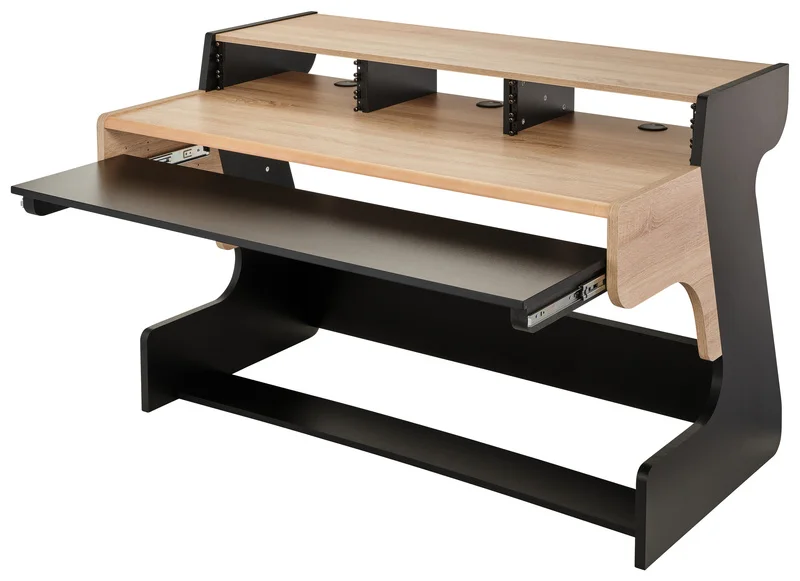
Price: $933 at Thomann’s US store (October 2026).
The Miza 88 Flex is a heavier, more studio-style take on the same idea. Thomann lists room for two 30-inch screens on top, two 3U rack bays with a storage space between them, and a pull-out shelf for gear up to 53 inches wide.
That shelf moves to six heights. The desk is 57.9 inches wide, built from melamine-coated board, and weighs 81 kg (179 pounds). Zaor also makes a 49-key version, the Miza 49 Flex, which was $685 at Thomann’s US store in October 2026.
Who it’s for: producers with two screens and an 88-key controller.
Best standing and height-adjustable studio desks
A motorized desk lets you switch between sitting and standing at the push of a button. That helps on long nights, and some producers simply like to stand while they play or record.
12. Eureka Ergonomic Aero Pro Standing Desk
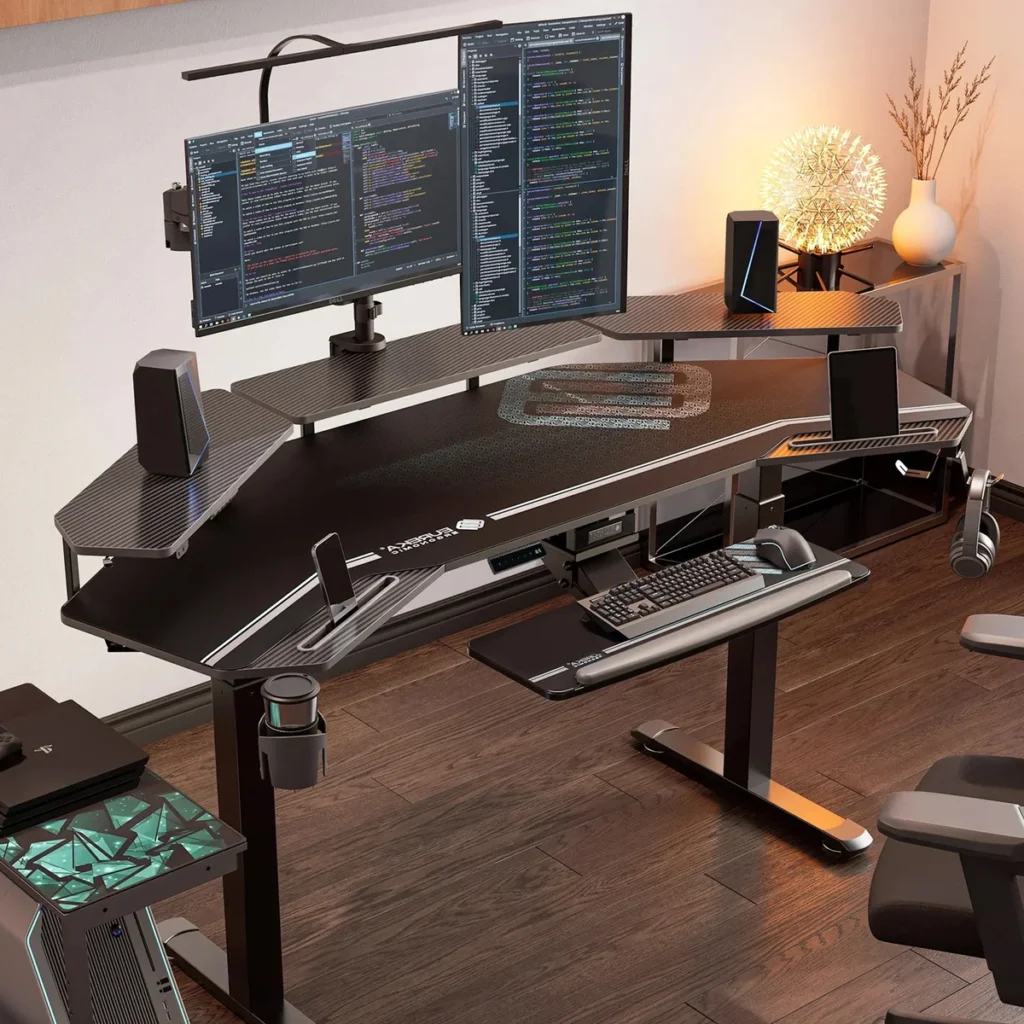
Price: $729 with the accessories set on Eureka’s US store (October 2026). The maple desk without the set is $409.
The Aero Pro is the most affordable big standing desk for music here. Two motors raise it from 29.5 to 48 inches, and you can save your favorite heights. The wing-shaped top is about 72 inches wide and 30 inches deep, and Eureka rates it at 220 pounds.
The accessories set adds a computer keyboard tray, two monitor risers, headphone hooks and RGB lighting. There are no rack bays, so it suits producers who work mostly inside the computer.
Who it’s for: producers who want to stand part of the time and don’t use rack gear.
13. Studio Desk Fantom
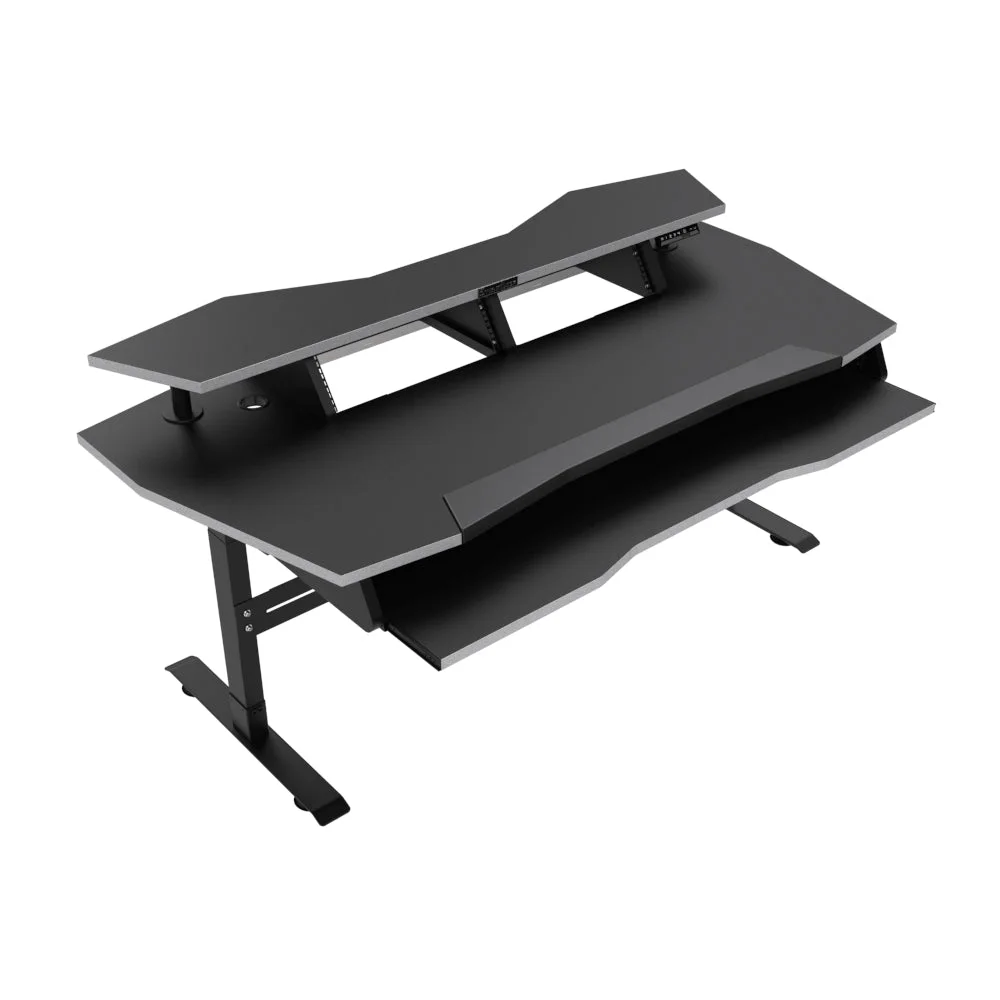
Price: $1,990 with the pull-out tray on Studio Desk’s US store (October 2026), or $1,790 without it. Thomann’s US store had the bundle for $1,666 the same month.
Fantom is a real studio workstation that also stands. A motor takes it from 70 to 120 cm (27.6 to 47.2 inches), with four saved heights, and a 6U rack bay sits in the middle, in reach either way.
The pull-out tray fits the biggest 88-key workstations, adjusts in height and locks when you pull it all the way out. The speaker shelf holds up to two pairs of monitors, and there’s a padded armrest. Studio Desk says your gear, keyboard included, shouldn’t go over 60 kg (132 pounds).
Who it’s for: producers with rack gear and an 88-key keyboard who want to stand while they work.
Best studio desks for small rooms and corners
In a small room, every inch counts. These two take up little floor space but keep the speaker shelf and the keyboard tray.
Corners are tempting, but they boost the bass, so keep the speakers out of the corner itself. If an L-shape is the only way to fit everything, On-Stage sells a corner piece for the WS7500 and Gator sells a corner section for its Elite desk. That way the speakers stay on the main desk, along the wall.
14. Wavebone Star Rover
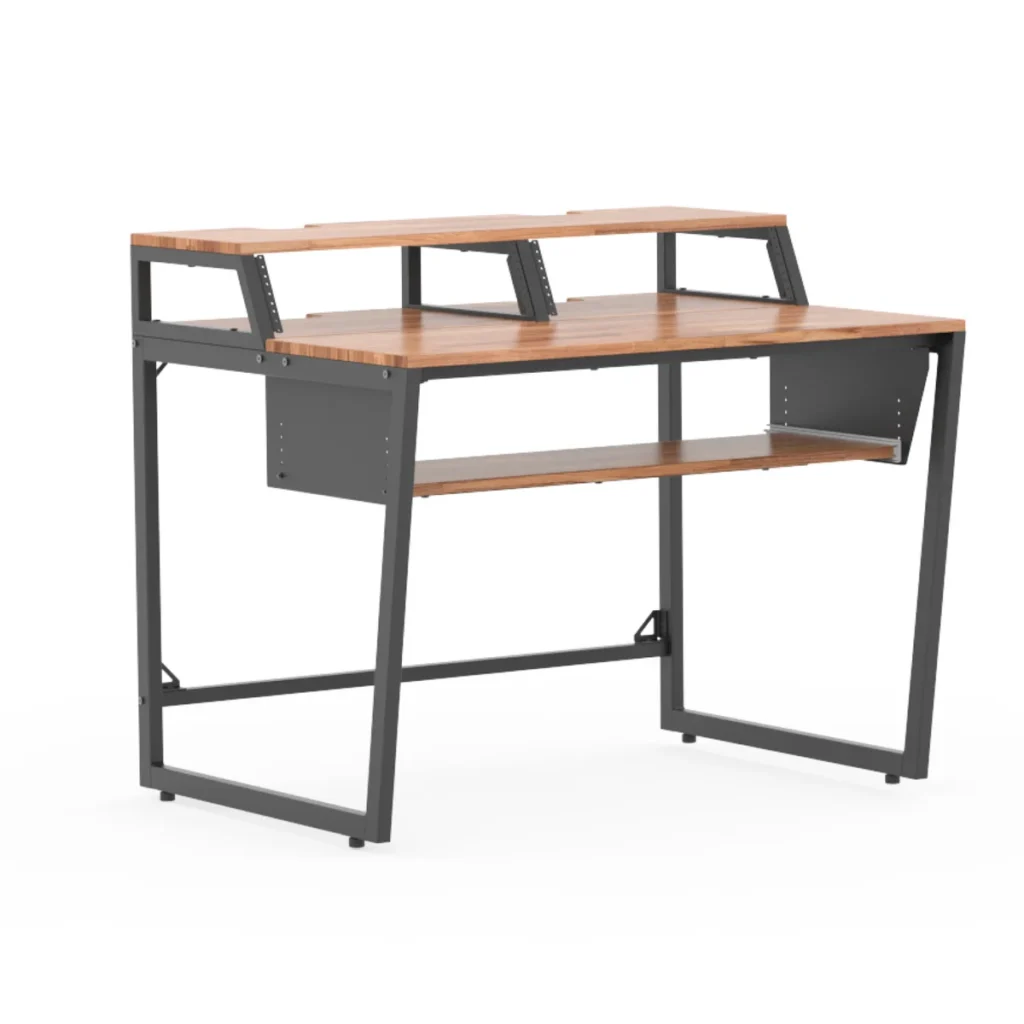
Price: $629 on Wavebone’s US store (October 2026). Thomann’s US store had it for $375 the same month.
Wavebone built the Star Rover for studios with little space: it takes up just 8.93 square feet of floor. Even so, the raised monitor shelf has two 3U rack bays, and the keyboard shelf below moves to five heights for controllers up to 49 keys.
It’s 41.3 inches wide and 29.1 inches deep, with a steel frame and a desktop 29.9 inches off the floor. It comes in walnut or black. It’s small but complete.
Who it’s for: a bedroom studio with a 25- to 49-key controller.
15. Zaor Miza Junior Flex
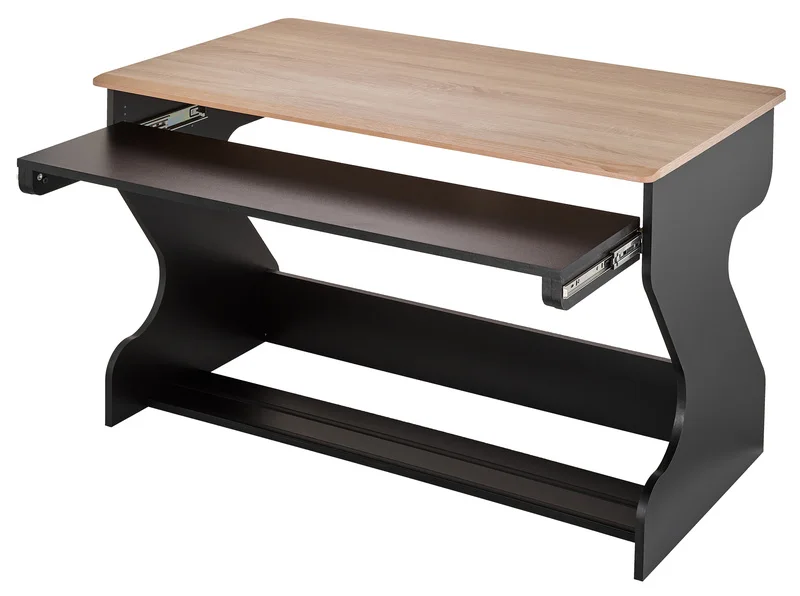
Price: $518 at Thomann’s US store (October 2026).
The Miza Junior Flex is the compact Zaor: 49.2 inches wide and 25.6 inches deep with the tray pushed in. The tray is 46.9 inches wide and moves to seven heights, so a keyboard, a mouse and a small controller fit side by side.
There’s no rack built in, which keeps it small, but you can add up to two Zaor Gripracks later. It weighs 46 kg (101 pounds).
Who it’s for: small rooms where a full workstation won’t fit.
How do you fit a music production desk in a small bedroom?
Center the desk on one wall so you sit in the middle, keep the speakers out of the corners and use height instead of floor space. A raised shelf, a pull-out keyboard tray and gear on the walls keep a small room from feeling cluttered.
- Put the desk in the middle of a wall, so both speakers sit the same distance from the side walls.
- Pick a narrow desk with a pull-out tray, like the Wavebone Star Rover or the Monoprice Stage Right.
- Hang headphones, cables and guitars on wall hooks instead of floor stands.
- Use a mic arm that clamps to the desk, and swing it away when you’re done recording.
- Run cables through the desk’s cable holes or a tray under the desk.
Soft, heavy things in the room help the sound too. In the same gear video, Max says: “You don’t need to hire an expert or buy expensive panels.” Shelves full of books, a sofa, carpets and even an old mattress soak up a lot of echo. Our DIY acoustic treatment guide shows the cheap fixes step by step.
How can you turn a normal desk into a music production desk on a budget?
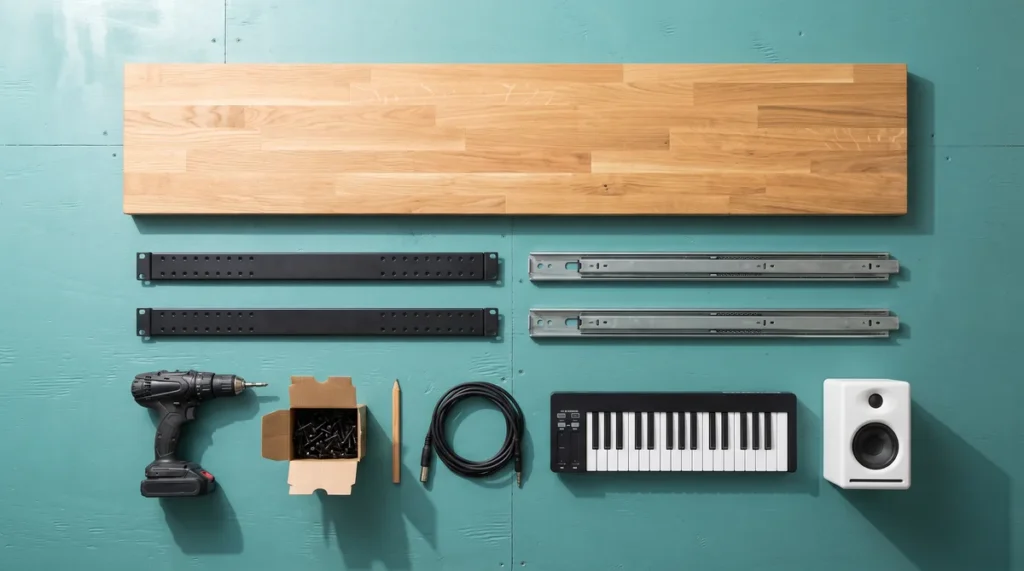
Lift the speakers, give the keyboard a strong tray or stand, and tidy the cables. A wooden riser shelf or desk stands bring the tweeters up to ear level, foam pads keep the desk from shaking, and heavy-duty drawer slides or a keyboard stand handle the keyboard.
- Build a riser: screw short furniture legs or brackets under a shelf board and set it at the back of the desk for your speakers and screen.
- Put foam isolation pads or small desk stands under the speakers to raise them and keep the desk from buzzing.
- For a keyboard tray, use heavy-duty drawer slides rated above your keyboard’s weight, not a light office tray made for typing.
- Or skip the tray and set a keyboard stand in front of the desk, just above your knees.
- If you own rack gear, screw a pair of 19-inch rack rails inside a cabinet or under the riser.
- Screw a cable tray under the back edge of the desk to hold the power strip and spare cable.
IKEA furniture makes a popular base. A common build sets a long tabletop, like a LAGKAPTEN tabletop or a KARLBY countertop, on two ALEX drawer units, then adds a riser for the speakers. Check the depth first, because you still need room for the triangle. Measure twice, buy once.
Do you need a studio desk to start making music?
No. A computer, headphones and music software are enough to start, and any sturdy table works for your first songs. A studio desk is worth it once you add speakers, a MIDI keyboard or rack gear and want them in the right place.
After the computer, the headphones and the software, Max says in Mix Elite’s gear video: “That’s all the necessary hardware you need to make music.” Everything else, the desk included, can wait until you know what you need.
For the full order of what to buy, read our home studio setup guide for beginners. Then use our studio monitors guide to pick speakers that fit the desk you choose.
All 15 studio desks side by side
| Desk | Width | Rack | Keyboard tray | Price |
|---|---|---|---|---|
| Glorious Sound Desk Compact | 40 in | 6U | Up to 61 keys | $259 (Thomann) |
| On-Stage WS7500 | 43 in | None | 27 in wide | $149 (Thomann) |
| Millenium SD-120 B | 47.2 in | 10U | 39.6 in wide | $177 (Thomann) |
| Monoprice Stage Right | 31.5 in | None | 49 keys | $114.99 (Amazon) |
| Gator Frameworks Elite | 47.2 in | Up to 8U | 49 keys | $394 (Thomann) |
| De-Fi Platform | 60 in | 9U | Most 88 keys | $1,099 (Vintage King) |
| Studio Desk Harmony | 65.8 in | 8U | 88 keys | $1,590 (Studio Desk) |
| Zaor Miza X2 Flex | 75.2 in | 12U | Gear up to 69.3 in | $2,069 (Thomann) |
| Glorious Sound Desk Pro | 61 in | 6U | 88 keys | $499 (Thomann) |
| Thomann ComboDesk 88 | 64 in | 6U | 88 keys | $375 (Thomann) |
| Zaor Miza 88 Flex | 57.9 in | 6U | Gear up to 53 in | $933 (Thomann) |
| Eureka Aero Pro | 72 in | None | Computer keyboard | $729 (Eureka) |
| Studio Desk Fantom | 75.7 in | 6U | 88 keys | $1,990 (Studio Desk) |
| Wavebone Star Rover | 41.3 in | 6U | 49 keys | $629 (Wavebone) |
| Zaor Miza Junior Flex | 49.2 in | None | 46.9 in wide | $518 (Thomann) |
DAY 1 OF THE 7-DAY MUSIC PRODUCER COURSE
Desk sorted? Day 1 sets up the rest of your studio
Day 1 of Mix Elite’s 7-Day Music Producer Course is all about setup and workflow: the ‘Perfect Triangle’ formula for a pro-sounding home studio on any budget, exactly which gear and software to get (and what to skip), and the FL Studio features you need to move like a pro from day one. It’s taught in FL Studio, and the free trial works. At the end, a pro gives you personal feedback on your finished track. It’s $27, with 60-day refunds.
Frequently asked questions
What size desk do I need for studio monitors?
For a screen between two small studio monitors, look for about 47 inches of width or more. That’s the size of the Gator Frameworks Elite’s top shelf, which Gator says fits a pair of monitors and a screen. Then check the depth, so the speakers can sit about as far from your ears as they are from each other, and raise them until the tweeters reach ear level.
How deep should a music production desk be?
Deep enough for an equal speaker triangle. The desks in this guide run from 24 to 45 inches deep. A shallow desk puts the speakers too close to your face, so pick one with a raised back shelf or put the speakers on stands just behind it. Mix Elite’s free placement calculator shows the exact distances for your room.
Can I use a regular desk or an IKEA desk for music production?
Yes. Any sturdy desk works for your first songs. Add a riser shelf or desk stands so the tweeters reach ear level, foam pads under the speakers and a cable tray under the desk. For a MIDI keyboard, use heavy-duty drawer slides or a keyboard stand in front of the desk, because light office trays are made for typing keyboards.
Is a standing desk good for music production?
It can be, especially for long sessions, because you can switch between sitting and standing. Look for a motorized desk with saved heights and a weight rating that covers your speakers and screens. The Eureka Aero Pro holds 220 pounds, and the Studio Desk Fantom adds a 6U rack bay and an 88-key tray.
Do I need a studio desk with rack space?
Only if you own or plan to buy 19-inch rack gear, like a rack-mount audio interface, a power conditioner or outboard processors. Most beginner interfaces sit on the desk. If you’re not sure yet, a desk with two 3U bays, like the Glorious Sound Desk Compact, leaves room to grow for little extra money.