

“Buy less, choose well, make it last.”
The best studio monitors for most home studios are a flat-sounding pair of 5-inch speakers. The PreSonus Eris Studio 5 ($149.99 each) is the best value under $300 a pair, and the Yamaha HS5 and JBL 305P MkII (about $200 each) are the classics. For a tiny desk, the PreSonus Eris 3.5 2nd Gen costs $99.99 a pair; for a bigger room, step up to the Yamaha HS8 or the Neumann KH 120 II.
You can spend real money on speakers and still hate how your mixes sound in the car. The bass booms in your room, then disappears everywhere else. Most of the time, the speakers aren’t the only problem.
Max, the founder of Mix Elite, says in his gear video: “With the monitors, however, placement matters even more than the gear itself.” So this guide does two jobs. First you get the 21 best studio monitors, grouped by budget and room size, with prices checked in October 2026. Then you get the simple setup that makes any pair sound honest.
Table of Contents
What makes a good studio monitor?
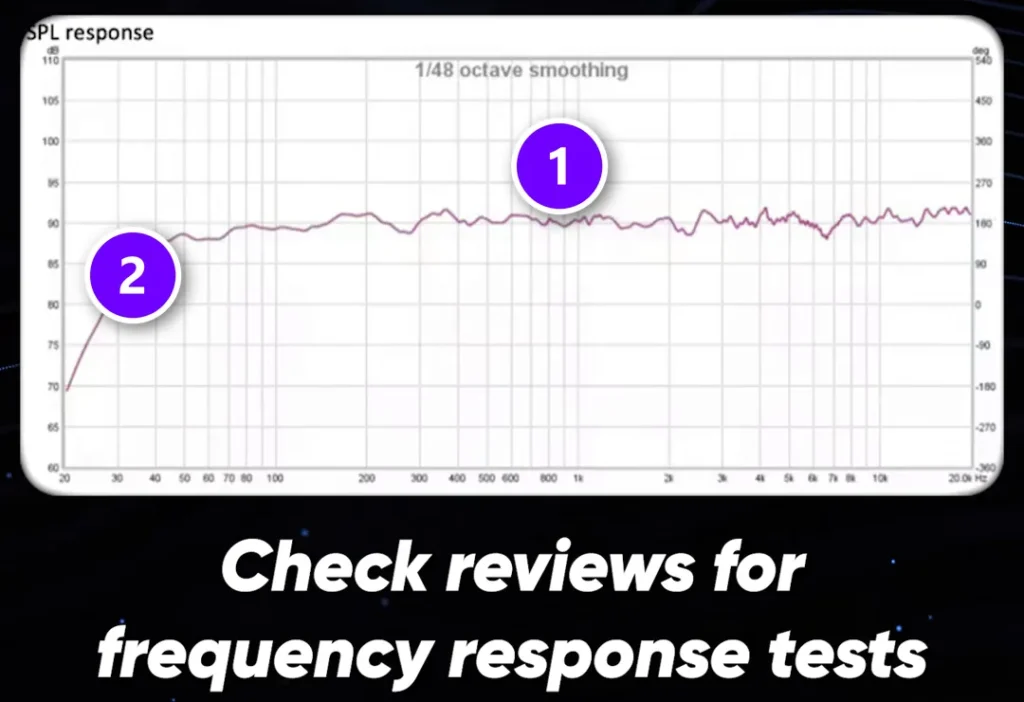
A good studio monitor has a flat frequency response: it plays the lows, the mids and the highs at the same level, so you hear your mix as it really is. Regular speakers boost the bass and the top end to sound exciting, and that pushes you to mix the wrong way.
Here’s why flat matters so much. If your speakers hide the bass, you’ll add too much of it. If they boost it, you’ll cut too much, and your song will sound thin everywhere else.
In this chart from Mix Elite’s gear video, the line stays almost level through the mids and highs (1). It only drops at the very bottom (2), where every small speaker runs out of bass. That’s what a good test looks like, so look for reviews that show a measured chart like this one.
That’s the big one. Four more things matter when you’re starting out:
- Powered speakers. Powered (or active) monitors have the amplifier built in, so they plug straight into your audio interface. Every pick on this list is powered.
- Room controls. Small switches on the back turn the bass or the highs down a little, so the speakers can match your room.
- Good inputs. Balanced XLR or 1/4-inch TRS cables keep hum and noise out, even on long runs.
- Nearfield design. Nearfield monitors are made to be heard from close up, so you hear more of the speaker and less of the room. Neumann, for example, recommends 1 to 2 meters (3 to 6 feet) for the KH 120 II.
What size studio monitors should you get for a small bedroom?
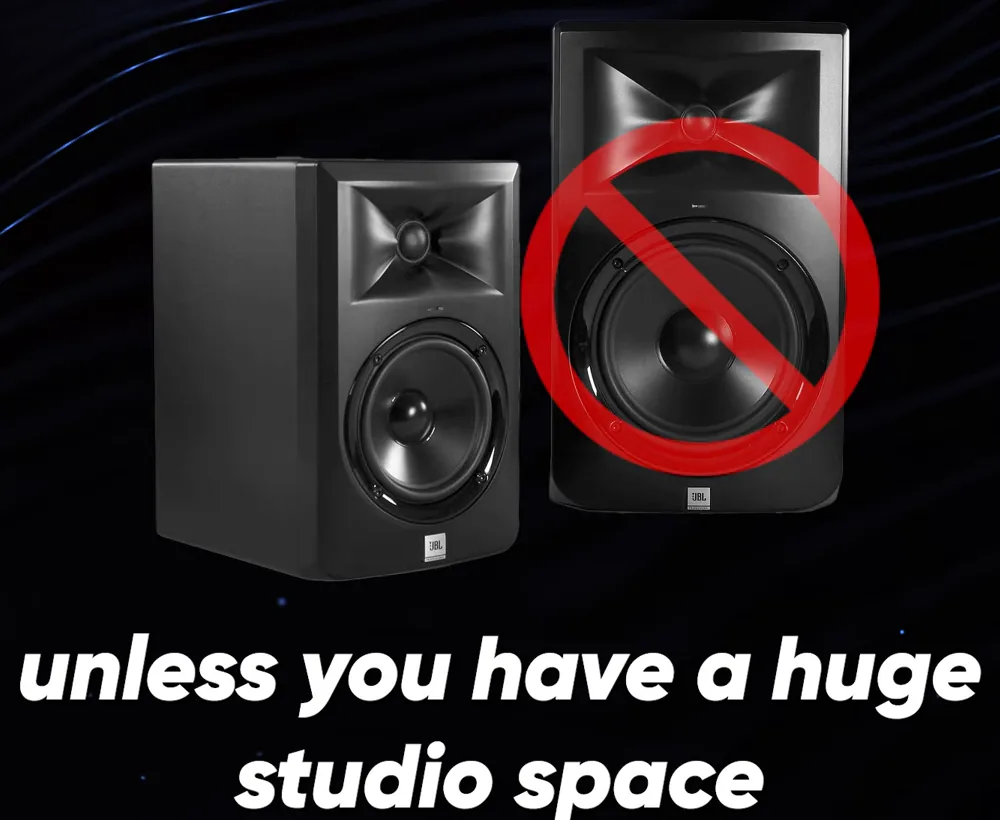
Get 5-inch monitors for an average bedroom, even an untreated one. Drop to 3.5 or 4 inches for a tiny desk or a very tight budget, and save 6.5 to 8 inches for a bigger room with some treatment, because a small room can’t handle that much bass.
Max says: “If you have an average size room, 5-inch speakers will be perfect.” He adds that you shouldn’t go bigger than that unless you have a huge studio space. The size is the woofer, the big cone that plays the lows.
Bigger speakers make more bass, but a small room can’t handle it. The low end bounces off the walls and piles up in spots, so an 8-inch pair in a bedroom often sounds boomy, not better. Here’s how size lines up with rooms:
- 3.5 to 4 inches: a small desk, a tight budget, or a second pair for checking your mix.
- 5 inches: the sweet spot for most bedrooms and spare rooms.
- 6.5 to 8 inches: bigger rooms with some treatment, or when you sit farther back.
- A subwoofer: skip it for now. A beginner doesn’t need a full setup with a sub.
How much should you spend on studio monitors?
About $300 buys a great pair of 5-inch monitors that lasts 10 years or more. On a tight budget, a pair around $100 is still a big step up from laptop speakers, and it becomes your second pair for checking mixes after you upgrade.
You only pay once. Max puts it this way: “Monitors don’t wear out like headphones, so for about $300, you can get an amazing sounding pair that you’ll keep for 10 years or more.”
That puts most beginners right in the 5-inch range below. Keep a little back for stands or foam pads, too. Mix Elite’s short gear video below covers monitors, placement and room treatment in its first half.
The 21 best studio monitors by budget and room size
Here are the 21 best studio monitors for a home studio, grouped by budget and room size: under $300 a pair, under $600, under $1,000, high-end with a subwoofer, and small 3 to 4-inch speakers for a desk. Every pick is powered, so it plugs straight into your audio interface.
Each price line says whether it’s for one speaker or a pair. Most studio monitors are sold one at a time, so double a per-speaker price for a stereo pair. We took prices from the maker’s own store in October 2026. When a maker shows no price, you get a US dealer’s price with the store and the month. Prices change, so check before you buy.
The best studio monitors under $300 a pair
The best studio monitors under $300 a pair are the PreSonus Eris Studio 5 ($299.98 a pair) for most bedrooms and the Mackie CR5BT ($199.99 a pair) if the same speakers also play your music, games and calls. Three of the small desk picks below cost under $300 a pair too.
1. PreSonus Eris Studio 5
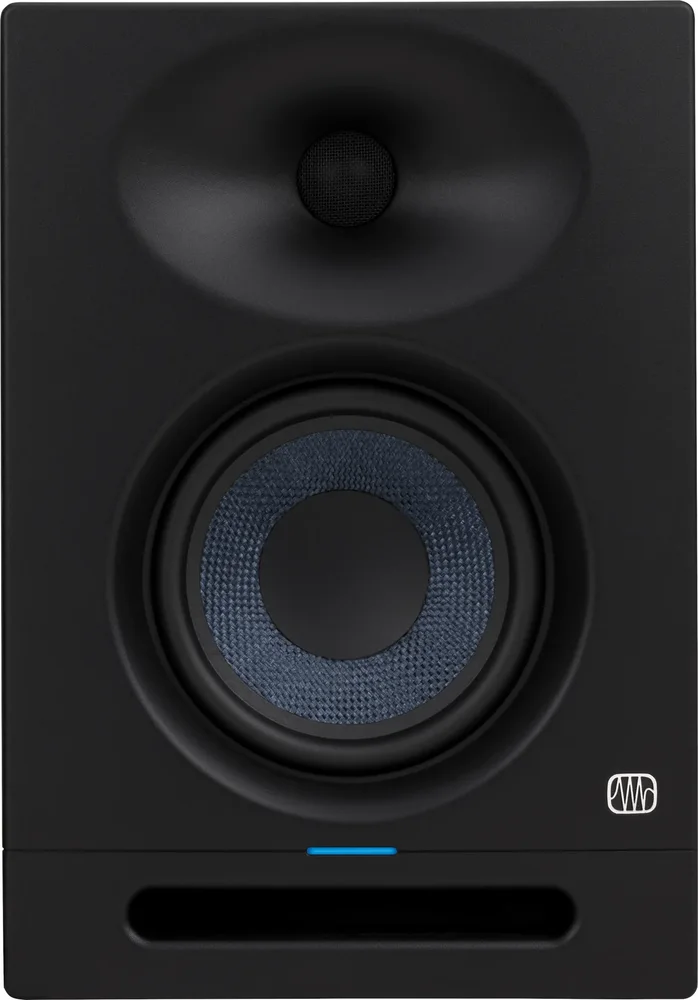
Price: $149.99 per speaker on PreSonus’s store (October 2026), so a pair is $299.98, right on that $300 mark.
The PreSonus Eris Studio 5 is the third generation of PreSonus’s Eris line. It has 80 watts of power and plays bass down to 48 Hz without a subwoofer. Most beginners should start here.
Its waveguide, the shaped panel around the tweeter, spreads the highs 120 degrees from side to side. That gives you a wider sweet spot, so the mix doesn’t change every time you lean back. On the back you get Low-cut, Mid and High controls, plus a three-way setting for where the speaker sits in the room.
Who it’s for: the best-value 5-inch pair for most bedrooms.
2. Mackie CR5BT
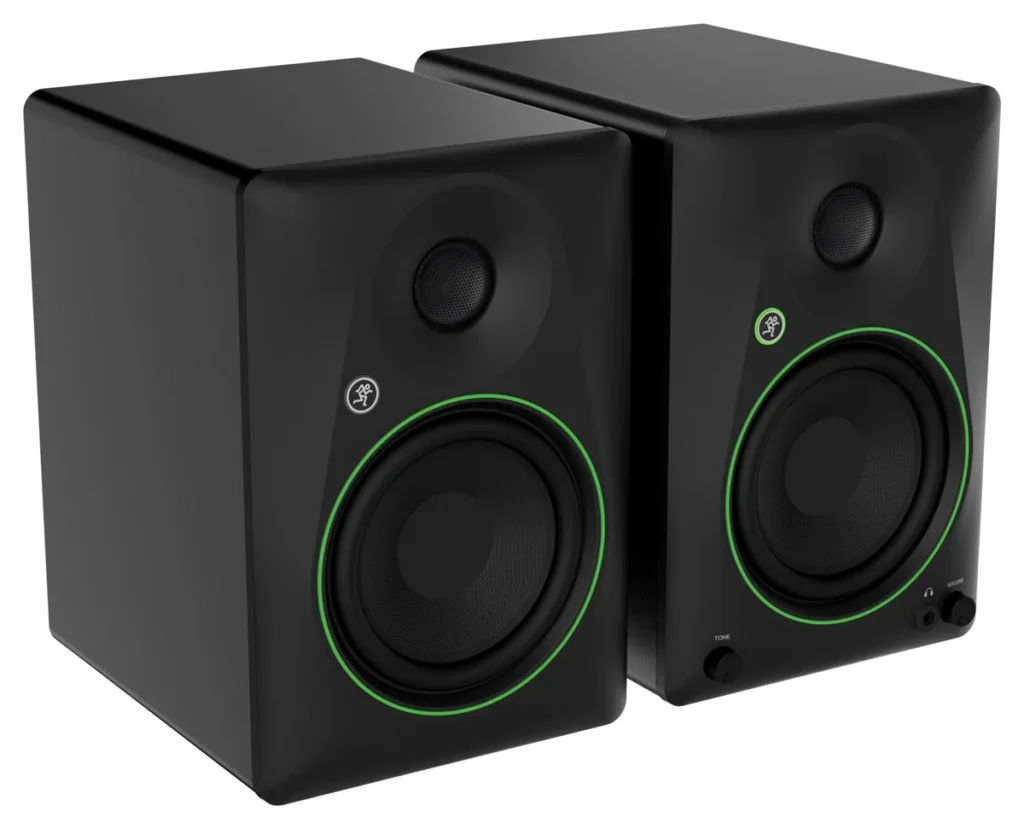
Price: $199.99 per pair at Amazon US (October 2026). Mackie’s own page sends you to dealers instead of showing a price.
The Mackie CR5BT is the 5-inch pair in Mackie’s third-generation CR Series, and it’s the newer version of the popular CR5-X. Each speaker has a 5.25-inch woofer and a 1-inch silk-dome tweeter, with 100 watts for the pair and a range of 59 Hz to 20 kHz (-3 dB).
The tone knob on the front is flat when you turn it all the way left, so that’s where it lives while you mix. Turn it right for more bass and sparkle when you just listen. Mix with it flat. The volume knob, a headphone jack that cuts the speakers and a Bluetooth button sit on the front too, and a switch sets it up for a desk or a bookshelf.
Who it’s for: a first pair on a tight budget that also works as your everyday speakers.
The best studio monitors under $600 a pair
The best studio monitors under $600 a pair are the Yamaha HS5, the JBL 305P MkII, the ADAM Audio T5V and the KRK Rokit 5 Generation Five, all 5-inch speakers at about $200 to $240 each. For a bigger room, the Kali LP-6 2nd Wave and the PreSonus Eris Studio 8 add more bass for under $500 a pair.
3. Yamaha HS5
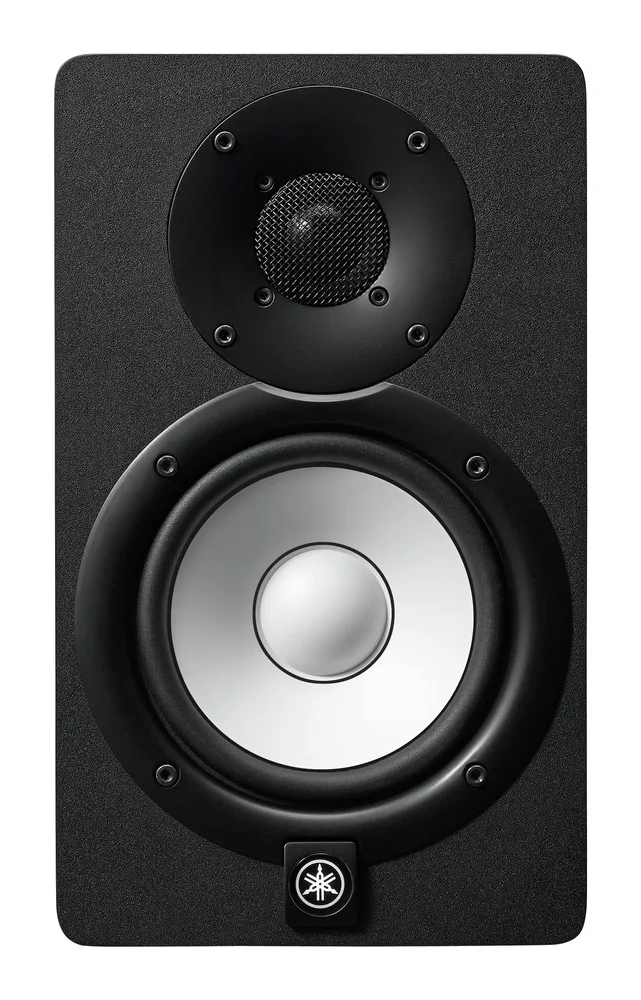
Price: $199.99 per speaker at Guitar Center (October 2026), so about $400 a pair. Yamaha doesn’t list prices on its own site.
The Yamaha HS5 is the classic flat-sounding studio monitor, and Yamaha HS speakers are among the ones on screen in Mix Elite’s gear video.
Each speaker has a 5-inch woofer and a 1-inch tweeter powered by 70 watts, covering 54 Hz to 30 kHz. On the back, a Room Control switch turns the bass below 500 Hz down by 2 or 4 dB when the speaker sits near a wall. A High Trim switch moves the highs up or down by 2 dB. It takes XLR or TRS cables, and it also comes in white.
Who it’s for: honest mixing, as long as you don’t need it to flatter you.
4. JBL 305P MkII
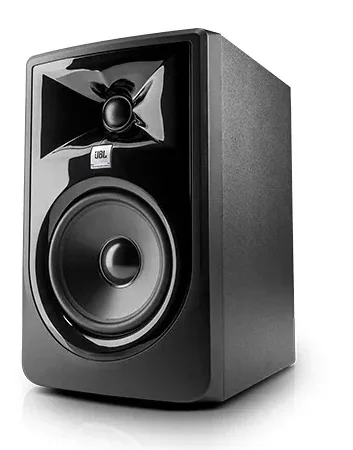
Price: $199 per speaker on JBL’s own store (October 2026), so about $400 a pair. Guitar Center had it at the same price.
The JBL 305P MkII is the other 5-inch pair on almost every beginner list. Its tweeter sits in JBL’s Image Control Waveguide, which JBL says gives a broad, room-friendly sweet spot.
Inside are 82 watts for a 5-inch woofer and a 1-inch soft-dome tweeter, with a response of 49 Hz to 20 kHz. A Boundary EQ switch tames the extra bass you get close to a wall, and an HF Trim switch adjusts the highs.
Who it’s for: a wide sweet spot, so you can move around while you work.
5. ADAM Audio T5V
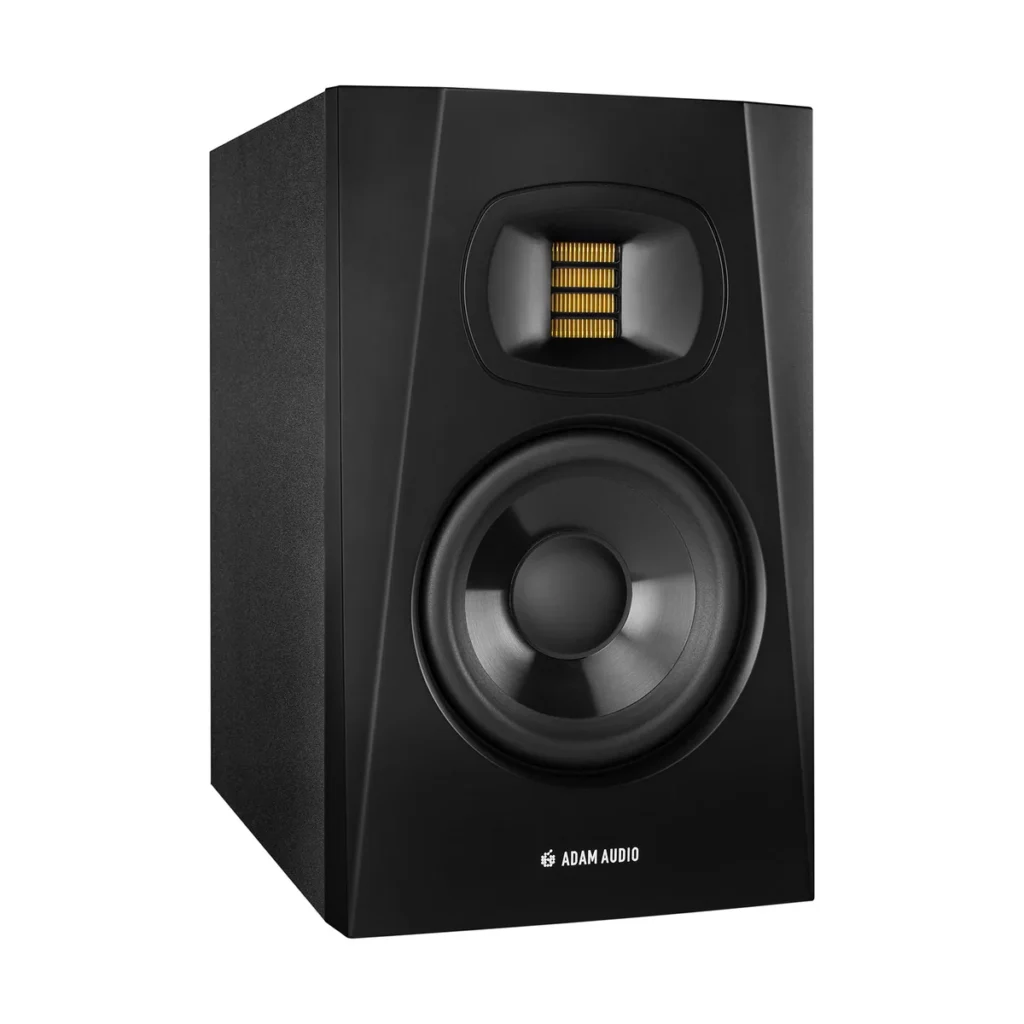
Price: $239.99 per speaker on ADAM Audio’s US store (October 2026), so $479.98 a pair.
The ADAM Audio T5V uses a ribbon tweeter instead of the usual dome. ADAM calls it the U-ART tweeter, and it says its even spread of highs gives you a wide sweet spot. Behind it sit a 5-inch woofer and 70 watts, and the range runs from 45 Hz to 25 kHz (-6 dB).
Two switches on the back trim the highs above 5 kHz and the lows below 300 Hz by 2 dB. It takes XLR or RCA cables. The bass port is on the back, so leave a little space between the speaker and the wall. Then enjoy the detail.
Who it’s for: crisp, detailed highs in a small room. ADAM built it for small control rooms, which is what a bedroom studio is.
6. KRK Rokit 5 Generation Five
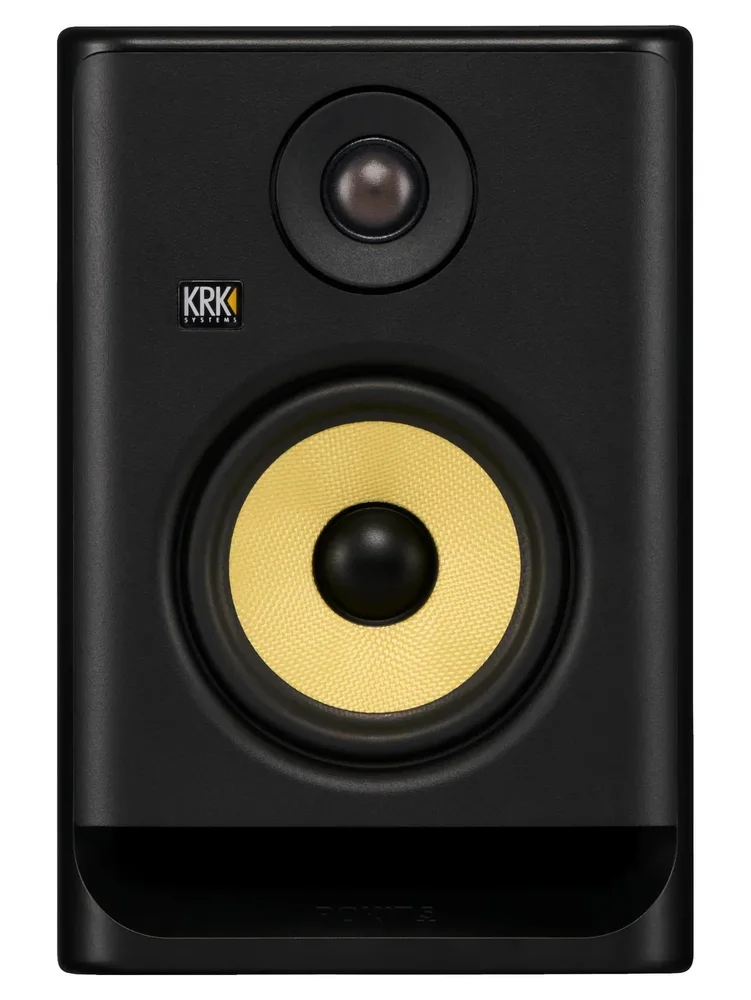
Price: $199 per speaker on KRK’s store (October 2026), so $398 a pair.
This fifth generation adds DSP, a small computer inside the speaker that shapes its sound. The DSP gives you three voicing modes. Mix mode is the flat one, made for mixing and mastering, and Focus mode brings the mids forward so you can check details.
You also get 25 boundary and tuning EQ settings, and KRK’s free app helps you set them for your room. Inside are a 5-inch Kevlar woofer and a 1-inch silk-dome tweeter.
Who it’s for: room tuning built in. Leave it in Mix mode while you mix. Always.
7. Kali Audio LP-6 2nd Wave
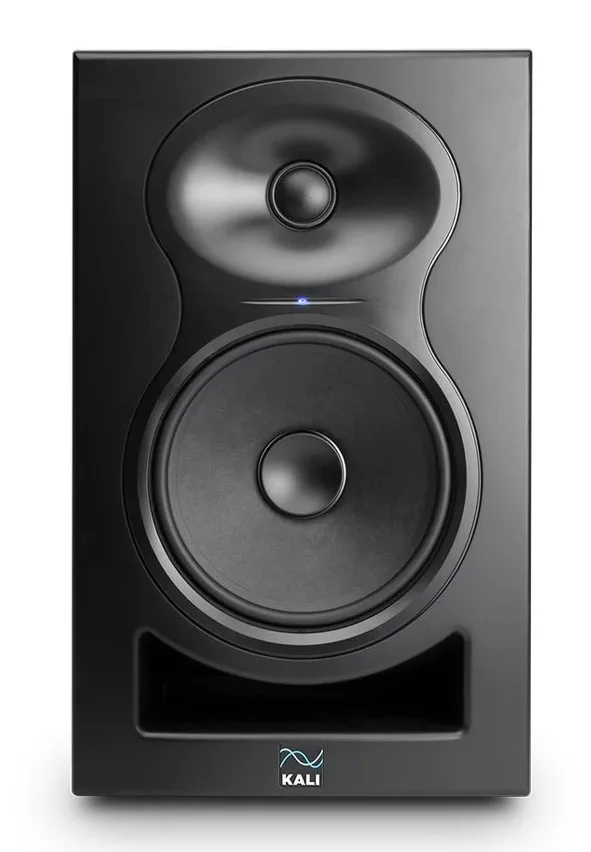
Price: from $249 per speaker on Kali’s site, the same as Guitar Center in October 2026, so a pair stays under $500.
The Kali Audio LP-6 2nd Wave has a bigger 6.5-inch woofer, a 1-inch soft-dome tweeter and 80 watts, and it reaches down to 39 Hz.
Kali tuned its Boundary EQ switches at The Village Studios in Los Angeles. They correct the bass for where the speaker stands, like on a desk or close to a wall. The bigger woofer suits a bigger room, so pick this one if you sit a little farther from your desk.
Who it’s for: a bigger room and more low end, still without a subwoofer.
8. PreSonus Eris Studio 8
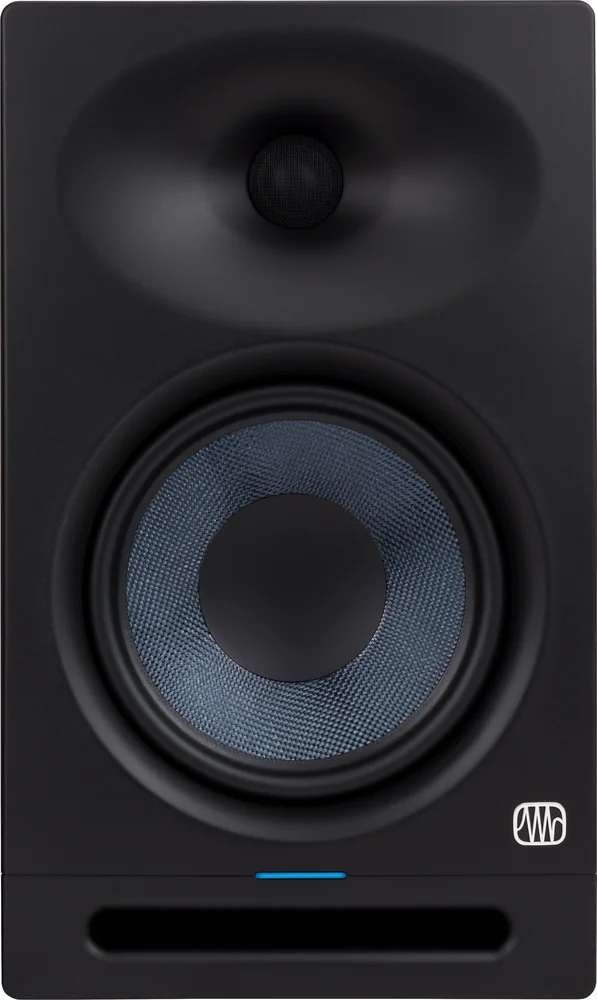
Price: $209.99 per speaker on PreSonus’s store (October 2026), so $419.98 a pair.
The PreSonus Eris Studio 8 is the cheapest 8-inch pair on this list. It has an 8-inch woofer, a 1.25-inch silk-dome tweeter and 140 watts, and PreSonus says it reaches 35 Hz with no subwoofer.
It takes XLR, 1/4-inch TRS and RCA, so almost anything plugs straight in. On the back, an Acoustic Space switch cuts the bass by 2 or 4 dB when it sits near a wall, and a Low Cut switch helps if you add a sub later. It’s a big speaker at 16.5 inches tall and 22 pounds. Check your desk first.
Who it’s for: a bigger room, or anyone who wants deep bass for the least money.
The best studio monitors under $1,000 a pair
The best studio monitors under $1,000 a pair are the Yamaha HS8 ($797.98 a pair) for a bigger room and the IK Multimedia iLoud MTM MkII ($799.99 a pair) for a small, untreated one. The Genelec 8010A, a 3-inch desk speaker, also lands at $900 a pair in the small desk group below.
9. Yamaha HS8
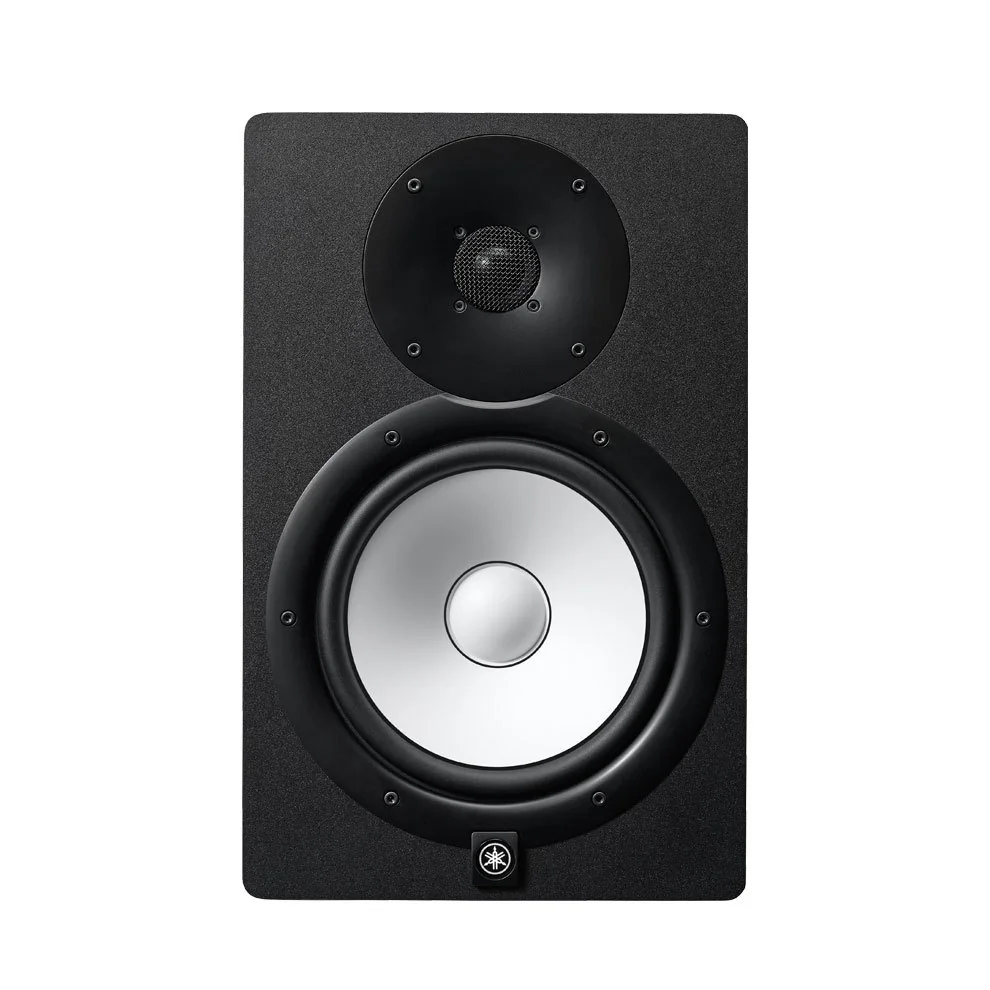
Price: $398.99 per speaker at Sweetwater (October 2026), so $797.98 a pair. Yamaha doesn’t show prices on its site.
The Yamaha HS8 is the 8-inch model of the HS series. It has an 8-inch woofer, a 1-inch tweeter and 120 watts, and it reaches 38 Hz (-10 dB), so you hear much more of the low bass than on the HS5.
It has the same Room Control and High Trim switches as the HS5, and it takes XLR or 1/4-inch TRS cables from an audio interface. Each speaker is 15.4 inches tall and weighs 22.5 pounds. Plan for solid stands.
Who it’s for: a medium or bigger room where you want to hear the sub-bass of an 808 without a subwoofer.
10. IK Multimedia iLoud MTM MkII
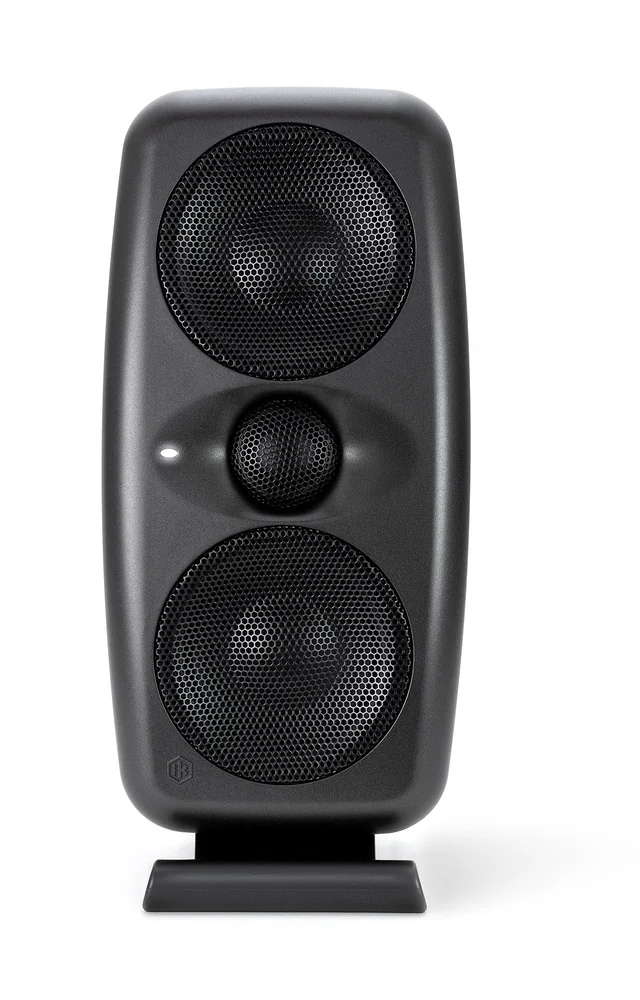
Price: $799.99 per pair on IK’s store ($699.99 on sale there, October 2026). One speaker is $399.99 ($349.99 on sale), but the single box has no measuring mic.
The iLoud MTM MkII stacks two 3.5-inch woofers around a 1-inch tweeter, and it corrects your room by itself. Put the included ARC mic where you sit, and the speakers measure the room and adjust their own sound. IK says the woofer-tweeter-woofer layout also cuts down reflections off the desk.
Each speaker is only about 10 inches tall, yet it reaches 48 Hz (±2 dB) with 100 watts. It has one combo XLR/TRS input, so you’ll need an audio interface.
Who it’s for: an untreated bedroom and a small desk. Buy the pair, because only the pair comes with the mic.
What are the best high-end studio monitors?
The best high-end studio monitors for a home studio are the Neumann KH 120 II, the IK Multimedia iLoud Precision 6 MkII, the Focal Shape 65, the EVE Audio SC2070 and the Focal ST6 Solo6, at about $900 to $1,500 per speaker. Above them sit bigger three-way monitors like the Neumann KH 310 or the Genelec 8351B from The Ones series, which give the mids their own driver.
Pick them once your room is bigger or already treated. Don’t buy them to fix a bad room, though. Better speakers just show you the room’s problems more clearly. The Yamaha HS8S subwoofer closes this group, for when your speakers can’t go low enough.
11. Neumann KH 120 II
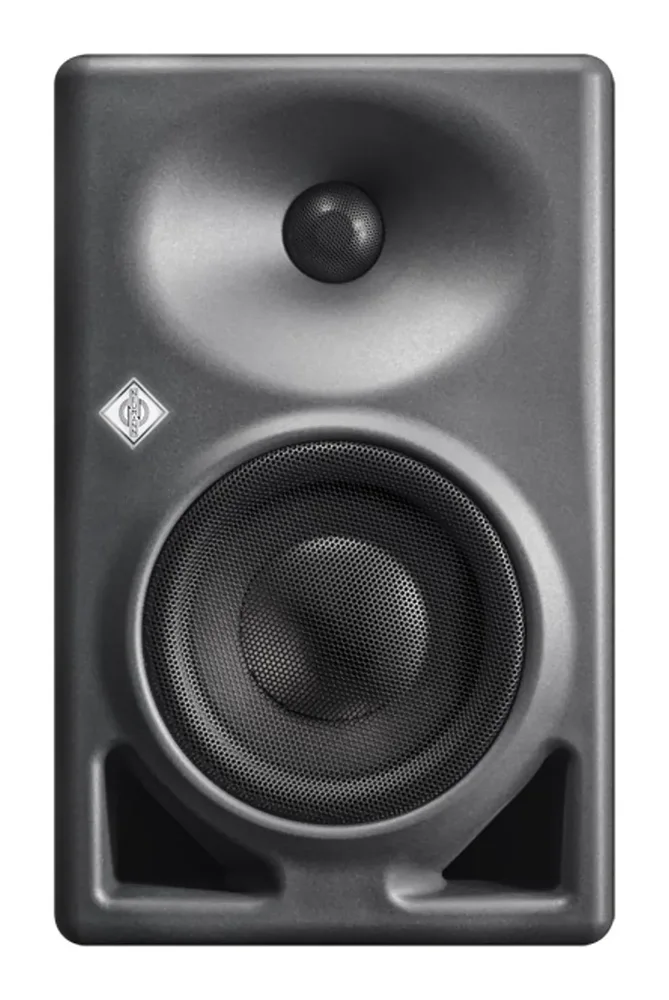
Price: $949 per speaker at Guitar Center (October 2026). Neumann sells through dealers and doesn’t show a price on its page.
The Neumann KH 120 II puts 145 watts into a 5.25-inch woofer and 100 watts into a 1-inch tweeter, with a response from 44 Hz to 21 kHz.
Its DSP is ready for Neumann’s MA 1 Automatic Monitor Alignment, sold separately, which adapts the speakers to the character of your room. Neumann recommends listening from 1 to 2 meters (3 to 6 feet), which fits a desk in a bedroom.
Who it’s for: a treated room and a pair you’ll keep for a very long time.
12. IK Multimedia iLoud Precision 6 MkII
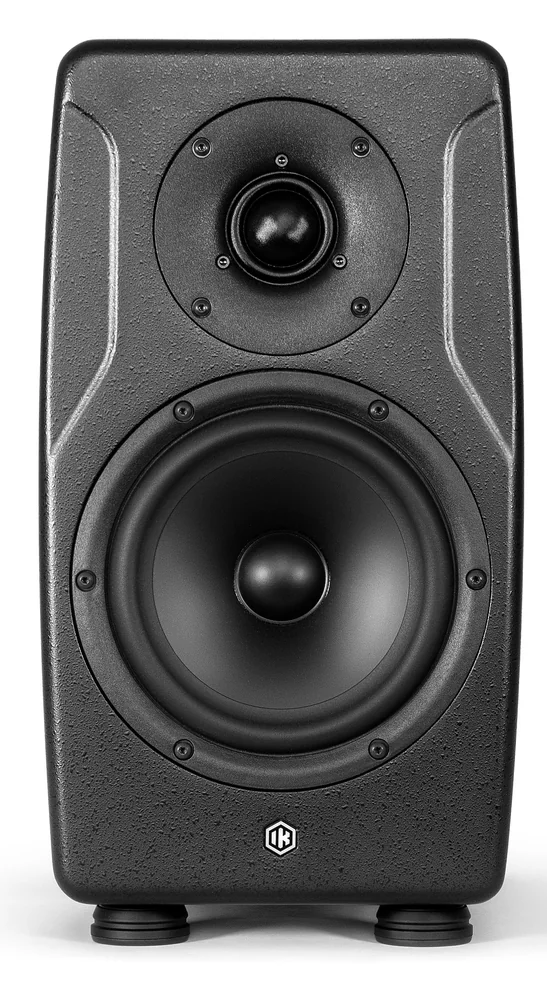
Price: $899.99 per speaker on IK’s store ($699.99 on sale there, October 2026).
The iLoud Precision 6 MkII is the newer version of the iLoud Precision 6 from our old list. It has a 6.5-inch woofer, a 1.5-inch tweeter and 150 watts, and it stays within 1 dB from 45 Hz to 22.5 kHz. That’s very flat.
Room correction comes in the box. The included mic and IK’s ARC X software measure your room and correct its bass bumps. A built-in high-pass filter, adjustable from 35 to 80 Hz, lets you add a subwoofer later without extra gear.
Who it’s for: mixing in a room you haven’t treated yet, with one speaker that reaches down to about 37 Hz.
13. Focal Shape 65
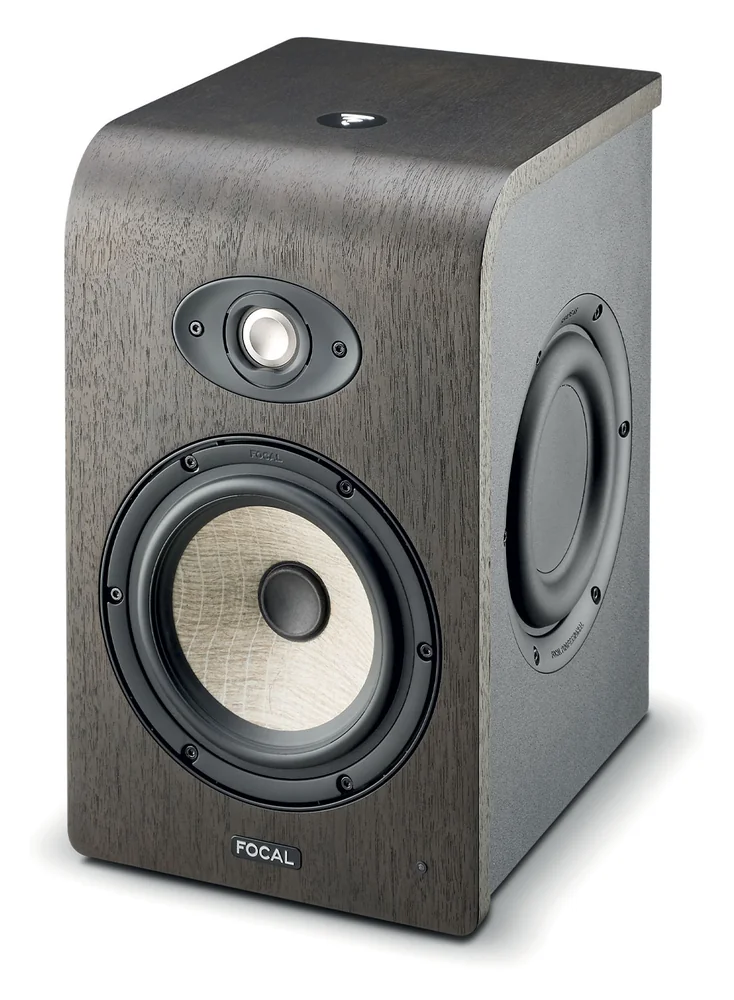
Price: $899 per speaker at Vintage King (October 2026). Focal shows no price on its own site.
The Focal Shape 65 has a 6.5-inch flax-cone woofer and a 1-inch inverted-dome tweeter, with a range of 40 Hz to 35 kHz (±3 dB). Instead of a bass port, it uses passive radiators, extra cones on its sides that move with the bass.
That helps in a small room. With no port, it can sit closer to a wall without the boomy bass a rear port often adds there. It takes XLR or RCA, and four EQ controls on the back fit it to your room.
Who it’s for: a smaller room where the speakers have to sit near the wall.
14. EVE Audio SC2070
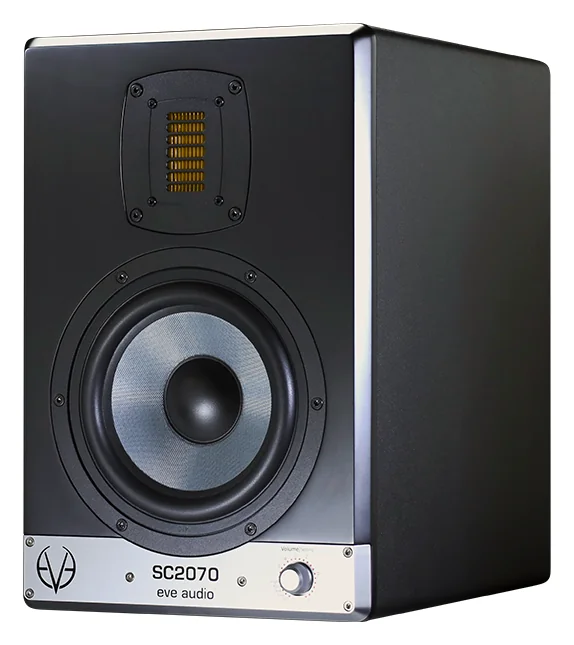
Price: $1,499.99 per speaker, brand new from US dealers on Reverb such as TriStar Music Gear (October 2026). EVE sells through dealers and shows no price.
The EVE Audio SC2070 pairs a 6.5-inch woofer with EVE’s biggest ribbon-style tweeter, called an AMT (Air Motion Transformer). It has 250 watts per speaker and reaches 38 Hz to 25 kHz (-3 dB).
All the tone controls sit on one knob on the front. You can tune it to your desk and your room from your chair, then lock the settings. It takes XLR or RCA, and it’s built in Berlin.
Who it’s for: detailed highs and vocals in a medium room you’ve started to treat.
15. Focal ST6 Solo6
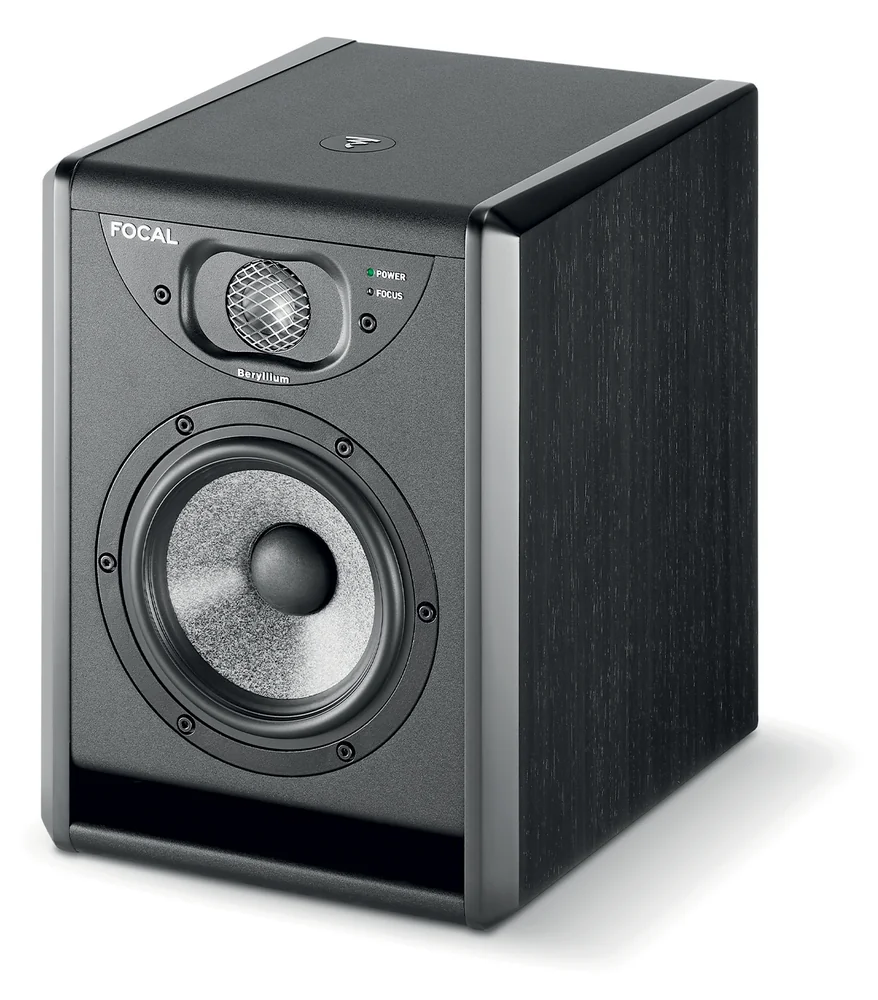
Price: $1,499 per speaker at Vintage King (October 2026). Focal shows no price on its own site.
The Focal Solo6, from Focal’s ST6 range, is the most expensive monitor on this list. It has a 6.5-inch woofer, a pure beryllium tweeter and 130 watts, with a range of 40 Hz to 40 kHz (±3 dB).
Its Focus mode is a handy trick. One switch turns it into a woofer-only speaker (110 Hz to 10 kHz), so you can hear how your mix sounds on small, cheap speakers without buying a second pair. It’s made in France, weighs 28.6 pounds and takes XLR only.
Who it’s for: a treated room, and a producer who already finishes songs and wants speakers for life.
16. Yamaha HS8S subwoofer
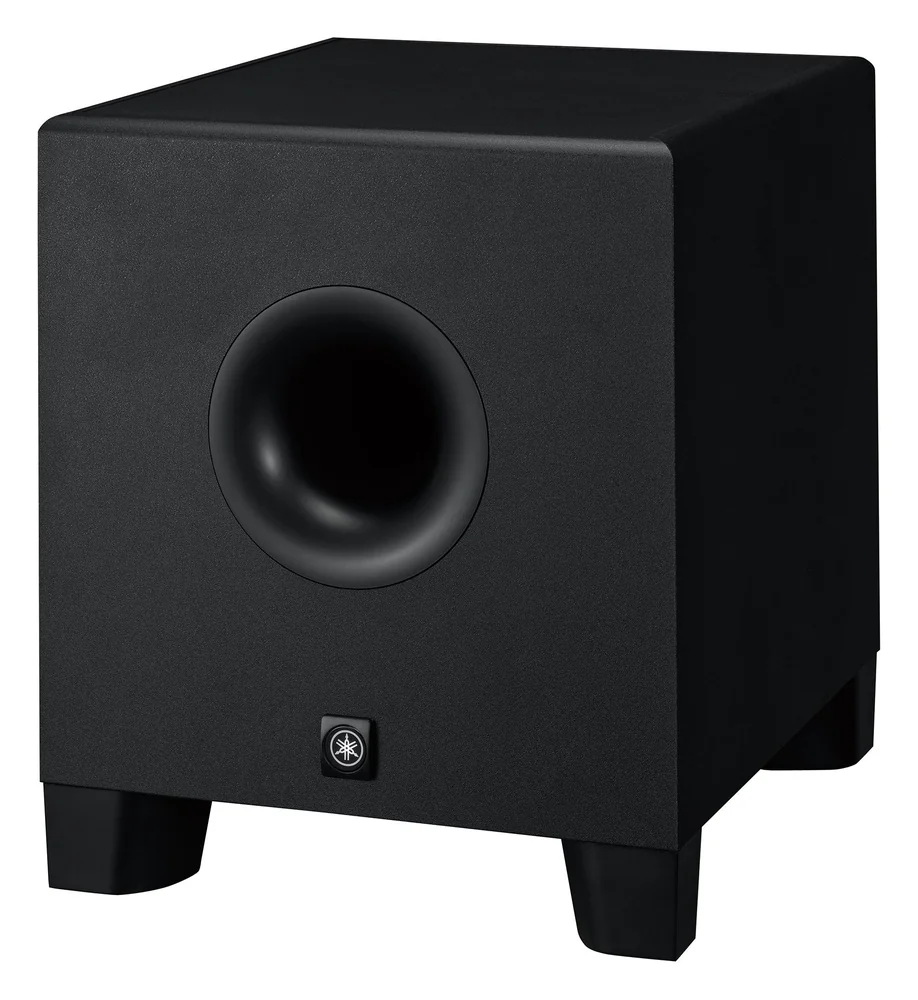
Price: $499.99 for one subwoofer at Vintage King (October 2026). Yamaha doesn’t show a price on its site.
The Yamaha HS8S is the matching subwoofer for the HS5, HS7 and HS8. Its 8-inch driver and 150 watts reach down to 22 Hz, the deep 808 and kick range that 5-inch speakers can’t play.
It has its own crossover. You plug your interface into the sub, then run the sub’s outputs to your speakers. Low Cut and High Cut controls, from 80 to 120 Hz, split the bass between the sub and the speakers. Most beginners can wait.
Who it’s for: a set-up, treated room once your speakers sound right. Skip it while you’re starting out.
The best small studio monitors for a desk (3 to 4 inches)
The best small studio monitors for a desk are the PreSonus Eris 3.5 2nd Gen ($99.99 a pair), the JBL 104-BT ($199 a pair) and the IK Multimedia iLoud Micro Monitor ($299.99 a pair). The KRK GoAux 4 travels in its own bag, and the Genelec 8010A is the small speaker pros carry between studios.
Small speakers can’t play the deepest bass. That’s fine for a tiny desk, and they make a great second pair for checking your mix later.
17. PreSonus Eris 3.5 2nd Gen
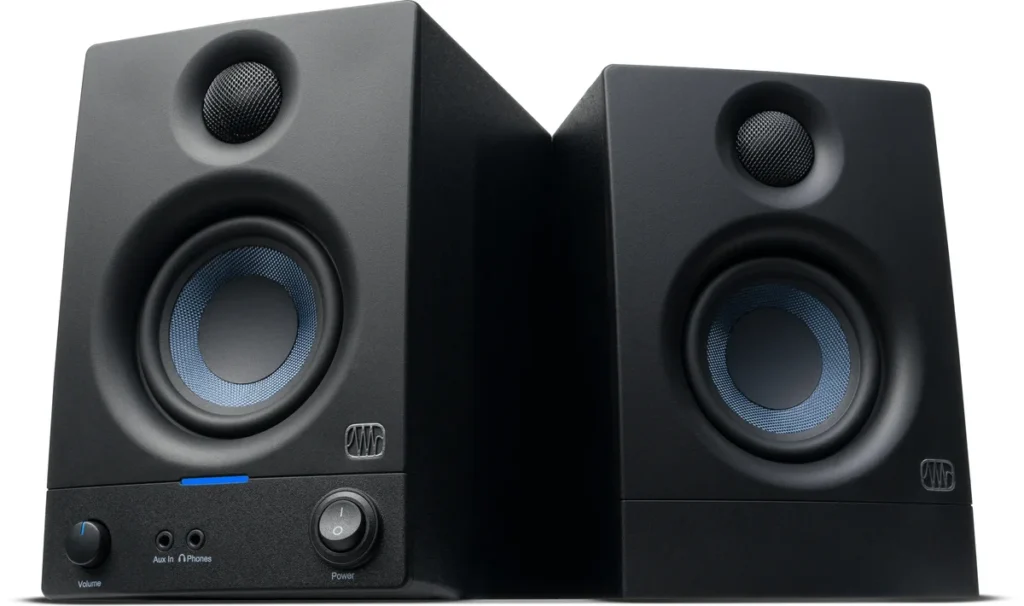
Price: $99.99 per pair on PreSonus’s store (October 2026), in black or white.
The PreSonus Eris 3.5 2nd Gen is the cheapest real pair here. Each one has a 3.5-inch woofer and a 1-inch silk-dome tweeter, with 25 watts of power per side.
It’s made for small desks. The volume knob and a headphone jack sit on the front, so you never reach behind the speaker. High and low controls help it fit your room, and three kinds of inputs mean it plugs into almost anything.
Who it’s for: a tiny desk, or a first pair on a tight budget.
18. JBL 104-BT
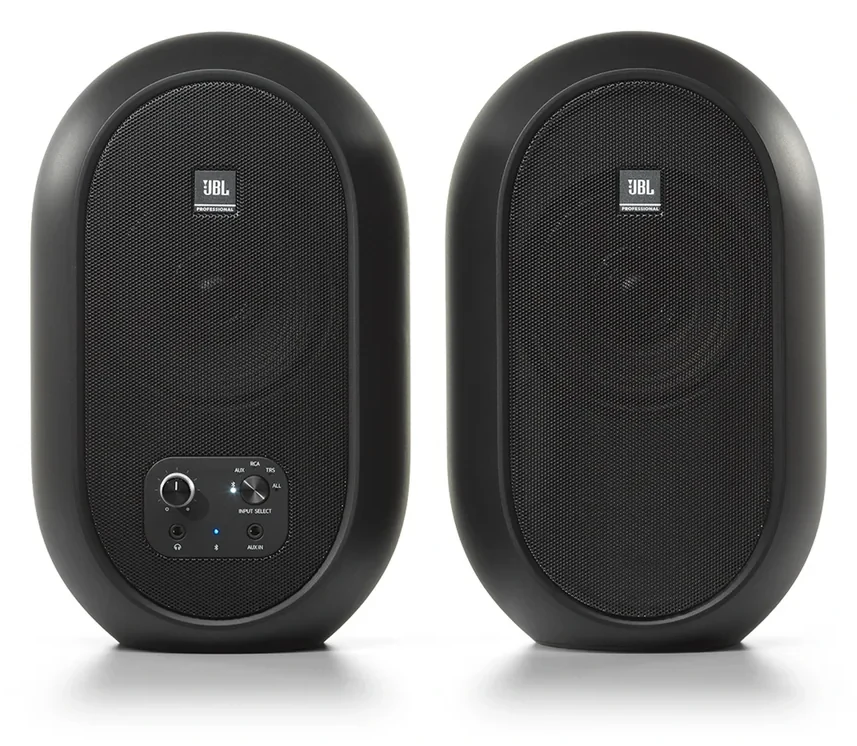
Price: $199 per pair on JBL’s store (October 2026).
The JBL 104-BT is the current version of the JBL One Series 104 from our old list, now with Bluetooth. Each speaker has a 4.5-inch woofer with a 0.75-inch tweeter in its center, with 60 watts for the pair and a range of 60 Hz to 20 kHz (±3 dB).
Everything is on the front: volume, an input switch and a headphone jack that silences the speakers. One speaker powers the other, so you need just one wall outlet. It takes 1/4-inch TRS, RCA, a 1/8-inch aux cable or Bluetooth.
Who it’s for: a small desk, a laptop setup, or a second pair to check your mix.
19. IK Multimedia iLoud Micro Monitor
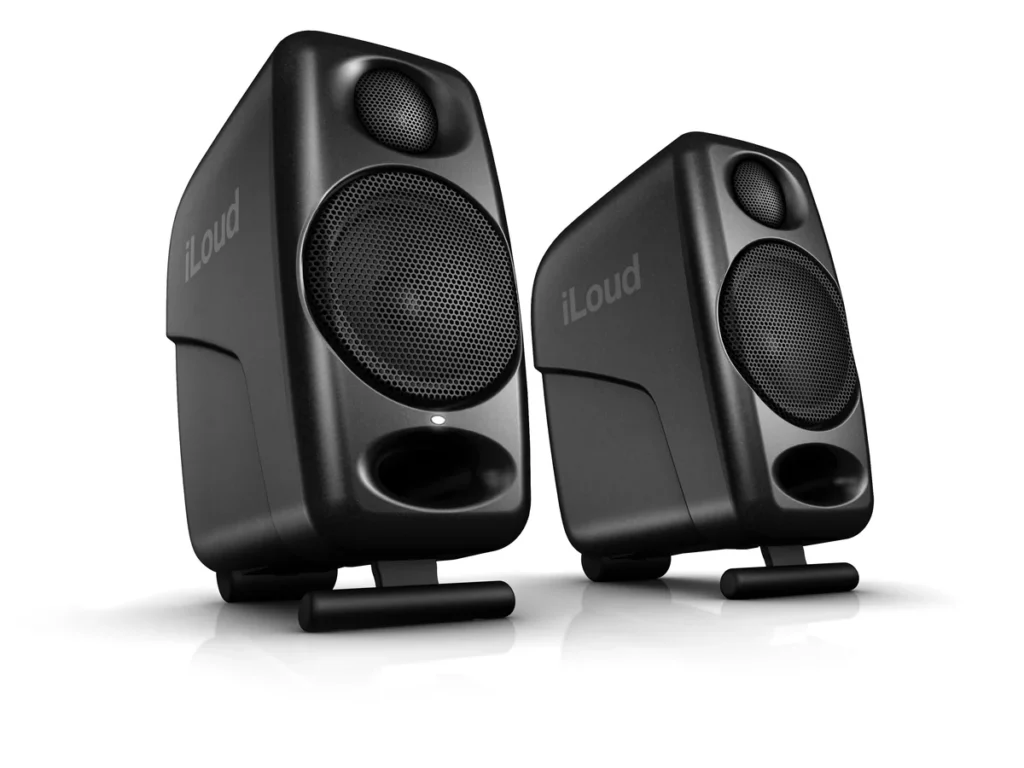
Price: $299.99 per pair on IK’s store (October 2026).
The iLoud Micro Monitor is tiny, about 7 inches tall, but it reaches 55 Hz (-3 dB). Each speaker has a 3-inch woofer and a 0.75-inch silk-dome tweeter, with 50 watts for the pair.
A built-in stand tilts it up toward your ears. A Desktop switch fixes the boomy sound a desk adds, and two more switches trim the bass and treble. It takes RCA, a 1/8-inch cable or Bluetooth.
IK also sells the newer iLoud Micro Monitor Pro, $599.99 a pair ($499.99 on sale at IK’s store, October 2026), which adds an XLR input and automatic room correction.
Who it’s for: a laptop desk with almost no space.
20. KRK GoAux 4
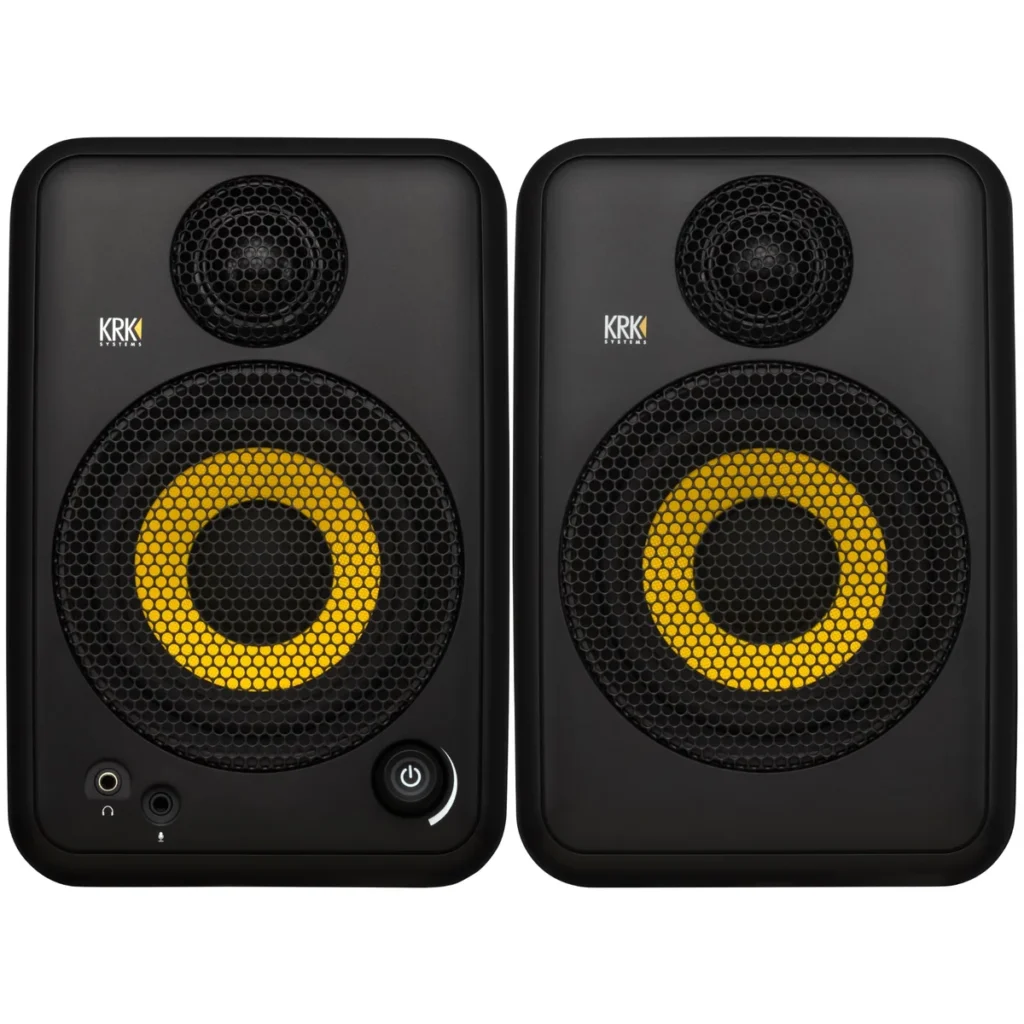
Price: $375.99 per pair on KRK’s store (October 2026). KRK lists it with its legacy products, so stock may be limited.
The KRK GoAux 4 is a portable pair. A bag holds both speakers, their stands, the cables and a measuring mic. Plug in the mic, and KRK’s Auto ARC room correction tunes the speakers to the room you’re in. Then press play.
Each speaker has a 4-inch woofer and a 1-inch tweeter, with 100 watts for the system and a range of 65 Hz to 20 kHz (-3 dB). It takes Bluetooth, USB, RCA, 1/4-inch TRS and 1/8-inch inputs, and the headphone jack on the front mutes the speakers.
Who it’s for: a producer who works in more than one place, like home and a friend’s studio.
21. Genelec 8010A
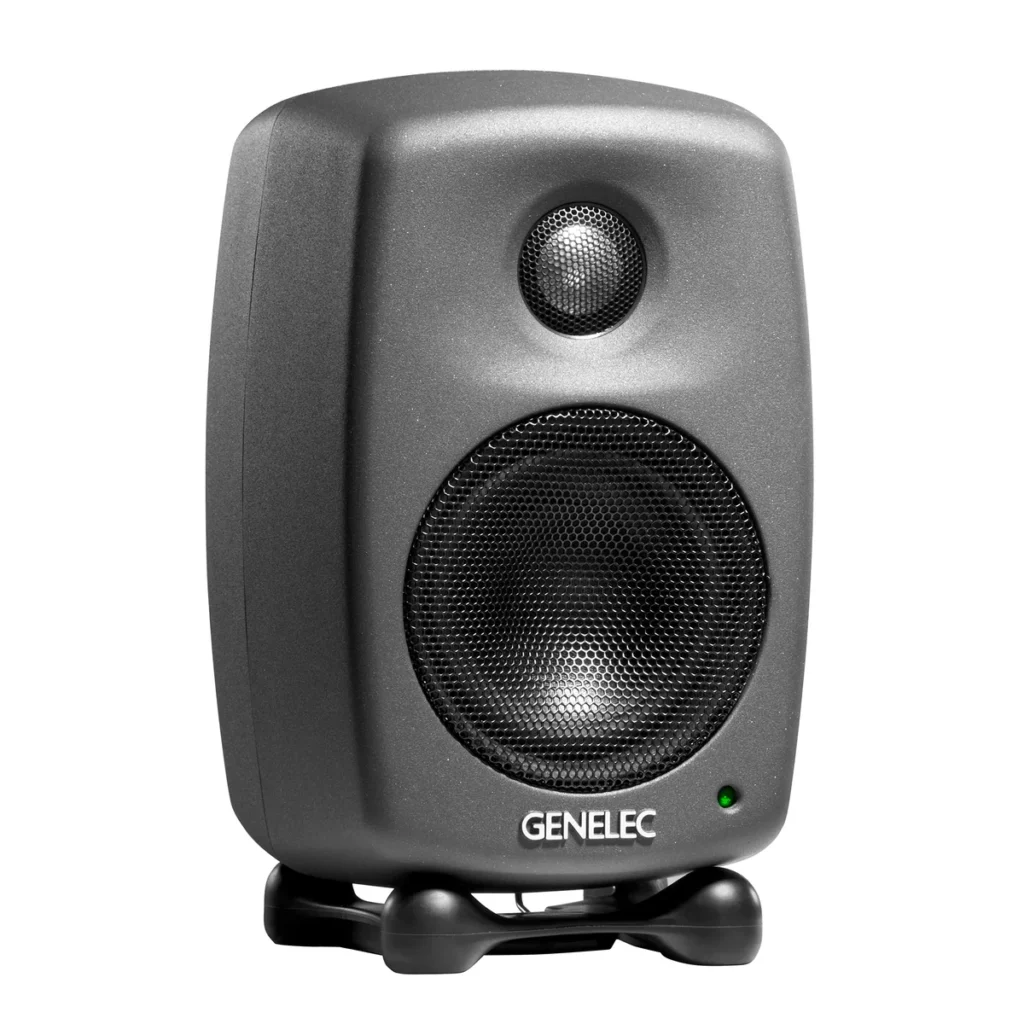
Price: $450 per speaker at Sweetwater (October 2026), so $900 a pair. Genelec sells through dealers.
The Genelec 8010A is the smallest speaker in Genelec’s 8000 series. It has a 3-inch woofer, a 0.75-inch metal-dome tweeter and 50 watts in a die-cast aluminum box, and it covers 74 Hz to 20 kHz (±2.5 dB). It weighs just 3.3 pounds. It fits in a backpack.
Switches on the back fit it to a desk, and the rubber Iso-Pod stand tilts it toward your ears. It takes XLR only, so plug it into an audio interface.
Who it’s for: a small desk, travel, or a second pair you can trust.
Where should you put your studio monitors?
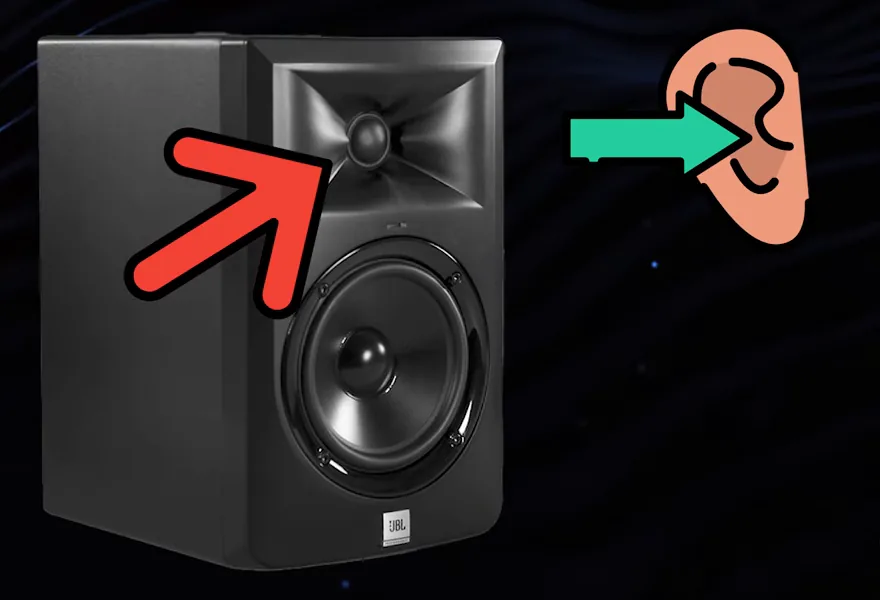
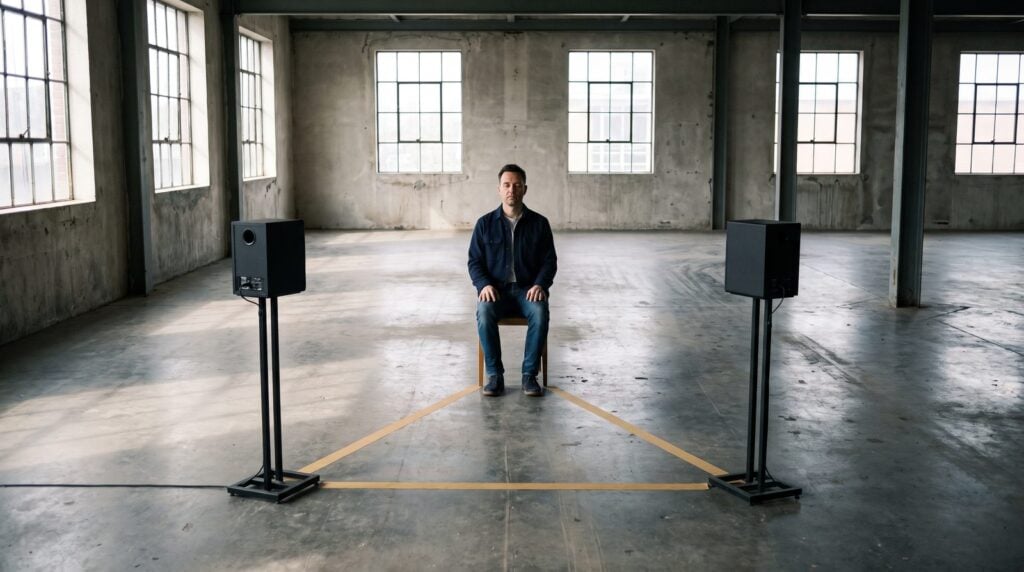
Place them so your head and the two speakers form an equal triangle, with both speakers turned in toward you and the tweeters at ear level. Keep them off the wall and out of the corners, where the bass builds up.
This step costs nothing, and it changes the most. Here’s the method from Mix Elite’s gear video, plus two room basics:
- Put your desk in the middle of one wall, so you sit centered between the side walls.
- Tilt both monitors in toward your ears.
- Raise them until the tweeters, the small domes on top, are at ear level.
- Make an equal triangle: your head and the two speakers are its three corners.
- Keep the speakers off the wall and out of the corners, where the bass builds up.
In the video, the arrow runs from the tweeter straight to your ear. If the tweeter points at your chest or over your head, you lose detail in the highs.
For the exact distances, use Mix Elite’s free studio monitor placement calculator. Max says in the gear video: “You’ll need to measure your room, type in some numbers, and it will tell you the exact placement.” It uses the 38% rule, and our home studio guide explains that rule step by step: where your chair goes and how far the speakers sit from the wall.
Set the speakers on stands or foam pads, not straight on the desk. A desk shakes along with the bass and blurs the low end.
Do studio monitors need acoustic treatment?
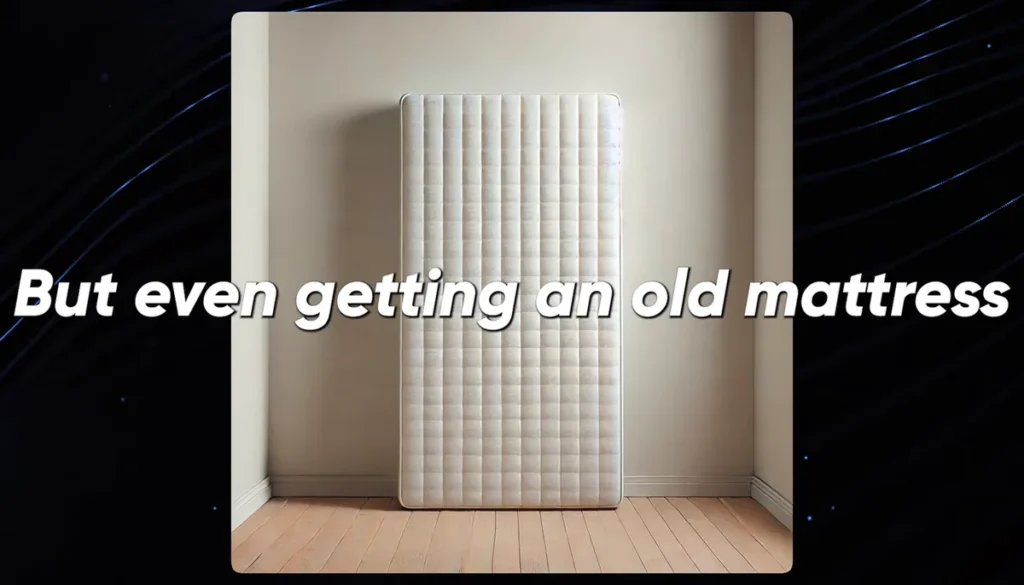
A little, yes. In an untreated room, sound bounces off the walls and the bass piles up in the corners, so you hear your room instead of your mix. Heavy, soft things you already own, like full bookshelves, a sofa or an old mattress against the wall, fix a lot for free.
The bass is the worst part. It can fool you into thinking your music sounds bad. It doesn’t. Your room does.
You don’t need to hire an expert or buy expensive panels. Shelves full of books, a sofa, carpets and mattresses soak up and scatter sound, which is why a furnished bedroom is often a better studio than an empty room.
Cheap foam only tames the mids and highs, like the human voice. The bass is the hard part, and it needs something dense, like rock wool, or the cheapest trick of all: an old mattress stood against the wall. Our DIY acoustic treatment guide shows how to build cheap panels and bass traps when you’re ready.
You can also find the exact spots where your room booms. This free trick comes from Mix Elite’s video on a punchy, clean low end:
- Play a sine wave through your speakers and sweep it up slowly through the low end, below about 500 Hz.
- Write down every spot where it suddenly gets much louder. That’s your room ringing.
- Put an EQ on your master and make a small cut at one or two of those spots.
- Keep that EQ off when you export. It’s there to fix your room, not your song.
Do you need a subwoofer with studio monitors?
Not at first. A good 5-inch pair plays down to about 45 to 55 Hz, which covers most of a song, and Mix Elite’s gear video says you don’t need a full setup with a subwoofer. Add one later, once your room is treated and you make bass-heavy music like trap or house.
A subwoofer, or sub, is a speaker that only plays the deepest bass. In a small, untreated room it often makes the low end harder to judge, not easier, because the room boosts some bass notes and swallows others. Get your placement right with the placement calculator first.
When you do add one, match it to your speakers. The Yamaha HS8S (pick 16) pairs with the HS5 and HS8, and speakers with a built-in high-pass filter, like the iLoud Precision 6 MkII and the Eris Studio 8, hand the deepest bass to the sub without an extra box.
How do you connect studio monitors to your computer?
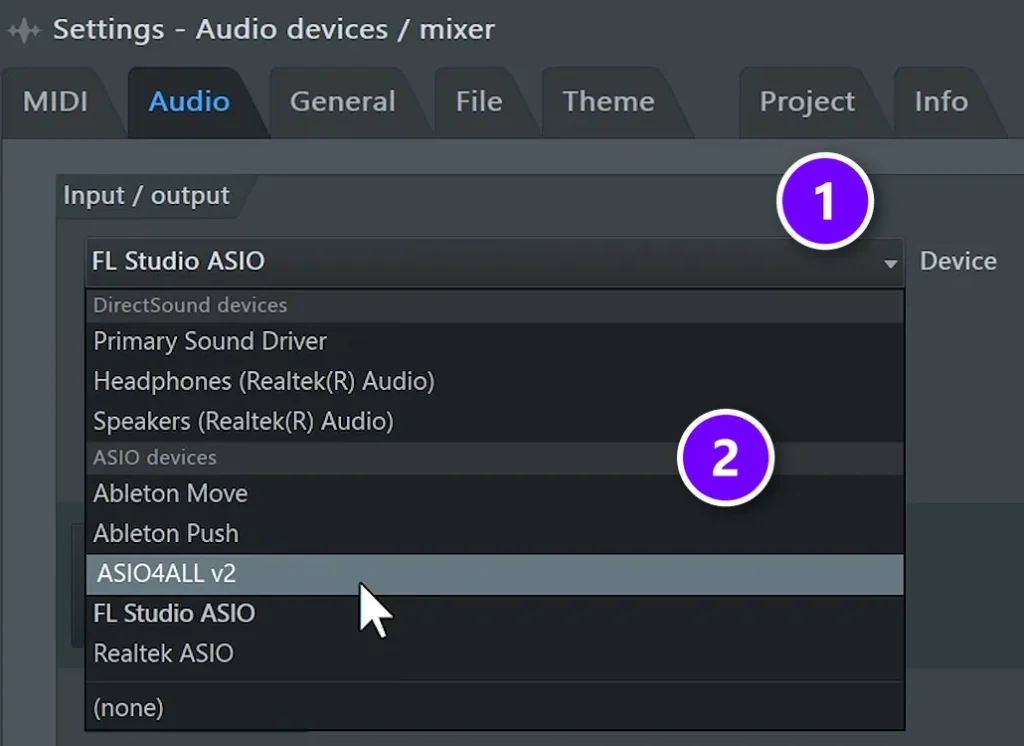
Through an audio interface: run balanced XLR or TRS cables from its main outputs to the speakers’ inputs, then pick the interface as the audio device in your music software. Every pick here is powered, so you don’t need a separate amplifier.
The interface turns your computer’s audio into a clean signal for the speakers, and it gives you one big volume knob you can grab fast. Here’s the setup:
- Connect the interface’s main outputs, often marked L and R, to the speakers’ inputs with balanced XLR or TRS cables.
- Plug the speakers into power and turn their volume down before you switch them on.
- In FL Studio, open Options > Audio settings.
- Click the Device menu (1) and pick the driver with your interface’s name under ASIO devices (2). If you don’t see one, FL Studio ASIO works too.
- Play something quiet, then turn the speakers up until it feels comfortable.
If you don’t own an interface yet, here are our picks of the best audio interfaces for every budget.
Switch the speakers on last and off first. Turning the interface on or off while the speakers are on can send a loud pop through them.
Why does my mix sound good on headphones but bad in the car?
On headphones, each ear hears only one side and you hear the bass without feeling it, so the low end is hard to judge. A car is a small box of glass and hard plastic, and many car stereos boost the lows and highs, so any extra low end turns to mud there.
Sonarworks explains the first part well: speakers send both sides to both ears, but headphones keep each side in its own ear. That makes the stereo picture feel wider than it really is and makes reverb sound bigger, so headphones can mislead you on panning and reverb too.
Your room and your gear add to it. Mix Elite’s low-end video points out that a room resonates in the muddy range below about 500 Hz, and that some popular studio headphones already dip that range. So a mix can sound clean at your desk and muddy everywhere else.
Will studio monitors fix it?
Partly. Monitors let both ears hear both speakers and let you feel the bass in a real room, like the car does, so your balance decisions carry over better. But an untreated room fools you just like headphones do, so placement and a little treatment come first.
Either way, test before you call a song done. In Mix Elite’s free 4.5-hour FL Studio course, the final step after mastering is to play the track on different headphones, laptops, cars and Bluetooth speakers, then fix anything that sounds off.
Should you buy studio monitors or headphones first?
Headphones first. A computer and a good pair of headphones are all you truly need to make music, and everything else is optional. Monitors come next, once you have the space and about $300 for a pair.
If you’re torn, our guide to mixing in headphones vs studio monitors explains what each one hides from you, and here are the best headphones for mixing and recording. Gear is only step one, though. Our guide on how to produce music shows what to do once your setup works.
What happened to the monitors on our old list?
Earlier versions of this page listed a few models that have changed since. Here’s where each one stands in October 2026:
- Neumann KH 120: replaced by the KH 120 II (pick 11).
- Kali Audio LP-6: replaced by the LP-6 2nd Wave (pick 7).
- KRK Rokit 5 (older generations): replaced by the Rokit 5 Generation Five (pick 6).
- PreSonus Eris E8 XT: replaced by the Eris Studio 8 (pick 8). PreSonus’s store shows the E8 XT sold out, and Sweetwater now points to the Studio 8.
- IK Multimedia iLoud Precision 6: replaced by the iLoud Precision 6 MkII (pick 12).
- JBL One Series 104: now sold as the 104-BT (pick 18), which adds Bluetooth.
- Alesis Elevate 5 MkII: no longer sold new at Guitar Center, B&H or Amazon (October 2026), and Alesis hasn’t named a newer model. The Mackie CR5BT (pick 2) fills the same spot for about the same money.
The rest of the old list is still on sale and back on this page: the Yamaha HS8 (pick 9), the Genelec 8010A (pick 21), the KRK GoAux 4 (pick 20), the EVE Audio SC2070 (pick 14) and the Focal ST6 Solo6 (pick 15).
The 21 best studio monitors side by side
Prices are from October 2026: on the maker’s own store where it sells direct, and otherwise at the US dealer named. “Each” means one speaker.
| Monitor | Woofer | Price (October 2026) | Best for |
|---|---|---|---|
| PreSonus Eris Studio 5 | 5 in | $149.99 each (PreSonus) | Best value for most bedrooms. |
| Mackie CR5BT | 5.25 in | $199.99 a pair (Amazon) | Tight budgets, everyday listening. |
| Yamaha HS5 | 5 in | $199.99 each (Guitar Center) | Honest, flat mixing. |
| JBL 305P MkII | 5 in | $199 each (JBL) | A wide sweet spot. |
| ADAM Audio T5V | 5 in | $239.99 each (ADAM Audio) | Detailed highs, small rooms. |
| KRK Rokit 5 Generation Five | 5 in | $199 each (KRK) | Room tuning built in. |
| Kali Audio LP-6 2nd Wave | 6.5 in | From $249 each (Kali) | Bigger rooms, more low end. |
| PreSonus Eris Studio 8 | 8 in | $209.99 each (PreSonus) | Deep bass for less. |
| Yamaha HS8 | 8 in | $398.99 each (Sweetwater) | Medium to big rooms. |
| IK Multimedia iLoud MTM MkII | 2 x 3.5 in | $799.99 a pair (IK) | Untreated rooms, auto room correction. |
| Neumann KH 120 II | 5.25 in | $949 each (Guitar Center) | Treated rooms, long-term pair. |
| IK Multimedia iLoud Precision 6 MkII | 6.5 in | $899.99 each (IK) | Room correction in the box. |
| Focal Shape 65 | 6.5 in | $899 each (Vintage King) | Speakers close to a wall. |
| EVE Audio SC2070 | 6.5 in | $1,499.99 each (Reverb dealer) | Detailed highs and vocals. |
| Focal ST6 Solo6 | 6.5 in | $1,499 each (Vintage King) | Treated rooms, speakers for life. |
| Yamaha HS8S subwoofer | 8 in | $499.99 each (Vintage King) | Adding deep bass later. |
| PreSonus Eris 3.5 2nd Gen | 3.5 in | $99.99 a pair (PreSonus) | Tiny desks, tight budgets. |
| JBL 104-BT | 4.5 in | $199 a pair (JBL) | Laptop desks, Bluetooth. |
| IK Multimedia iLoud Micro Monitor | 3 in | $299.99 a pair (IK) | Almost no desk space. |
| KRK GoAux 4 | 4 in | $375.99 a pair (KRK) | Working in more than one place. |
| Genelec 8010A | 3 in | $450 each (Sweetwater) | A small second pair you can trust. |
DAY 1 OF THE 7-DAY MUSIC PRODUCER COURSE
Speakers sorted? Day 1 sets up the rest of your studio
Day 1 of the 7-Day course covers your whole setup: the ‘Perfect Triangle’ formula for setting up a home studio on any budget, how to choose the music hardware and software that suit you, and a download with our full list of the best hardware, so you don’t spend days researching. It’s taught in FL Studio (the free trial works), about 45 minutes a day, and at the end a pro gives you personal feedback on your finished track. It’s $27, and you get 60 days to decide if it was worth it.
Frequently asked questions
What size studio monitors should I get for a small bedroom?
Get 5-inch monitors. They’re the sweet spot for an average bedroom, even an untreated one, and you shouldn’t go bigger unless you have a huge studio space. Pick 3.5 to 4-inch speakers for a tiny desk, and save 6.5 to 8-inch pairs for bigger rooms with some treatment, because a small room can’t handle that much bass.
Will studio monitors fix a mix that sounds good on headphones but bad in the car?
Partly. Monitors let both ears hear both speakers and let you hear the bass in a room, so your mix decisions carry over better to cars and other speakers. But an untreated room fools you like headphones do, so set them up in an equal triangle, add a little treatment, and still test every mix in the car.
How do I choose studio monitors for a small room without overspending?
Match the speaker to the room: powered 5-inch monitors with a flat sound and room-control switches on the back, like the PreSonus Eris Studio 5 at $299.98 a pair. On a tiny desk, the Eris 3.5 2nd Gen costs $99.99 a pair. Spend what’s left on stands or foam pads, not on bigger speakers, and place them with a placement calculator.
What are the best high-end studio monitors?
The Neumann KH 120 II ($949 each at Guitar Center in October 2026) is the classic high-end pick for a home studio. The iLoud Precision 6 MkII adds room correction, and the Focal Shape 65, EVE Audio SC2070 and Focal ST6 Solo6 cost about $900 to $1,500 each. They only pay off in a treated room, because better speakers show a bad room’s problems more clearly.
Do studio monitors need acoustic treatment?
A little, yes. Without it, the bass builds up in the corners and sound bounces off bare walls, so you hear your room instead of your mix. Start free with full bookshelves, a sofa, carpets or an old mattress against the wall, then add dense panels or rock wool bass traps when you’re ready.