
“How we spend our days is, of course, how we spend our lives.”
In the music production school vs online course choice, an online school with real feedback wins for most adults with a job: you learn the same core skills (writing, arranging, mixing and mastering) at home, on your own schedule, for a few hundred dollars instead of a $63,000+ degree. A degree is worth it if you need the credential for teaching, studio or media jobs, or want full-time campus life. For the busy adult, our pick is Mix Elite Academy: lifetime access to 600+ trainings, weekly live coaching and unlimited feedback on your music, for 3 payments of $137.
Maybe you’ve had a music school’s tuition page open in one tab and your bank app in the other. You’ve wanted to make music for years, but a job takes your days, a family might take your evenings, and a small voice keeps asking if the only “real” way to learn is to go back to school.
This guide puts the options next to each other: what a degree, a diploma and an online course cost today, how much of your week each one takes, what you actually learn, and who listens to your songs. Every school price comes from the school’s own website, checked on October 11, 2026.
Table of Contents
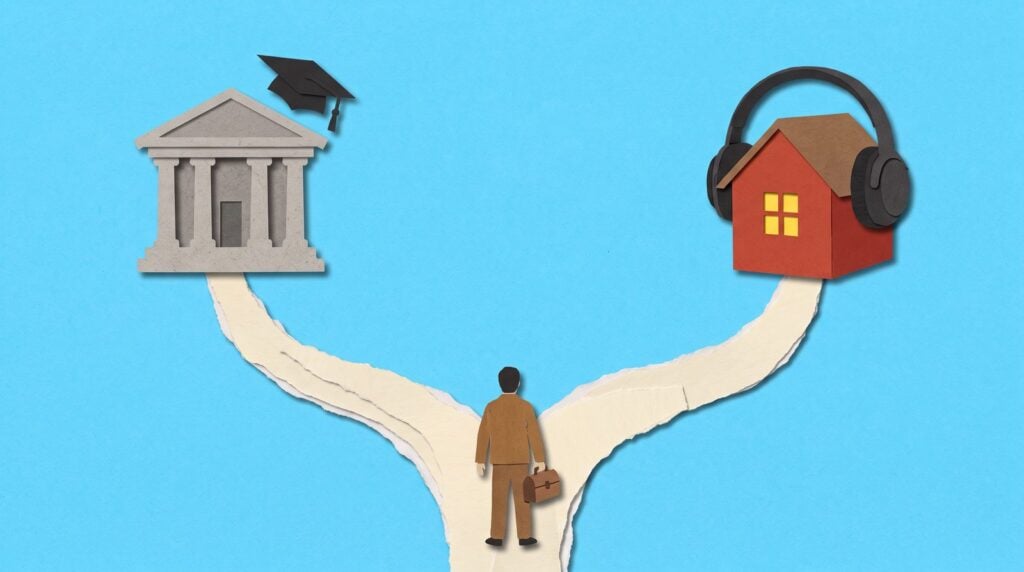
Music production school vs online course: what are you choosing between?
When people say “music production school,” they usually mean one of three things. They cost very different amounts, and they ask for very different weeks.
- A degree. A bachelor’s in music production from an accredited school, on a campus or online. It takes years, it comes with general classes like English and math, and it ends with a diploma you can put on a résumé.
- A diploma or certificate. A shorter school program, often one to two years, with live classes, set start dates and graded work, but no bachelor’s degree at the end.
- An online course or online school. Video lessons you follow at your own pace. The cheap ones are only videos. The better ones add live coaching and a real person who listens to your songs.
All three can teach you to make music. The difference is what you pay, how much of your week they take, and who tells you what’s wrong with your song. That last part matters more than most people think.
What does music production school cost in 2026?
These are the prices on each school’s own website, checked on October 11, 2026. Tuition changes every year, so check again before you apply.
Berklee: the Boston campus and Berklee Online
For one year of an undergraduate degree on its Boston campus, Berklee lists a 2026-27 cost of attendance of $85,817. That’s $54,020 in tuition, $1,600 in fees and $21,300 for room and board, plus a few other expected costs.
Berklee also has an online degree. The Berklee Online Bachelor of Arts in Music Production costs $63,350 for 120 credits, fees included, and takes about four years at 10 courses a year. If you only want a taste, one 12-week class such as Producing Music with FL Studio costs $1,575, plus a $75 registration fee.
Full Sail University (online)
Full Sail lists its online Music Production Bachelor of Science at $67,000 in total, spread over four academic years. That price includes books, lab fees and Project LaunchBox, a hardware and software package picked for the degree.
Point Blank (online diploma)
The UK school’s Music Production Complete Diploma is the most affordable full program here: £3,996 paid in full, or a £200 registration fee plus £254 a month, for 18 months. It’s a diploma, not a degree; Point Blank sells its bachelor’s degree as a separate program.
An online school with feedback
Mix Elite Academy costs 3 payments of $137, with lifetime access and a 60-day money-back guarantee. Those three payments add up to $411, about a quarter of what one 12-week Berklee Online class costs.
Watch out: the big number on a school’s page is rarely the whole bill. Berklee Online adds a $75 fee to each class you buy on its own, and a campus adds room and board on top of tuition: $21,300 a year at Berklee in Boston.
How much of your week does each path take?
Money is only half of the cost. The other half is your week, and that’s the part a busy adult runs out of first.
- Berklee Online: each 12-week course takes 10 to 12 hours a week, according to its online school FAQ. At the usual degree pace of 10 courses a year, that adds up to 1,200 to 1,440 hours of coursework a year.
- Full Sail online: a fixed course sequence that runs 108 weeks, with new classes starting every month.
- Point Blank: 18 months, with two live classes a week from 7 to 9pm GMT. That’s mid-afternoon on the US East Coast, so if you work days, you’ll be watching the recordings.
- An online course: whatever time you have. Forty-five minutes a night, five nights a week, comes to about 195 hours a year.
- Start dates: Berklee Online’s next semester starts January 11, and Point Blank’s next diplomas start in January, April, July and October 2027. An online course starts the night you sign up.
Look at those numbers side by side. Spread over a full year, 1,440 hours is close to 28 hours a week, which is a part-time job on top of the job you already have. With a family in the mix, the music is usually the first thing that gets squeezed out. An online course goes the other way: it fits into the hour you already have.
Berklee’s degree also starts with an application: an essay or video essay, two people to recommend you, and your school records. None of that is hard. It’s just one more thing between you and your first song.
If you’re worried that starting at 35 or 50 is already too late, read is it too late to learn music production? first. The short version: it isn’t.
What do you actually learn in music production school?
A degree teaches a lot more than music production. Full Sail’s online course sequence, for example, puts Recording Principles, Musical Arrangement and Audio Engineering Techniques next to English Composition, College Mathematics and Physical Science. Those general classes are what make it a bachelor’s degree. They’re also part of why it takes two years and $67,000.
Schools also choose your software. Full Sail teaches Pro Tools, Ableton Live, Logic Pro and Sibelius. Point Blank has you pick Ableton Live or Logic Pro, and Berklee’s certificate includes two Pro Tools courses. FL Studio, the program a lot of beginners start with, mostly shows up as one separate Berklee class. If FL Studio is your DAW, see the best FL Studio courses.
The core skills, the ones that turn an idea into a finished song, are the same in every program, whatever it costs:
- Writing chords and melodies that sound good together.
- Programming drums with groove.
- Arranging a loop into a full song, with an intro, verses, hooks and an ending.
- Recording and mixing vocals.
- Mixing, so every sound has its own space.
- Mastering, so your song is loud and clear on every speaker.
- Finishing the song and releasing it.
A good online course teaches all seven. What a degree adds is everything around them: the credits, the general classes, the campus and the paper at the end.
Who listens to your songs? Why feedback matters most
Here’s the catch with learning alone: you can’t hear your own mistakes yet. After an hour on the same loop, a muddy low end or a vocal that’s too quiet starts to sound normal to you. Someone with trained ears hears it right away.
In a video on beginner mixing mistakes, Max says that “after going through hundreds of projects one-on-one with our Academy members, I started to notice literally the same couple of mistakes repeating over and over.” Most of them, he adds, weren’t about skill at all. They were a handful of settings and habits you can fix the moment someone points them out.
So when you compare programs, ask one question first: how often does a real person listen to my own music, and how much do they tell me?
- Mix Elite Academy: unlimited 1:1 feedback from a pro, with a written review of 500+ words and homework for each track you send, plus weekly live coaching where pros fix projects in real time.
- Berklee Online: your instructor gives detailed critiques on your assignments every week, in classes capped at 20 students, plus a one-hour live class each week.
- Point Blank: two personal video reviews of your work per module, where the lecturer shows edits in your own DAW, plus the live classes.
- Full Sail: the degree is project-based and you finish with a portfolio, but its pages don’t say how often an instructor reviews your own tracks.
- Most cheap video courses and YouTube: usually no one. You get the lessons, and then you’re alone with your song.
That’s why an online school with feedback can beat a much more expensive program for someone who makes music after work. The videos teach you what to do. The feedback tells you what you actually did.
When is a music production degree worth it?

A degree is a real option, and for some people it’s the right call. It’s worth the money and the years when:
- You want a job where the diploma is on the checklist, like teaching music production at a college, where a degree is normally expected.
- You want to work in commercial studios, film, TV or games, and you’d use the internships, the alumni network and the hours in professional rooms that a campus gives you.
- You can study full time right now, and you want to be around other musicians every day.
- You need outside deadlines and grades to keep going, and you can afford them.
- You want college credit without a full degree. Berklee Online’s Music Production Professional Certificate is 5 courses and 15 credits for $7,875 in tuition, a middle road between a single class and a bachelor’s.
If none of those sound like you, a degree mostly buys a credential you won’t use. The songs you finish are what people listen to. Nobody asks a producer for a transcript.
Do you need a degree to be a music producer?
No. You don’t need a license, a diploma or anyone’s permission to make music, release it or work with artists. Artists, labels and listeners judge the song, not the paper behind it.
What you do need is finished work. Even Full Sail’s degree page says its graduates leave with a portfolio of produced and mixed music to show employers and clients, because the music is what people want to hear. A folder of finished songs proves what you can do better than any list of classes.
So the real question isn’t degree or no degree. It’s which path gets you to a handful of finished songs you’re proud of, while you still have a job, bills and people who want to see you at dinner.
Online music production course vs college: the pick for busy adults
If you have a job, maybe a family, and about 45 minutes a night, the smart move is an online school that mixes lessons with live coaching and real feedback. Video-only courses show you the steps. A school with coaching makes sure you use them on your own songs.
Our pick is Mix Elite Academy, from Max and the team behind the Mix Elite YouTube channel (full disclosure: it’s ours). Here’s what you get:
- Lifetime access to 600+ trainings, from your first beat to songs that are ready to release.
- Full beginner courses for FL Studio and Logic Pro, and lessons you can follow in any DAW.
- Live coaching calls in small groups, 1 to 3 times a week, all recorded so you can watch them after work.
- Unlimited 1:1 feedback on your songs, with a written review and homework each time.
- Unlimited mastering of your songs by the team, as a bonus.
- A private community of other producers.
- Free software is enough: you can finish everything with a trial version of your DAW.
In one of his videos, Max describes it as “weekly live coaching calls with me and my team” and “unlimited one-on-one in-depth feedback, not peer feedback, on your music and mixes.” That second part is the big difference from cheaper courses where students only grade each other.
It’s 3 payments of $137, with a 60-day money-back guarantee, so you can try the lessons, the calls and the feedback before you decide. Want to compare it with everything else first? Here’s our list of the best online music production courses and schools.
MIX ELITE ACADEMY
A music school that fits around your job
Lifetime access to 600+ trainings, live coaching calls every week and unlimited 1:1 feedback on your songs. Every coaching call is recorded, so a late shift doesn’t mean a missed class. It’s 3 payments of $137, with a 60-day money-back guarantee.
Not ready to pay anyone? Try a free course first
The cheapest way to make this decision is to find out if you enjoy the work. Before you spend $63,000, or even $411, give it a week of evenings with a free course.
Max’s free 4.5-hour FL Studio course on YouTube walks you through the whole process: gear, chords and melodies, drums, arranging, mixing, vocals and mastering. It’s taught in FL Studio, and FL Studio’s free trial is enough to follow along.
Even his advice on buying software points the same way. When you’re ready for the full version, Max recommends FL Studio’s Producer Edition, because “it’s much better to keep the difference you’ll spend on other versions and spend it on your knowledge and skills.” Spend on learning, not on stuff.
If a few hundred dollars is too much right now, there are good paid options for less. See the best music production course under $50.
Pro tip: give the free course five evenings before you pay anyone. If you still want more at the end of the week, you’ve learned something no tuition page can tell you.
Side by side: price, time and feedback
Here’s everything above in one place. School prices are from each school’s own site, checked on October 11, 2026.
| Option | Price | Time it takes | Feedback on your music |
|---|---|---|---|
| Mix Elite Academy. | 3 payments of $137. | Self-paced, with live coaching 1 to 3 times a week. | Unlimited, with written reviews and homework. |
| Berklee Online, one class. | $1,575 plus a $75 fee. | 12 weeks. | Weekly critiques on your assignments. |
| Point Blank, Complete Diploma (online). | £3,996, or £200 plus £254 a month. | 18 months. | Two video reviews per module. |
| Berklee Online, Bachelor of Arts. | $63,350 for 120 credits, fees included. | About four years at 10 courses a year. | Weekly critiques on your assignments. |
| Full Sail, Bachelor of Science (online). | $67,000 in total. | 108 weeks. | Project-based; how often isn’t stated. |
If you need the credential, pick the degree that fits your life and budget. If you want to finish songs you’re proud of around a job, start with the free course tonight, and when you want a pro listening to your music, join an online school with feedback.
Frequently asked questions
Is music production school worth it?
It depends on what you want from it. A degree is worth it if you need the credential, for example to teach at a college, or if you want studio, film or game jobs where internships and a school network help, and you can afford $63,000 or more and years of study. If you want to make and finish your own songs around a job, an online school with live coaching and feedback teaches the same core skills for a small part of the cost.
Do you need a degree to be a music producer?
No. You don’t need a degree, license or certificate to produce music, release it or work with artists. People judge your songs, not your diploma. A degree helps mainly if you want a job that asks for one, such as teaching at a college. For most producers, a folder of finished, well-mixed songs and honest feedback on them matter far more than a transcript.
How much does a music production degree cost?
On the schools’ own sites in October 2026, Berklee Online’s Bachelor of Arts in Music Production costs $63,350 for 120 credits, fees included, and Full Sail’s online Music Production Bachelor of Science costs $67,000 in total. One year on Berklee’s Boston campus has a cost of attendance of $85,817. Diplomas cost less: Point Blank’s 18-month online diploma is £3,996 paid in full.
Can you learn music production online?
Yes. Every core skill, from chords and drums to mixing and mastering, can be learned online, and you can start for free with a full beginner course on YouTube. What’s hard to get alone is feedback, so you know what’s wrong with your own mix. Online schools that add live coaching and pro reviews of your tracks fix that, without a campus or a fixed schedule.
How long does it take to learn music production online?
If you follow a step-by-step course, you can finish a first simple song within a few weeks of evenings. Getting really good takes longer, usually years of finishing songs and hearing feedback on them. At 45 minutes a night, five nights a week, you’d practice about 195 hours a year. For comparison, one Berklee Online class asks for 10 to 12 hours a week.