

“These concertos are a happy medium between being too easy and too difficult; they are very brilliant, pleasant to the ear, and natural, without being vapid.”
Start with a proven loop on the white keys (C major or A minor): 1-5-6-4 (C–G–Am–F) for happy songs, 6-4-1-5 (Am–F–C–G) for sad ones, or Am–Dm for dark trap. To make it sound professional, keep each chord’s notes close together, add a 7th, double the root an octave or two lower, push one chord half a beat early, use a soft piano and turn one minor chord major.
You click four chords into the Piano Roll, press play, and it sounds like a phone ringtone. So you copy a list of famous progressions, and your loop still sounds like every other beat on YouTube.
Here’s the good news: the chords were never the problem. Max, the founder of Mix Elite, puts it bluntly in his video: “pros working with god-tier artists don’t find better chord progressions than you. They just know what to do with them.” So below are 15 progressions that work, sorted by mood, then five steps that make any of them sound finished.
Table of Contents
How to read chord progression numbers

Producers write progressions as numbers because numbers work in every key. Count the notes of a scale from its first note, the root, from 1 to 7. Then build a chord on each note by stacking every other note of the scale. That’s all a progression like 1-5-6-4 means: the chords built on the 1st, 5th, 6th and 4th notes, one after another.
Roman numerals add one detail. Uppercase numerals (I, IV, V) are major chords, which sound bright. Lowercase numerals (ii, iii, vi) are minor chords, which sound darker. A small circle, as in vii°, marks a diminished chord, a tense one that most pop songs skip. Here are the seven chords of C major, the key with no black keys:
Minor keys work the same way. These are the seven chords of C minor, the natural minor scale the video starts from:
So 1-5-6-4 in C major is C, G, Am and F. Move the same pattern to G major and you get G, D, Em and C. Same shape, new key. Every progression below shows the numerals and the real chords in two common keys, with the notes of each chord for the first key, so you can click them straight into the Piano Roll.
FL Studio names black keys with sharps. So B♭ shows up as A# in the Piano Roll, E♭ as D# and A♭ as G#. Same key, two names.
Want the bigger picture first? Our music theory guide for producers explains keys and chords in plain English, and the beginner’s guide to music scales shows how a scale is built on the keyboard.
What makes a chord progression sound good and catchy?
A catchy progression is a short loop of three or four chords that moves smoothly, builds a little tension and then lets it go. You don’t need theory to write one: stay on the white keys in C major or A minor, loop a proven pattern like 1-5-6-4, and let repetition do the work.
Under the hood, three simple things are going on, and you can hear all of them:
- Tension and release. The V chord (G in C major) leans toward home, and landing back on the I chord feels like breathing out. Progressions that end on V pull you straight into the next loop.
- Shared notes. C and Am share two of their three notes, so the move between them sounds smooth. Chords that share notes flow, and chords that share none jump.
- Major against minor. Bright major chords next to darker minor ones create the bittersweet feeling so many hits live on.
Repetition does the rest. A four-chord loop comes back every four bars, and after one or two rounds the listener knows where it’s going. That’s what makes a progression catchy. The trick is adding one small surprise so it never gets boring, and that’s exactly what the five steps below are built on.
What chord progressions sound happy?
Major-key progressions that land on bright chords sound happy. The safest three are 1-5-6-4 (C–G–Am–F), 1-6-4-5 (C–Am–F–G) and 1-4-5 (C–F–G), and a simple melody sits on top of all of them easily.
1-5-6-4 (I–V–vi–IV): the pop progression
This is one of the most used progressions in pop. It starts at home, lifts on the V, dips into the minor vi for a moment, then opens up on the IV before it loops. “Let It Be” by The Beatles and “No Woman, No Cry” by Bob Marley both run on it, in this exact key.
Because everyone has heard it, the chords alone won’t make your song stand out. The voicing, rhythm and sound you give it are what turn it into yours.
1-6-4-5 (I–vi–IV–V): the ’50s progression
Doo-wop groups made this one famous, which is why people call it the ’50s progression. “Stand by Me” by Ben E. King uses it. It ends on the V, the chord that wants to go home the most, so every loop pulls you right back to the start.
1-4-5 (I–IV–V): the three-chord classic
Three major chords, built on the 1st, 4th and 5th notes. It powers rock, punk, country and blues, from “La Bamba” to “Twist and Shout”. In a beat it can sound plain on its own. That makes it the perfect progression to practice the five steps on, because you’ll hear every change.
What chord progressions sound sad?
Progressions that start on a minor chord, or borrow a chord from another key, sound sad. Try 6-4-1-5 (Am–F–C–G), the Andalusian cadence (Am–G–F–E) or the minor iv move from F to Fm in C major. The five below cover most of the emotional sounds in pop, film and anime.
6-4-1-5 (vi–IV–I–V): bittersweet
It uses the same four chords as 1-5-6-4, but it starts on the minor vi. That one change makes the loop sound sad, then hopeful, then sad again. “Zombie” by The Cranberries runs Em, C, G and D, which is this progression in G major. In a minor key the same shape is written i–VI–III–VII, and you’ll find it in the EDM section below.
1-7-3-4 (i–VII–III–iv): the pick from the video
This is the one built in the video. Count up the C minor scale from C: 1 is C, 7 is B♭, 3 is E♭ and 4 is F. As plain chords that’s Cm, B♭, E♭ and Fm. Then make one chord major, the trick the video calls the top 1% elite move: Fm becomes F, because its A♭ moves up one semitone to A. Tiny change, big feeling.
A major IV chord in a minor key keeps the dark mood but adds a lift right before the loop starts again. It’s borrowed from the Dorian mode, and our guide to musical modes explained shows how that mode sounds on its own. The video ends in F minor, where the same progression is Fm, E♭, A♭ and B♭m, and B♭ with the major move.
4-5-3-6 (IVmaj7–V7–iii7–vi): the anime progression
In Japan it’s called the Royal Road progression, and it’s all over J-pop, anime openings and future bass. It never starts on the home chord, so it always feels like it’s moving forward. It also ends on the minor vi instead of resolving. That open ending makes it ache.
i–VII–VI–V: the Andalusian cadence
Four chords walk down the scale, with a twist at the end: the last chord is major, E instead of Em. The G♯ in that E chord pulls hard back up to A, so the loop never feels finished. You hear it in flamenco, in film scores and in “Hit the Road Jack” by Ray Charles.
I–III–IV–iv: the Creep progression
Radiohead’s “Creep” runs G, B, C and Cm. Two of those chords are borrowed: B major (G major’s own chord would be Bm) and C minor (normally C). The last one, the minor iv, is the famous sad-but-sweet moment. Even a short I–IV–iv–I, which is C, F, Fm and C, gets you that feeling in 4 bars.
What chord progressions sound dark? (trap and drill)
Two minor chords, each held for a bar or more, sound dark. The i–iv loop (Cm–Fm) is the scariest, i–v (Em–Bm) is calmer, and i–VI (Cm–A♭) adds a little warmth. Trap and drill loop them for 8 bars so the 808 and the melody have room to move.
i–VI: the two-chord trap loop
Cm and A♭ share two notes, C and E♭, so the move is smooth, and the major VI adds a little warmth to the dark. Loop it for 8 bars and let the melody do the talking. Simple, and it works.
i–iv: dark and aggressive
A minor chord, then another minor chord on the 4th note of the scale. In Mix Elite’s drill video this is the scary one, and our step-by-step guide to UK drill melodies shows how to strip it down to two notes per chord.
i–v: dark but melodic
A minor chord, then a minor chord on the 5th. It’s calmer and more melodic than i–iv, so it leaves room for a busy melody on top. For the darkest sound of all, the drill guide also slides two bare fifths up a half step, from E and B to F and C.
House and EDM chord progressions
Dance music loops one progression for a long time, so the chords have to stay interesting on repeat. These two do.
i–VI–III–VII: the minor anthem
This is 6-4-1-5 counted from the minor key: Cm, A♭, E♭ and B♭ are the vi, IV, I and V of E♭ major. It’s a favorite for big EDM and future bass drops. It starts dark, climbs through two major chords and ends on the VII, which pulls straight back to the i.
i7–iv7: the deep house groove
Two minor seventh chords, a 4th apart. A seventh chord adds one more note on top of the triad, and that extra note is where the warm, smoky deep house sound lives. Play them as short stabs between the kicks or as long pads. For even more color, add the 9th: Am9 is A, C, E, G and B.
What chord progressions sound chill? (lo-fi, R&B and neo-soul)
Seventh chords that move smoothly sound chill. The 2-5-1 (Dm7–G7–Cmaj7) and the 1-6-2-5 turnaround (Cmaj7–Am7–Dm7–G7) come straight from jazz, and R&B, lo-fi and neo-soul use them all the time. Play them soft and slow, and never as plain triads.
2-5-1 (ii–V–I): the jazz move
This is the backbone of jazz, and R&B and lo-fi borrow it all the time. Inside G7, the notes B and F clash a little, and that tension melts into C and E when Cmaj7 arrives. Use seventh chords here, because plain triads lose the smooth, jazzy color.
1-6-2-5 (I–vi–ii–V): the turnaround
Old jazz standards end their sections with this loop, which is why it’s called a turnaround. It ends on V7, so it circles back to the start forever. Add a dusty drum loop and you have an instant lo-fi bed.
Why do my chords sound boring?
Usually because every chord is a plain three-note triad in root position, hit right on the beat at the same volume. Change one or two things, not all of them: add a 7th or 9th, swap in a sus chord, use inversions so each chord sits close to the last, change the rhythm, or borrow one chord from another key.
- Add a 7th or 9th. Stack one or two more notes on top, skipping one note of the scale each time, so Am becomes Am7 (A, C, E and G). Step 1 below does exactly this.
- Try a sus chord. A suspended chord swaps the third for the note above or below it, so Csus4 is C, F and G, and Csus2 is C, D and G. With no third it sounds open, neither major nor minor, and it pulls nicely back to the plain chord.
- Use inversions. An inversion puts a note other than the root at the bottom, like E, G and C for a C chord. Pick the one closest to the chord before it, and the loop moves in small, smooth steps.
- Move the rhythm. Push a chord half a beat early, as in Step 4, or break chords into single notes. In FL Studio’s Piano Roll, Alt + A opens the Arpeggiate tool, and Alt + S opens Strum, which staggers the notes of a chord like a guitar.
- Borrow one chord. Turn one minor chord major, as in Step 5, or slip in the minor iv: F, then Fm, then back to C.
- Change the sound. The same chords on a soft piano feel far more emotional than on a bright, hard preset, so Step 3 matters more than it looks.
How to make chord progressions that sound good and professional
Pros don’t use secret chords. They play common ones well, and Mix Elite’s five-step method does the same: build the chords, voice them close with the third on top and a pedal note below, pick a soft sound, push two chords half a beat early, then change the key and turn one chord major.
The video below runs the whole method in FL Studio‘s Piano Roll, and it starts on a deliberately bad piano sound to prove the point. Watch it, then follow the steps. Our guide on how to make chords in FL Studio walks through every click in more detail.
Step 1: Turn the numbers into chords
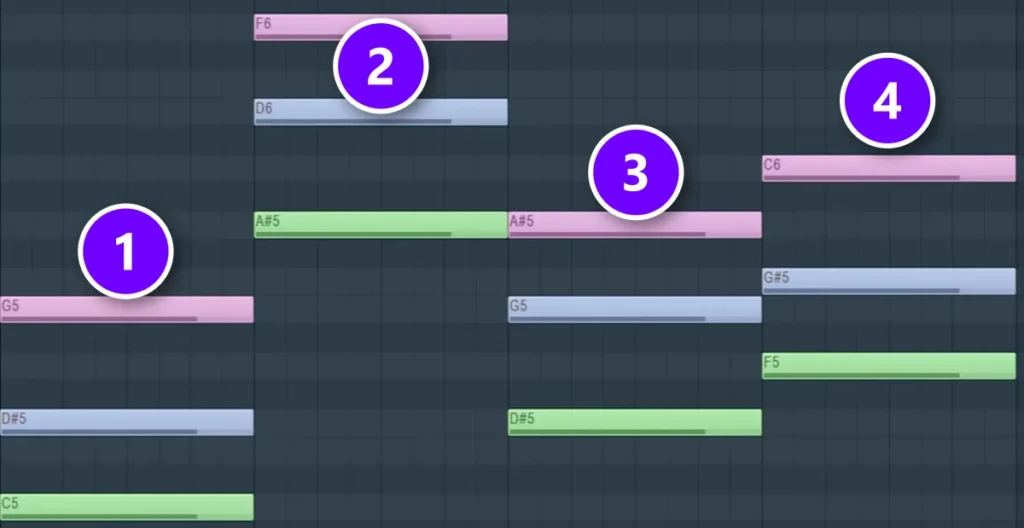
Open the Piano Roll, right-click the note icon in its toolbar and pick Minor Natural (Aeolian), so FL Studio highlights the notes of the scale. Count up the highlighted rows from C and put one root note in each bar: for 1-7-3-4 that’s C, B♭, E♭ and F. Then stack two more notes on every root by skipping one highlighted row each time.
That gives you plain triads: Cm (1), B♭ (2), E♭ (3) and Fm (4). Add a 7th and a 9th on top the same way, and mute them for now with Alt + M. It will sound plain, maybe even bad. That’s normal.
Step 2: Put the third on top and add a pedal note
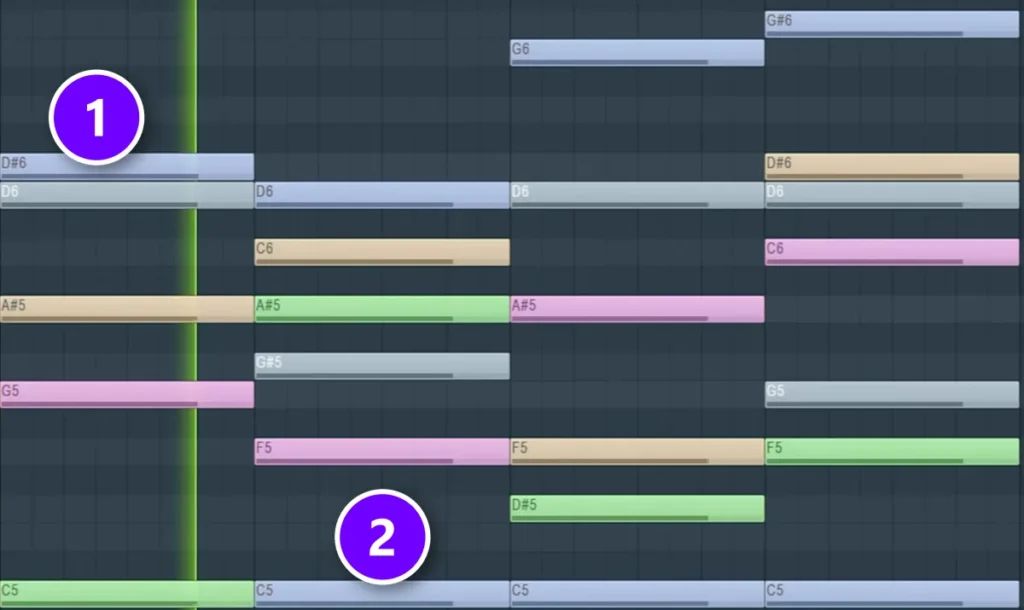
Bring the notes of each chord close together, so the chords move in small steps instead of jumping around. Moving a note up or down an octave like this turns the chord into an inversion. Ctrl + Up Arrow or Down Arrow moves selected notes up or down an octave. Then make the third, the middle note of the triad, the highest note of every chord (1). Max says: “The third note of a chord defines whether it’s major or minor.” With the third on top, you always know where it is.
Now unmute the 7ths and 9ths one at a time with Alt + Shift + M, and keep the ones you like. As Max puts it: “Not every one will sound great. That’s why you just need to listen.”
Last, hold Shift and drag the root notes two octaves down, from C5 to C3, to copy them into a bass. Then add a pedal note, one note that keeps playing under the whole progression (2). The root, C, works well. Our guide to writing bass lines shows where to take the low end from there.
Step 3: Pick a soft, emotional sound
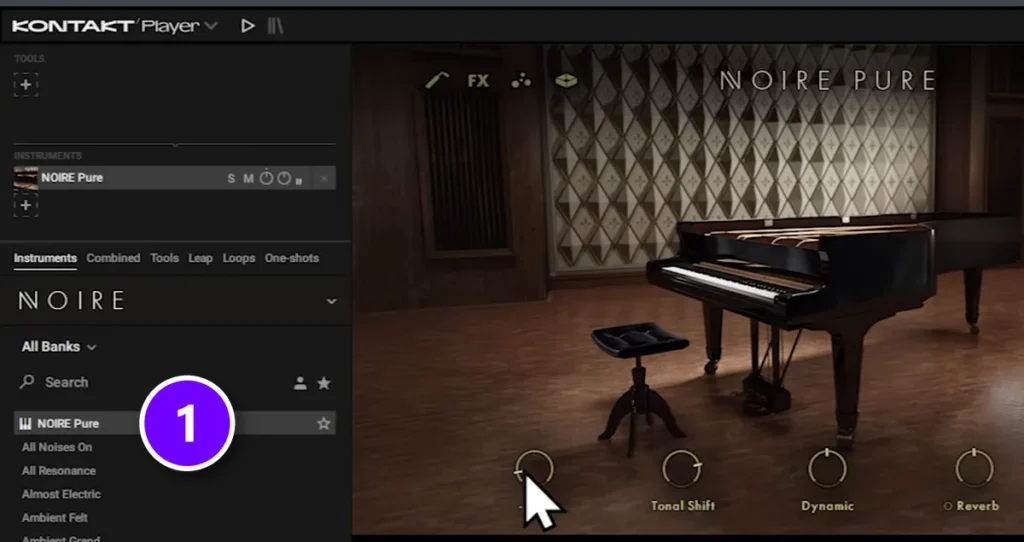
The sound changes how chords feel more than most beginners expect. In FL Studio’s own FL Keys, pick the grand piano and turn the hardness down a little, and do the same in any piano plugin. For really emotional, soft chords, the pick in the video is Noire by Native Instruments (1), a grand piano that runs in Kontakt.
If your sound is less realistic, make it feel played. Press Shift + R a couple of times to select random notes, then hold Alt and scroll down to lower their velocity, how hard each note is hit. Repeat that with timing too, nudging a few notes a pixel or two off the grid.
Step 4: Push two chords half a beat early
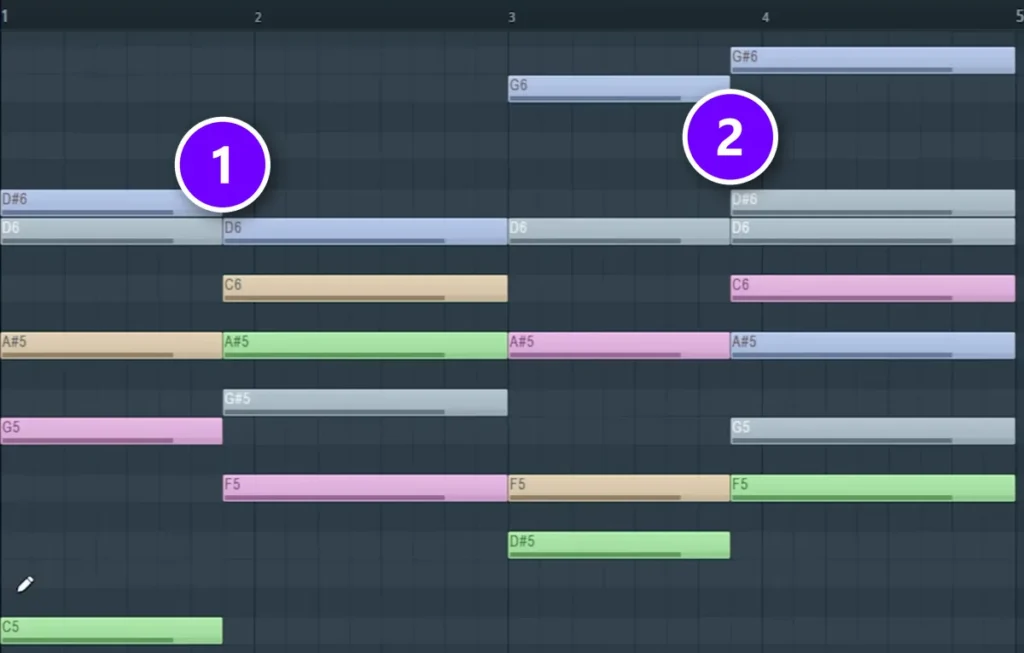
Chords that all land exactly on beat one sound stiff. Select the second chord and move it half a beat earlier, so it starts just before the bar line (1), then do the same with the fourth chord (2). Shift + Left Arrow moves a selection back one grid step. It’s a small move. Now the loop leans forward the way a real player would play it.
Step 5: Change the key, then make one chord major
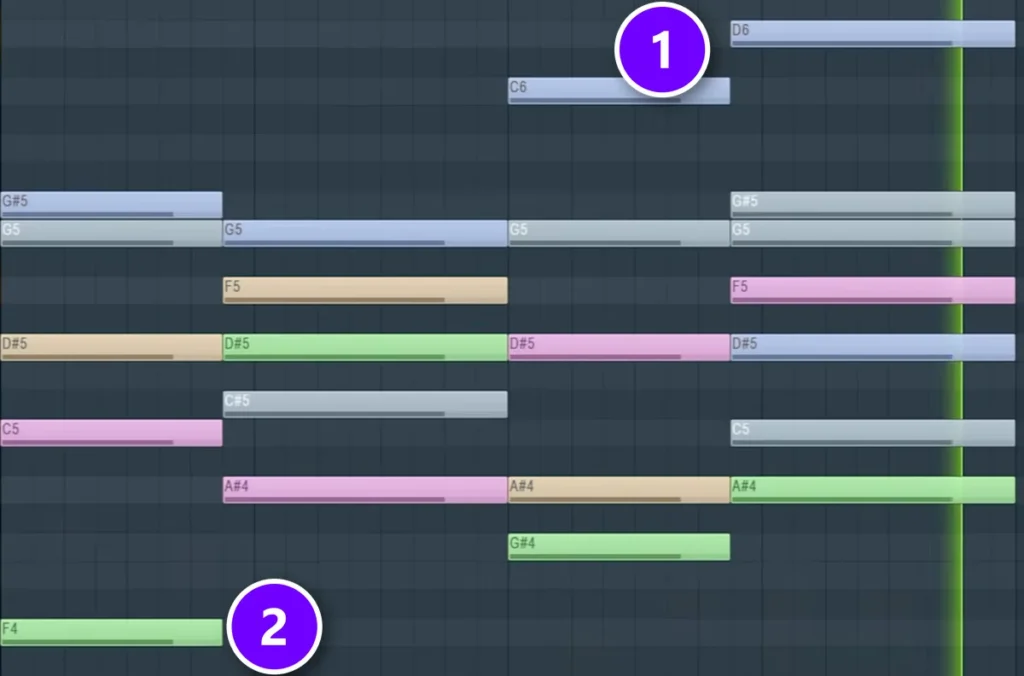
If it still sounds generic, try a new key. The loop is still in C, so select everything with Ctrl + A and move it all down seven semitones with Shift + Down Arrow. Now the first chord starts on F (2), and the progression is in F minor.
Then comes the move the video calls the top 1%: make one chord major. Because the third sits on top of every chord, you only raise that top note by one semitone. It usually works best on the last chord, so B♭m becomes B♭ (1). Test it on the others too.
To finish, the video adds a vocal ambience layer, an arpeggio and, most of all, a melody played in sixths, two notes a sixth apart, like C with the A above it. Four plain triads have turned into something that sounds like a song.
The best chord progressions for each mood
Still not sure where to start? Pick the feeling you want, then run that progression through the five steps above.
- Happy, bright pop: 1-5-6-4 or 1-6-4-5.
- Sad but hopeful: 6-4-1-5.
- Dark and emotional: the 1-7-3-4 from the video, with the last chord made major.
- Cinematic or anime: the Royal Road (4-5-3-6) or the Andalusian cadence.
- Trap and drill: i–VI, i–iv or i–v, two chords for 8 bars.
- House and EDM: i7–iv7 for deep house, i–VI–III–VII for big drops.
- R&B and lo-fi: 2-5-1 or 1-6-2-5, always with seventh chords.
Whichever you choose, the progression is only the start. Voice it close, push one chord, pick a soft sound and surprise the ear once. That’s Mix Elite’s method in one line.
DAY 2 OF THE 7-DAY MUSIC PRODUCER COURSE
Write your own progressions with the Day 2 formula
Day 2 of Mix Elite’s 7-Day Music Producer Course covers music theory, chords and melodies: the 3-step chord progression writing formula, 4 easy ways to write melodies even if you’ve never touched a keyboard, and where to find pro-quality instruments. You also download 30+ of the best chord progressions to start from. It’s taught in FL Studio (you can follow along in the free trial), about 45 minutes a day, and on day 7 a pro gives you feedback on your finished track. It’s $27, and you get 60 days to decide if it was worth it.
Frequently asked questions
What are the best chord progressions for beginners?
Start on the white keys, in C major or A minor, so every note fits. The 1-5-6-4 (C, G, Am, F), 6-4-1-5 (Am, F, C, G) and 1-4-5 (C, F, G) progressions are the easiest to play and the easiest to write a melody over. Loop one for 8 bars, then use the five steps on this page to make it sound finished.
What is the most popular chord progression?
The most popular one is I–V–vi–IV, often called 1-5-6-4: C, G, Am and F in C major. Songs like “Let It Be” and “No Woman, No Cry” use it, and its rotation vi–IV–I–V (Am, F, C, G) is almost as common. Because so many songs share it, the way you voice, time and color the chords decides whether it sounds fresh or generic.
What chord progressions sound dark, sad or chill?
For dark, loop two minor chords, like Cm and Fm (i–iv). For sad, start on a minor chord: vi–IV–I–V (Am, F, C, G) or the Andalusian cadence (Am, G, F, E). For chill, use seventh chords, like the 2-5-1 (Dm7, G7, Cmaj7). A soft sound and a slow tempo push any of them further.
How do I make my chords sound less boring?
Change one thing at a time. Add a 7th or 9th, try a sus2 or sus4 chord, use inversions so each chord sits close to the last, push one chord half a beat early, or turn one minor chord major. Then pick a softer sound. Small changes like these make a basic loop sound finished.
Does FL Studio have a chord progression generator?
Yes. Recent versions of FL Studio have a Chord Progression tool in the Piano Roll. Press Alt + P to open it, generate a progression, and move the Conventional to Adventurous slider for plainer or jazzier chords. It’s great for ideas, but a generated progression still needs the five steps on this page (voicing, sound, timing and one major chord) to sound finished.