


“There’s only so many notes and very few chords used in pop music.”
A music scale is a set of notes, in order, that sound good together. The three scales beginners should learn first are the major scale (bright and happy), the natural minor scale (darker, and more popular than major in today’s pop, hip-hop and electronic music) and the pentatonic scale (five notes that are hard to get wrong).
You can make a whole beat without knowing a single scale. Then you try to add a melody, and every note you click sounds a little bit wrong.
That’s the moment scales fix. This guide to music scales for beginners keeps it to what a producer needs: three scales, two simple formulas, and a piano roll that does the hard part for you. It follows a 17-minute music theory crash course by Max, the founder of Mix Elite, with real FL Studio screenshots from his videos.
Table of Contents
What are music scales?
A music scale is a set of notes played in order from low to high, picked from the 12 notes of an octave by a fixed pattern of whole and half steps. Most scales use seven notes. The scale you pick decides which notes sound right together in your melodies and chords.
The word comes from the Latin scala, which means ladder: the notes climb one rung at a time. A piano repeats the same pattern every 12 keys. Those 12 notes make an octave, and they’re all the notes Western music uses. A scale picks some of them, usually seven.
Max explains it with a painting idea: “We just use seven notes that create a scale. It’s like picking certain colors to paint a picture.” Pick your colors first, and everything you paint with them will match.
The first note of a scale is the root note, also called the tonic. It gives the scale its name, so a major scale that starts on C is C major. The other notes are numbered up from the root as scale degrees: 1, 2, 3 and so on to 7. After the 7th, the root comes back one octave higher.
Music scales for beginners: which scales should you learn first?
Learn three: the major scale, the natural minor scale and the pentatonic scale. Start with C major and A minor, because both use only the white keys, then add the pentatonic for melodies that are hard to get wrong. Natural minor is the one you’ll use most for trap, drill, hip-hop and R&B.
After those, this order adds one new idea at a time. Stop whenever you have enough to write with:
- C major, because it’s all white keys.
- A natural minor, the same white keys starting on A, so it sounds darker.
- The pentatonic scales, five-note versions of the two above.
- Harmonic minor, one changed note that makes minor more dramatic.
- The modes, later, once the first four feel easy.
Each scale below comes with a real screenshot from Mix Elite’s videos, so you can see the pattern of notes and copy it.
Half steps and whole steps: the scale formula
A scale formula is the pattern of whole steps and half steps between a scale’s notes, and those are the only two distances you need. A half step, also called a semitone, is the move from one key to the very next key, black or white. A whole step is two half steps.
Every scale is a recipe of those two steps. Write the recipe down once, and you can build that scale from any root note:
- Major: whole, whole, half, whole, whole, whole, half.
- Natural minor: whole, half, whole, whole, half, whole, whole.
- Harmonic minor: whole, half, whole, whole, half, one and a half, half.
- Major pentatonic: whole, whole, one and a half, whole, one and a half.
- Minor pentatonic: one and a half, whole, whole, one and a half, whole.
You don’t have to memorize these to make music. They just explain why each scale sounds the way it does, and they help when a tutorial says something like “go up a whole step.”
The major scale: bright and happy
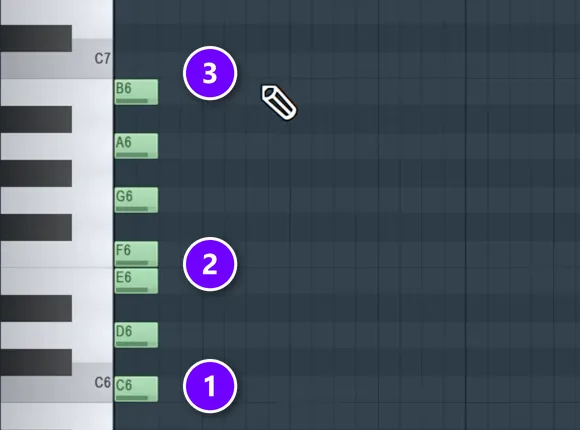
The major scale is the one to learn first, because in C it uses only the white keys. In Mix Elite’s theory video, it’s drawn in the piano roll from C6 (1) up to B6: C, D, E, F, G, A and B.
Look at where the half steps fall: between E and F (2), and between B and C (3). There’s no black key between those pairs. Everywhere else the scale skips over a black key, which makes a whole step.
Major scales sound happy and bright, and that’s the sound of a lot of feel-good pop. Start the same recipe on E and you get E major. It needs four black keys, but it sounds just as bright.
The natural minor scale: darker and more serious
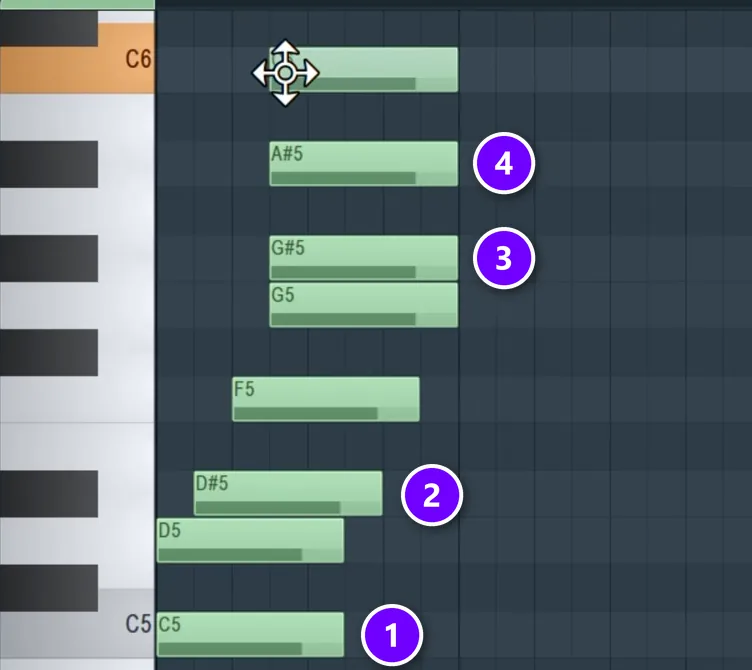
Minor scales sound more serious or sad, and they’re the ones you’ll use most as a producer. As the video points out, minor is the more popular choice today in pop, hip-hop, R&B and electronic music.
Here’s C natural minor in the piano roll: C (1), D, D# (2), F, G, G# (3) and A# (4). Compared with C major, three notes drop by a half step: the 3rd, the 6th and the 7th. That lower 3rd (2) is what makes it sound minor. FL Studio names black keys with sharps, so D# is the same key as E flat.
There’s a shortcut worth knowing. A natural minor uses the same notes as C major, just starting on A. Every major scale has a minor twin like this, called its relative minor. It starts three half steps below the major’s root.
Harmonic minor: one changed note, more drama
Harmonic minor is natural minor with one change: the 7th note goes up a half step. In C, A# becomes B. That raised note pulls hard back to the root, and it gives a melody a darker, more dramatic edge.
It’s Max’s pick: “The most common one is minor natural and minor harmonic, which is my personal favorite.” In Mix Elite’s free 4.5-hour FL Studio course, the whole trap loop is written in C# harmonic minor. If you make drill or trap, our drill melody guide shows the same dark sound in action.
You may also see a third version, melodic minor, which raises both the 6th and the 7th note when the melody goes up. You can skip it for now.
The pentatonic scale: five notes, hard to get wrong

Pentatonic means five notes. Take a major or minor scale, leave out the two notes that clash the most, and you get a scale where almost any order of notes sounds fine.
- Major pentatonic: the major scale without its 4th and 7th. In C, that’s C, D, E, G and A.
- Minor pentatonic: the natural minor without its 2nd and 6th. In A, that’s A, C, D, E and G.
- Blues scale: the minor pentatonic plus one extra note between the 4th and 5th. In A, the extra note is D#.
Some music teachers use the same trick with kids. They take the F and B bars off a xylophone, and every bar that’s left belongs to C major pentatonic, so nobody can hit a wrong note. It’s the fastest scale for jamming a hook without thinking.
What about chromatic and whole tone scales?
You’ll see two more names in tutorials. The chromatic scale is all 12 notes in a row, each a half step apart. It’s less a scale for melodies and more a way to slide between notes in runs and fills.
The whole tone scale uses only whole steps, so it has six notes. It sounds dreamy and unsettled, a bit like a flashback in a movie. Both are fun to try, but neither is where a beginner should start.
How do you choose a scale for a song?
Start with the feeling you want, then let your genre and samples narrow it down:
- Bright, happy or uplifting: major.
- Dark, moody or serious: natural minor, the safe default for trap, drill, house and most pop.
- Dramatic or exotic: harmonic minor.
- Simple and catchy, or you’re jamming: pentatonic.
- You’re using a sample or loop: match its key. Most sample packs put the key in the file name, like Cmin or F#maj.
- You’re not sure: pick C minor or A minor and start writing. You can change it later in seconds.
In the theory video, the scale comes first and the chords come after. The scale decides which chords and melodies can work, so choosing it early makes the rest of the song easier.
Why do my melodies sound out of key?
Usually because some notes fall outside the song’s key, or because they clash with the chord playing under them. A scale fixes the first problem: it narrows the 12 notes down to the 7 that belong together. For the second, put notes from the current chord on the strong beats, and save the other scale notes for the moments in between.
Here’s how to fix an off-key melody in FL Studio:
- Shade your song’s scale in the piano roll, so you can see which rows belong. The steps are in the next section.
- Snap stray notes back in. Select them and press Alt + K, and the Limit tool moves every note onto the scale.
- Land on chord notes. Turn on ghost notes with Alt + V to see your chords behind the melody, and put a chord note on each strong beat.
- End on the root. The root note, or tonic, is home. A phrase that ends there sounds finished, and one that never touches it can sound lost.
Max makes the same point about chords in the theory video: stick to the scale, build the progression and its basic chords first, and only then play with voicings, and you can’t really write a bad-sounding progression.
How to use scales in FL Studio’s piano roll
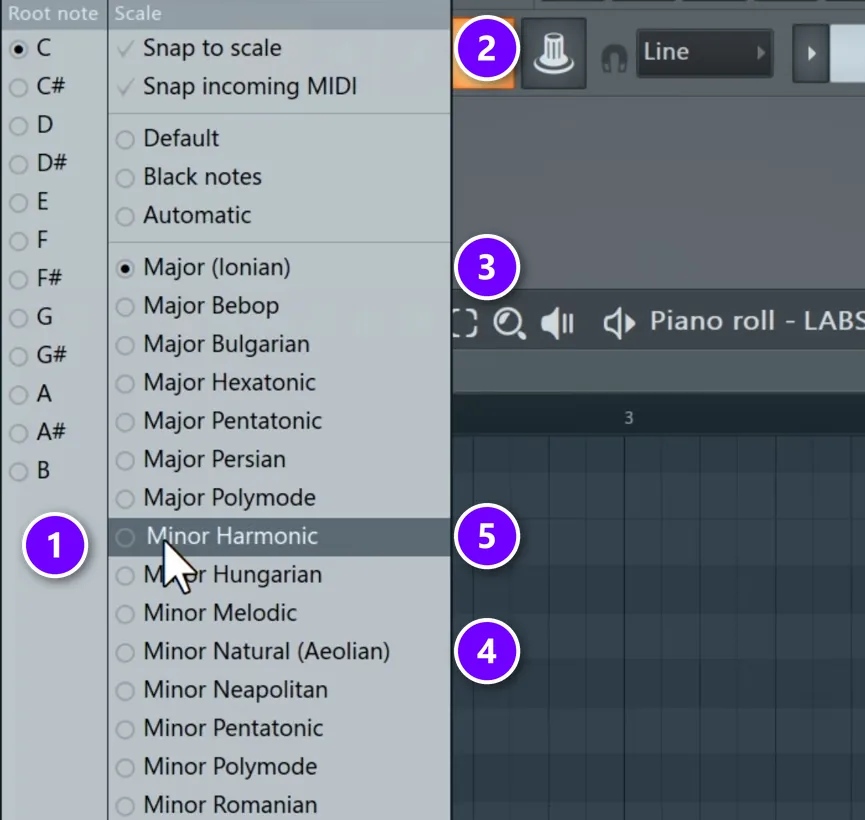
You don’t need to memorize a single formula, because FL Studio’s piano roll can light up any scale for you:
- Right-click the small note icon in the piano roll’s top bar.
- Pick your root note in the left column (1).
- Pick a scale on the right, like Major (Ionian) (3), Minor Natural (Aeolian) (4) or Minor Harmonic (5).
- The piano roll now shades the notes of that scale, and the root note row is darker.
- Want every new note to land on the scale? Turn on Snap to scale (2), or just left-click the note icon.
In the video, snap stays off on purpose. Happy accidents happen that way, and one note outside the scale is sometimes exactly the spice a melody needs. With the scale shaded, you can still see when you’ve stepped outside it.
How do you build a minor scale in the piano roll?
Count rows: each row in the piano roll is one half step, so from your root go up 2, 1, 2, 2, 1, 2 and 2 rows. Or skip the counting. Draw your idea on the white keys starting from A, which is A minor, then select every note and drag it up 3 rows to get C minor.
The quickest route of all is the scale menu above. Pick your root and Minor Natural, and FL Studio shades the right rows for you.
Change a melody’s scale with the Limit tool
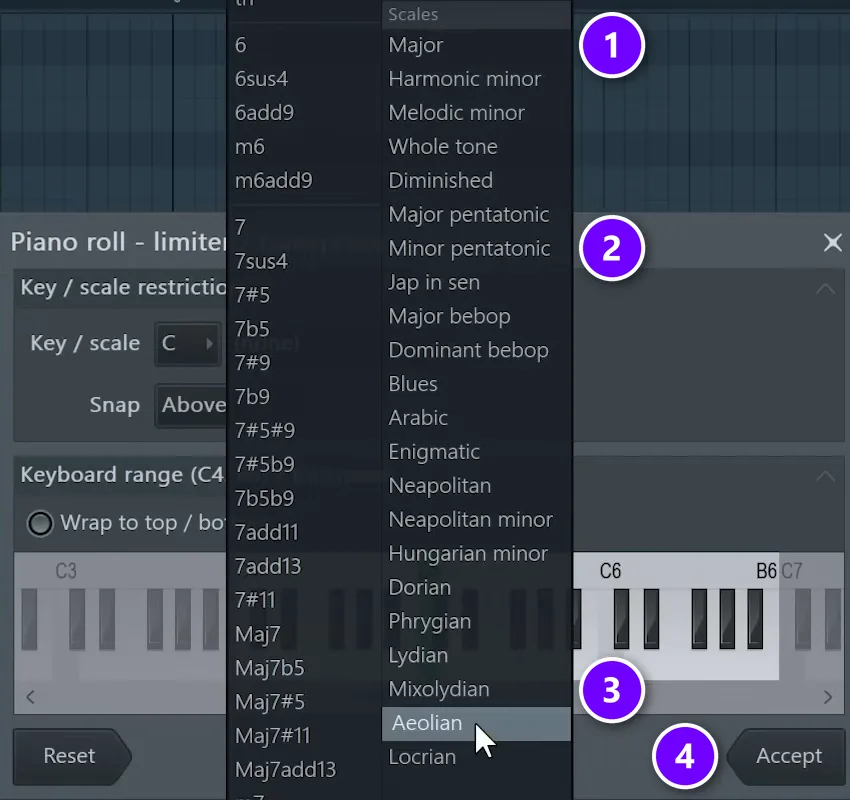
Already wrote something? Select the notes and press Alt + K to open FL Studio’s Limit tool. Set the key, pick a scale such as Major (1) or Minor pentatonic (2), and click Accept (4). Every note moves onto the new scale. The same list also holds the modes, from Dorian to Locrian (3).
Max shows it in the chord-writing video: “If you are already writing great melodies and harmonies, you can use this tool to change the scale of your track.” Try your chords in Major, then in Aeolian, and listen to how the mood flips.
Play a scale on your computer keyboard
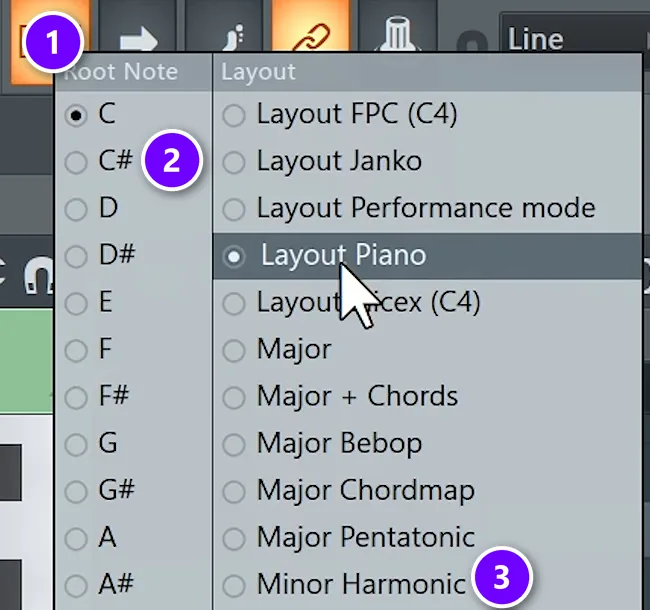
No MIDI keyboard? Right-click the typing keyboard to piano keyboard button (1), pick a root note (2) and a scale such as Minor Harmonic (3). Now every key on your computer plays a note from the scale, with the root on Z, A, Q and 1.
It’s the quickest way to hear what a scale sounds like. Play around for a few minutes, and when a phrase sticks, record it or draw it into the piano roll.
Forgot to record a great idea? FL Studio keeps a log of what you play. Go to Tools > Dump score log to selected pattern to bring back the last few minutes.
How do scales turn into chords?
A chord is three or more notes played at the same time. The simplest chords come straight from a scale: stack every other note, like the 1st, 3rd and 5th. A scale has seven notes, so it gives you seven basic chords, one starting on each note.
In C major those are C major, D minor, E minor, F major, G major, A minor and B diminished. Most songs use just four of them on repeat, and some use only two, as the video points out.
Chords from outside the scale have a name too: borrowed chords. Playing an F minor chord in a C major song, for example, borrows it from C minor and adds a bittersweet turn.
For the hands-on version, read our guide to writing chords in FL Studio with no experience. Then see how scales, chords and melodies fit together in music theory for producers.
What are the 7 modes?
Start a major scale on each of its seven notes and you get seven modes. They use the same notes, but each one feels different because a different note is home:
- Ionian: the major scale.
- Dorian: minor with a brighter 6th, smooth and a little jazzy.
- Phrygian: minor with a lower 2nd, dark and tense.
- Lydian: major with a higher 4th, floating and dreamy.
- Mixolydian: major with a lower 7th, bluesy and rocky.
- Aeolian: the natural minor scale.
- Locrian: the darkest and least stable, and rare in songs.
You don’t need modes to finish a track. When you’re ready for them, musical modes explained goes deeper.
THE 7-DAY MUSIC PRODUCER COURSE
Turn your scale into chords and melodies
Day 2 of the 7-Day course covers music theory, chords and melodies: the theory you need for fresh-sounding harmonies, a 3-step formula for writing chord progressions, and 4 easy ways to write melodies even if you’ve never touched a keyboard. You also get 30+ chord progressions and 20+ free plugins and tools. The course is $27, and you have 60 days to decide if it was worth it.
Frequently asked questions
What are the 3 music scales to learn first for making beats?
The natural minor scale, the minor pentatonic scale and the major scale. Natural minor is the sound of most trap, drill, hip-hop and R&B. The minor pentatonic keeps only five of those notes, so it’s hard to hit a wrong one, and major covers bright, happy pop. Start with A minor and C major, because both use only the white keys.
Why do my melodies sound out of key?
Usually some notes fall outside the song’s key, or clash with the chord underneath. Pick the scale your chords use and keep the melody on its notes: in FL Studio, shade the scale in the piano roll, or press Alt + K to move stray notes onto it with the Limit tool. Land on chord notes on the strong beats, and end phrases on the root.
How do I build a minor scale in the piano roll if I can’t play piano?
Count rows, because each row is one half step: from your root, go up 2, 1, 2, 2, 1, 2 and 2 rows. Or draw your idea on the white keys starting from A, which is A minor, and move every note up 3 rows for C minor. Easiest of all, right-click the note icon in FL Studio’s piano roll and pick your root and Minor Natural.
What are the 7 scales in music?
People usually mean the seven modes: Ionian, Dorian, Phrygian, Lydian, Mixolydian, Aeolian and Locrian. They all use the notes of the major scale but start on a different note, so each has its own mood. Some mean the seven notes of one scale, like C, D, E, F, G, A and B. For beginners, the scales that matter most are major, natural minor, harmonic minor and the two pentatonics.
Do I need to learn scales to make beats?
Not to start, because FL Studio can shade and snap to any scale for you. Knowing the major and minor formulas still helps you write melodies faster, pick chords that fit, and fix notes that sound off. Mix Elite’s 17-minute theory video covers the basics, and Day 2 of the 7-Day course teaches chords and melodies step by step.