


“When I hear a song come on the radio I’m not calculating what the chords are, unless I have an emotional reaction.”
Producers need only the basics: pick a key (a major or minor scale), build chords by stacking every other note of that scale, play the chord roots in your bass or 808, and write melodies from the chord notes. You can skip sheet music and most classical rules, because FL Studio’s piano roll can highlight the right notes while you learn.
Music theory for producers can sound like a wall of rules, odd words and sheet music, and it’s easy to decide it just isn’t for you. You only need a small part of it to make songs, and you can learn that part one idea at a time. This guide teaches it in the order you’ll use it, following Mix Elite’s 17-minute music theory crash course, with real screenshots from FL Studio. Build it in the right order, says Max, the founder of Mix Elite, and “there’s just no way you’ll write a bad sounding chord progression.”
Table of Contents
What is music theory?
Music theory is the set of names and patterns that explain why some notes sound good together. For producers, it comes down to a few ideas: notes and octaves, scales and keys, chords and chord progressions, melody and bass, and rhythm. Think of it as a map that helps you find good notes faster, not a rulebook.
How much music theory do you need to make beats?
Less than you think. You can make beats by ear, but a little theory makes you much faster: pick one key, build chords from its notes, put the chord roots in your bass or 808, and write a melody from the chord notes. That small set covers most pop, hip-hop, trap and electronic music.
Nobody checks your theory before they press play. What theory gives you is speed. Instead of clicking random notes until something sounds right, you know which 7 of the 12 notes fit your song and which chords you can build from them.
And theory won’t make your music sound like a formula. It explains why things sound good, and it doesn’t stop you from breaking the rules. Max even keeps FL Studio’s snap-to-scale tool off most of the time, because he likes the happy accidents he gets from notes outside the scale.
What music theory can you skip as a beginner?
Skip sheet music at first: the staff, the clefs and the note symbols are for players who read music off paper. Counterpoint, rare scales and modes, and odd time signatures can wait too, because most pop, hip-hop and electronic music uses major or minor scales and four beats to a bar.
In a DAW (a digital audio workstation, the program you make songs in, like FL Studio), every note is a bar on a grid that you can see, hear and drag. So you never need to read a note off a page to write a good song.
Music theory for producers: what to learn first
Think of it as music theory for beginners, trimmed down to what a producer really uses. Learn it in the order you’ll use it, because each step builds on the one before:
- Notes and octaves: the 12 notes that repeat up the keyboard.
- Half steps and whole steps: the distance between two notes.
- Major and minor scales: the 7 notes that fit your song.
- Keys: a scale plus its home note, like C minor.
- Chords: three or more scale notes played together.
- Chord progressions: chords in a row, counted with Roman numerals.
- Melody, bass and rhythm: what goes on top, what goes underneath, and when it plays.
The video below covers most of this list, building every chord live in FL Studio.
Notes and octaves: the 12 keys that repeat
Everything starts on a piano keyboard. The white and black keys are the notes, and just like letters make words and sentences, notes come together to make melodies and chords.
Look closely and you’ll see a pattern that repeats every 12 keys. Those 12 notes make an octave. Once you pass the 12th key, the pattern starts over at a higher pitch, so the next C sounds like the first C, only higher.
The white keys use the letters A to G. Each black key borrows the name of a white key next to it, plus a sign. C# (C sharp) is the black key just above C, and Db (D flat) is the same key, seen from the D side. In the screenshots below you’ll see names like C5 and G#6. The letter is the note. The number is the octave.
What are half steps and whole steps?
The distance from one key to the very next one, white or black, is a half step, also called a semitone. Two half steps make a whole step. C to C# is a half step. C to D is a whole step. E to F is a half step too, because there’s no black key between them.
Why care? Tutorials use these words all the time, and they’re how scales are built. Every scale is just a recipe of whole and half steps.
Major and minor scales: which notes fit your song
You almost never use all 12 notes in one song. You pick 7 of them, and that set is a scale. It’s like choosing a few colors before you paint a picture: the scale sets the mood. The two you need are major, which sounds happy and bright, and minor, which sounds more serious or sad.
- Major: whole, whole, half, whole, whole, whole, half. Start on C and you get C D E F G A B, all white keys. C is the root, the note the scale is built from, so this is C major.
- Natural minor: whole, half, whole, whole, half, whole, whole. Start on A and you get A B C D E F G, the same white keys, so this is A minor.
Notice that C major and A minor share the same 7 notes. Every major scale has a minor twin like this, called its relative minor, which starts three half steps lower. Only the home note changes, and with it the mood.
Which one should you use? Max’s answer: “In today’s music, pop, hip-hop, R&B, and any electronic music, minor scale is definitely more popular.” There are a few kinds of minor. The two you’ll meet most are natural minor and harmonic minor, which raises the 7th note by a half step. They differ by only one or two notes, and harmonic minor is his personal favorite.
How do you use scales in the piano roll to stay in key?
Pick one key, then turn on the scale helper in every piano roll you use: chords, melody and bass. FL Studio highlights the notes that fit, and snap to scale stops you from placing any others. Build chords on the highlighted rows, play the chord roots in the bass, and write the melody from chord notes.
How to show a scale in FL Studio’s piano roll
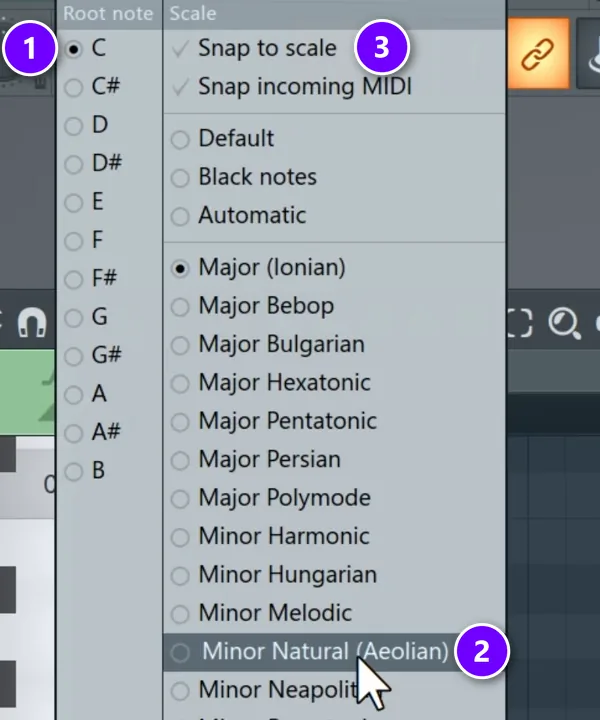
You don’t have to memorize the whole-step and half-step patterns, because FL Studio’s piano roll can light up the right notes for you. Right-click the small note icon in the piano roll’s toolbar to open the scale menu.
- Pick the root note on the left (1).
- Pick the scale, for example Minor Natural (2). The rows of your scale get highlighted, and the root note is marked darker.
- Left-click the same icon to turn on Snap to scale (3). Now FL Studio only lets you place notes on scale rows, which is handy when you want to work fast.
The menu also lists names like Major (Ionian) and Minor Natural (Aeolian). Those are modes, which you can learn later.
Then keep every part of the song in that one key:
- Chords: build them only on highlighted rows, as shown in how to build chords from a scale.
- Bass or 808: play the root note of each chord, an octave or two lower.
- Melody: build it from the chord notes, which you can see as ghost notes with Alt + V.
- Samples: pick loops and 808s whose file name shows your key, or check a sample’s key with a free key finder such as Tunebat.
- Vocals: set your pitch correction plugin to the same key and scale.
- Typing keyboard: set FL Studio’s computer-keyboard piano to the same root and scale, so every key you press plays a note that fits.
What is a key? (and the circle of fifths)
A key is a scale plus its home note. C minor means the notes of the minor scale, starting on C, with C as the note that feels like home. When a producer says a beat is in C minor, every chord, melody and bass note comes from those 7 notes. That’s also why loops and 808 samples often have their key in the file name.
The circle of fifths is a map of all 12 keys. Picture a clock with C major at the top. Each step clockwise jumps up a fifth (7 half steps) and adds one sharp: G, D, A, E, B. Each step counterclockwise adds one flat: F, Bb, Eb, Ab, Db. At the bottom, F# and Gb meet as the same key.
| Major key | Sharps or flats | Relative minor |
|---|---|---|
| C | none | A minor |
| G | 1 sharp | E minor |
| D | 2 sharps | B minor |
| A | 3 sharps | F# minor |
| E | 4 sharps | C# minor |
| B | 5 sharps | G# minor |
| F# / Gb | 6 sharps / 6 flats | D# / Eb minor |
| Db | 5 flats | Bb minor |
| Ab | 4 flats | F minor |
| Eb | 3 flats | C minor |
| Bb | 2 flats | G minor |
| F | 1 flat | D minor |
Here’s how producers use it:
- Find chords that fit. The two keys next to yours are your 4 and 5 chords. In C major, that’s F and G.
- Find the relative minor. Each major key shares all its notes with one minor key, listed in the right column.
- Change key smoothly. Neighbors on the circle share all but one note, so a move of one step sounds natural.
- Borrow a chord. A chord from a nearby key adds color without sounding wrong.
You don’t need to memorize the circle to make beats. It earns its place later, when you want to change key or borrow a chord.
How to build chords from a scale
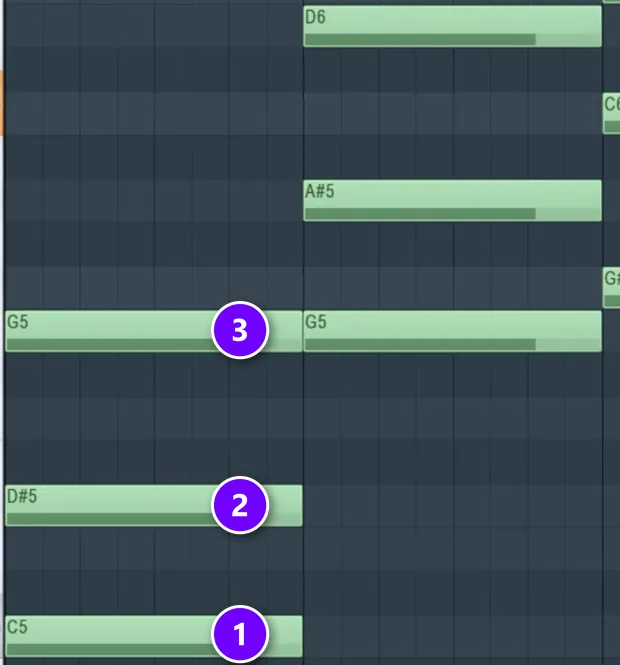
A chord is three or more notes played at the same time. The easy way to build one is to stack every other note of your scale. The method is called “skip one, place one”: start on a root note, skip the next scale note, place one, skip one, place one.
In the screenshot, the scale is C minor.
- The root is C (1).
- Skip D and place D# (2).
- Skip F and place G (3). That’s a C minor chord.
The next chord does the same thing from G, giving G, A# and D.
Because you only stack scale notes, the scale decides whether each chord comes out major, minor or diminished (a tense, unstable chord), so you don’t have to work it out. A 7-note scale gives you 7 basic chords. If the chords end up too high, select everything and press Ctrl + Down arrow to move them all an octave lower.
Add a 7th for a richer chord
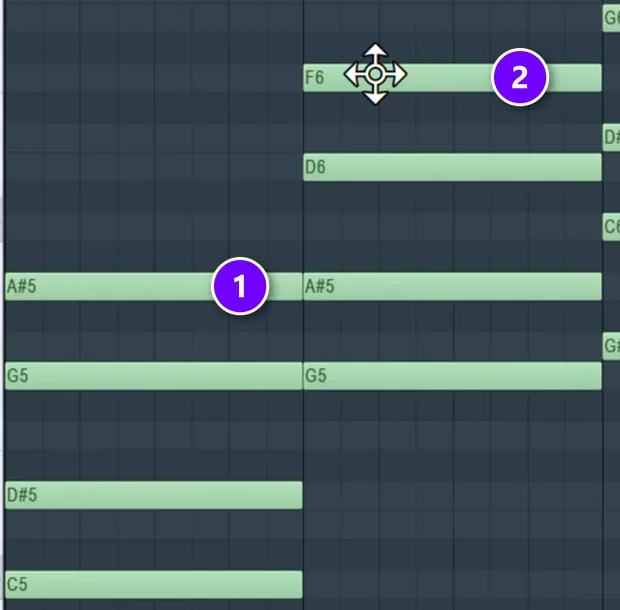
Stack one more note the same way, skip one and place one, and you get a four-note chord called a 7th, because the new note is seven scale notes up from the root. In the screenshot, A# is the 7th on the C chord (1) and F is the 7th on the G chord (2). It instantly sounds richer and a little jazzy. Piling on even more notes doesn’t always make a chord sound better, so let your ears decide.
Double the root and fix the voicing
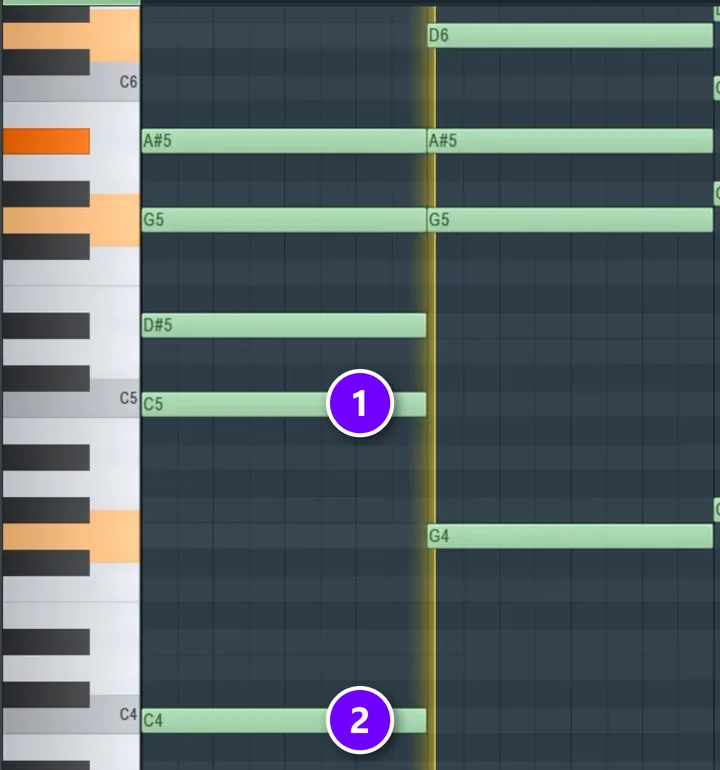
Two small moves make plain chords sound finished. First, copy each root note an octave lower to make the chord fuller. Here C5 is the root (1) and C4 is its copy (2). To copy them:
- Hold Ctrl + Shift and click each root to select it.
- Hold Shift and drag to copy the notes.
- Drop the copies one octave down.
Second, fix the voicing, which is the octave each note sits in. If the top note jumps far from one chord to the next, the chords sound jumpy. Hold Ctrl, drag a box around the high notes and press Ctrl + Down arrow to drop them an octave. Same notes, smoother flow.
How chord progressions work (Roman numerals)
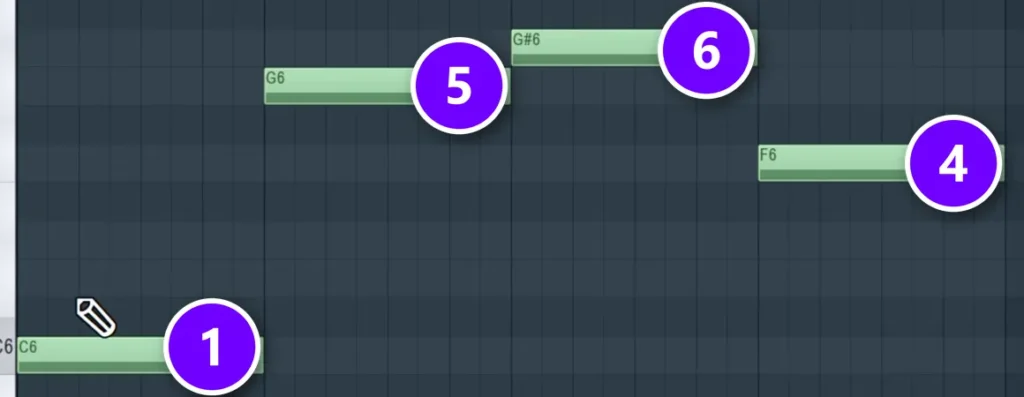
A chord progression is a few chords played one after another, usually on repeat. It’s the backbone of your song. Most songs use just four chords on a loop, and some use only two.
For ready-to-use progressions by mood (happy, sad, dark and chill), see chord progressions that sound good.
Musicians count chords with Roman numerals. Count up the scale notes from your root, and the root is 1. A classic first example is 1, 5, 6 and 4. In C minor, that’s C (1), G (5), G# (6) and F (4). Place those four root notes first, then build a chord on each one with skip one, place one.
Which root notes should you pick? There are no fixed rules. In the lesson, 1, 2, 3, 4 and then a totally random set both sounded good once the chords were built and voiced. Still, as Max says, “The hard part is getting the right progression because it will define the vibe of your track.” Three progressions from the lesson to start with:
- 1, 5, 6, 4 in C minor, the first example.
- 1, 6, 2, 5 in C# major, which works for a ballad or a happier track.
- 1, 6, 2, 5 again in C# minor, with harmonic minor on the last chord.
That last one is worth a closer look. In natural minor, the final chord sounds a little off, so the lesson switches to harmonic minor, which raises one note and fixes it. The result works for melodic trap or any emotional kind of song. For the full click-by-click method, see our guide on how to make chords in FL Studio.
How do you make chord progressions sound more emotional?
Change how the chords are built and played, not just which chords you pick. Add 7ths and 9ths, keep the notes close together so the chords flow, hold one bass note under the changing chords, and try making one chord major in a minor key, usually the last one. A softer sound and a looser feel help too.
Mix Elite’s video on emotional chord progressions turns a plain minor loop into something much moodier with a handful of moves. None of them needs sheet music:
- Add 7ths and 9ths. Stack one or two more notes on each chord with skip one, place one.
- Pull the notes close together. Drop high notes an octave (Ctrl + Down arrow) so each chord moves only a little to the next one. Try putting each chord’s middle note, called the third, on top.
- Mute a few notes and listen. Turn notes off and back on one at a time, and keep only what sounds good.
- Put the root two octaves lower, under the chord, for a deeper sound.
- Hold one note through the whole loop. This is called a pedal note, and the root works well. It’s the same trick as holding the first bass note for a darker mood.
- Make one chord major. In a minor key, raise the third of one chord by a half step, usually the last chord. It’s the same idea as the harmonic minor switch above.
- Play it softer and looser. Pick a softer piano sound, vary the velocities a little, and nudge a chord half a beat off the grid.
How to write a melody that fits your chords
A melody is the part people hum. The simplest way to write one that fits is to build it from notes that are already in your chords. Mix Elite’s free 4.5-hour FL Studio course shows four ways to write melodies, and this is the first and easiest one.
For the whole method, step by step, read how to write a melody.
Show your chords as ghost notes
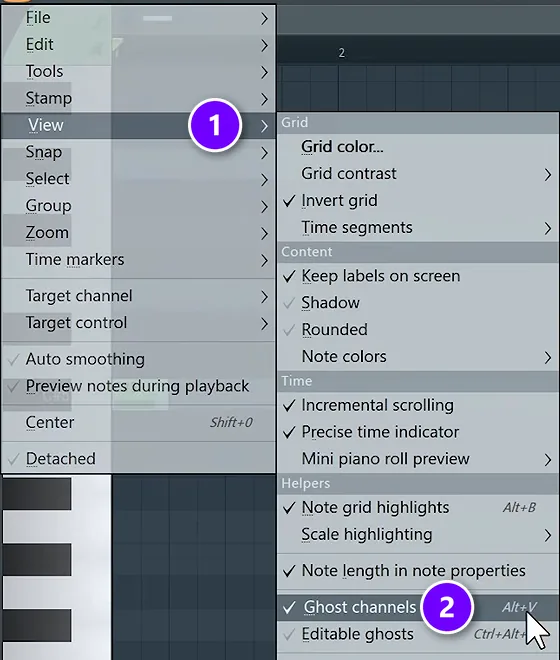
Open the piano roll for your melody instrument.
- Click the menu at the top left and go to View (1).
- Turn on Ghost channels (2), or press Alt + V.
The chord notes from your other patterns now show up as faint gray notes behind your melody.
Use chord notes, and change the rhythm every bar
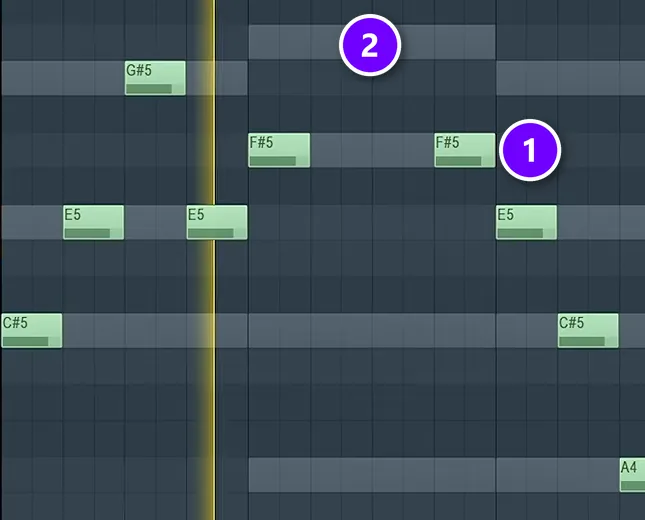
Now place melody notes on top of the gray ghost notes (2), like the F#5 note here (1). A small step off a chord note is fine too, as long as you stay in the scale. The bigger rule is rhythm: never keep it the same all the time. Give every bar a slightly different rhythm.
Two more tricks from the same lesson. Write a short idea, copy it two or three times, and change it in the last bar, like a question and an answer. And when a bar doesn’t sound right, change one note at a time instead of starting over.
For a darker style, see how to make UK drill melodies.
How to write a bass line from the chord roots
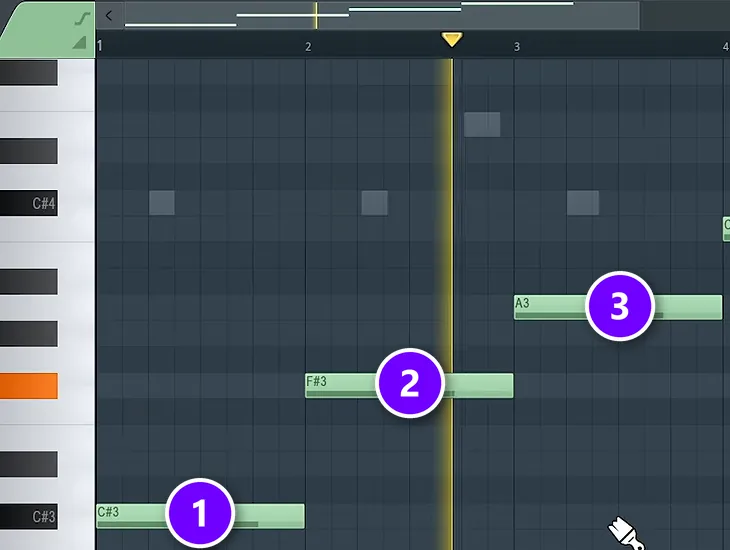
The bass line is the easiest part, because theory has already done the work. Play the root note of each chord, an octave or two below the chords. Here the bass follows the roots C# (1), F# (2) and A (3), and the faint gray notes above it are ghost notes.
Lost track of the root? Listen for the note that sounds like home over the chord. For a darker mood, hold the first root note while the chords above it change.
Don’t go too deep. Keep the bass one or two octaves under the chords and no lower, because lower than that it starts to sound weak.
For more ideas, read how to write bass lines and these tips for better basslines in FL Studio. In a trap beat, the bass is usually an 808, which follows the kick drum as well as the chords.
THE 7-DAY MUSIC PRODUCER COURSE
Learn chords and melodies on Day 2
On Day 2, Mix Elite’s 7-Day course teaches music theory, chords and melodies: the theory you need for fresh harmonies, a 3-step formula for writing chord progressions, 4 easy ways to write melodies even if you’ve never touched a keyboard, and where to find good instruments, paid and free. You also get 30+ chord progressions and 20+ free plugins and tools. It’s $27 for all seven days, and you have 60 days to decide if it was worth it.
Rhythm basics: bars, beats and BPM
Rhythm is the timing of all those notes. Most pop, hip-hop and electronic music counts four beats to a bar, which is what 4/4 time means. In a drum grid, each beat splits into four steps, so one bar has 16 steps.
Tempo is how fast those beats go, measured in BPM (beats per minute). As a rule of thumb, every style sits somewhere between 90 and 160 BPM. Trap is usually around 140, not 130.
Drums are where rhythm matters most. Our guide on how to make beats shows exactly where every kick, snare and hi-hat goes in a trap pattern.
Song structure: sections and bars
Form is the order of the sections in a song. Pop songs use verses, a chorus and sometimes a bridge, while beats usually talk about the hook and the verse. Sections are counted in bars, often 8 or 16 at a time.
A simple layout for a trap beat is an intro, a hook, a verse and a hook again, each 16 bars long, then a short outro. For a longer song, add a second verse before the outro. To turn a loop into those sections, see how to arrange loops into a full song.
Scales and modes to learn next
Once major and minor feel easy, there’s more to explore. Modes are the 7 scales you get when you start the major scale on a different note. Dorian, for example, is a minor scale with one brighter note. The pentatonic scale uses only 5 notes, which makes it very hard to play a wrong one. You don’t need any of these for your first songs.
When you’re ready, start with our beginner guide to music scales, then read musical modes explained.
How to practice music theory as a producer
Theory sticks when you use it the same day. The free course ends its chord and melody lesson with homework: write a few progressions, each in its own pattern, and a simple melody for each. Stretched into a short routine, it looks like this:
- Pick one key, like C minor, and stay in it for the week.
- Write three or four chord progressions, each in its own pattern.
- Build the chords with skip one, place one, then fix the voicing.
- Write a short melody over each one, using notes from the chords.
- Add a bass line on the roots.
- Put drums under your favorite one and turn it into a beat.
Two habits speed it up. Learn the theory behind songs you already like: find their key and count their chords. And try every new idea in FL Studio right away, so you hear it instead of just reading about it. If you’re new to the program, start with our FL Studio beginner guide.
Frequently asked questions
How much music theory do you need to make beats?
Only the basics: one key (a major or minor scale), chords built by stacking every other note of it, bass notes on the chord roots, and a melody made from chord notes. You can skip sheet music, counterpoint and rare modes at first. FL Studio’s piano roll can highlight the scale, so you learn while you make beats.
How do you make chord progressions sound more emotional?
Add 7ths and 9ths, keep the notes close together so the chords flow, and hold one bass note under the changing chords. In a minor key, try making the last chord major by raising its middle note a half step. A softer piano sound and slightly varied velocities make it feel more human.
How do you keep the bass, chords and melody in the same key?
Pick one key and turn on the scale helper in every piano roll. Build chords only on highlighted notes, play the chord roots an octave or two lower for the bass, and write the melody from chord notes shown as ghost notes. Pick samples labeled with the same key, or check them with a key finder.
What is music theory?
Music theory is the language that explains how music works: which notes sound good together and why. It covers notes and octaves, scales and keys, chords and chord progressions, melody, rhythm and song form. Producers don’t need all of it, just the parts that help them pick the right notes faster in the piano roll.
What music theory should a producer learn first?
Learn it in the order you use it: notes and octaves, half and whole steps, major and minor scales, keys, chords and chord progressions, then melody, bass and rhythm. That covers most of what you need for pop, hip-hop, trap and electronic music. Sheet music, counterpoint and rare scales can wait until much later.