
“Candor could not be more crucial to our creative process. Why? Because early on, all of our movies suck.”
The best way to get feedback on your music, and the fastest way to improve, is regular notes from an experienced producer on your own songs, plus a way to ask follow-up questions. Mix Elite Academy is built around exactly that, with unlimited 1:1 feedback on your music, weekly live coaching calls and a community, for 3 payments of $137 with lifetime access. After that, in order of how much they help: Reddit and Discord feedback threads, honest listeners, reference tracks with a checklist, paid one-off mix critiques and AI tools.
You’ve looped the same drop so many times tonight that you can’t tell anymore if it’s good. That’s normal. After enough plays, your ears stop noticing the muddy bass and the vocal that sits a little too far back, while someone who hears the song for the first time catches both in seconds.
This guide shows how to get feedback on your music that you can actually use: where to send it, what to ask, what AI tools are good for, and the mistakes feedback catches most often.
One note before you start: Mix Elite Academy is our own school. Every fact about it below comes from its live page, checked on November 1, 2026.
Table of Contents
What’s the best way to get feedback on your music?
Get notes on your own songs from someone who makes music at a high level, again and again, and make sure you can ask them questions back. One experienced producer who hears every song you make will teach you more than a hundred strangers who each hear one song once.
Most of what holds a beginner’s song back is easy to fix once someone points at it. Max, the founder of Mix Elite, saw this up close: “after going through hundreds of projects one-on-one with our Academy members, I started to notice literally the same couple of mistakes repeating over and over.”
And as Max puts it, “most of these mistakes weren’t skill related. Instead, these were just a handful of settings and habits, most of which you can avoid by literally just knowing about them.”
That’s the whole case for feedback. You don’t need more talent. You need someone who can name the settings and habits holding your song back, and tell you which two or three to change first.
Good feedback, from anyone, has five parts:
- It’s about your song, not about songs in general.
- It comes from someone who knows your style and what you’re aiming for.
- It picks the two or three changes that matter most.
- You can ask “what do you mean?” and get an answer.
- Someone hears your next version and tells you if the fix worked.
Use those five parts to judge every option below. If you’re still at the very start, our plan for how to learn music production shows where feedback fits in.
How to get feedback on your music in 6 ways, ranked
Here are the six main ways, ranked by how much they help someone who’s learning. The first covers all five parts above. The rest cover some of them, which is why most producers use two or three together.
1. Mix Elite Academy
Best for: anyone who wants a pro’s ears on every song they make, plus live help when written notes aren’t enough.
Mix Elite Academy is our online music production school, and feedback sits at the center of it. You send a track, a reference track and a few things you’d like to improve. A pro on the Mix Elite team writes back with an in-depth review of 500+ words and homework for what to fix next, and there’s no limit on how many songs you send.
- Feedback: unlimited 1:1 feedback on your music, with written reviews and personal homework.
- Live coaching: small-group calls 1 to 3 times a week, with hot seats, Q&As, Fix-Your-Mix sessions and masterclasses. A pro fixes projects in real time, and every call is recorded.
- Community: a private community with daily office hours, for questions between calls.
- Lessons: 600+ trainings from beginner to release-ready, made so you can follow along in any DAW.
- Bonus: unlimited mastering of your songs by our team.
- Price: 3 payments of $137 for lifetime access, with a 60-day money-back guarantee.
The Academy calls this cycle the Dynamic Loop Method. You learn one skill, use it on your own song, get a pro’s feedback, then refine it live on a call. Each loop starts from your newest version, so every round of notes builds on the last one. It’s all self-paced, so it fits around a job.
Want to check us first? Read our fact-checked answer to is Mix Elite legit. On Trustpilot, 95% of our 74 reviews give five stars. To compare schools side by side, see our guide to the best online music production courses.
2. Feedback threads on Reddit and Discord
Best for: free, fast reactions from other producers.
This is the best free place to get feedback on your mix. On Reddit, r/WeAreTheMusicMakers runs a weekly feedback thread, and many Discord servers for a genre or a DAW have a channel just for track feedback. You post one song, and you comment on other people’s songs too. That’s the deal.
- Good at: lots of ears at no cost, often from people who make your style. Giving notes to others trains your own ears, too.
- Less good at: the quality of notes varies a lot, many people only skim, and two comments can say opposite things. Nobody follows your song to its next version.
To make it work, give feedback before you ask for it, ask one or two specific questions with timestamps, and only act on what more than one person points at.
3. Friends, family and real listeners

Best for: finding out how your song feels to people who don’t make music.
Your friends can’t tell you that the kick and bass are fighting. They can tell you where they got bored, which part they still hum the next day and whether they’d play it again. That’s what your listeners will feel.
The catch is that people who like you want to be nice. So skip “is it good?” and ask questions that are easy to answer honestly:
- Where did you start to get bored?
- What’s the first part you remember?
- Did anything sound too loud or too quiet?
- Would you play it again tomorrow?
Watch them while they listen, too. If they reach for their phone halfway through the verse, that’s your answer, whatever they say afterward.
4. Reference tracks and your own checklist

Best for: checking your own mix any night, for free.
A reference track is a released song in your style that sounds the way you want yours to sound. Play it right after your song at the same loudness, and switch back and forth. Problems you’d stopped hearing jump out: a thin snare, a buried vocal, a bass that’s much bigger in the pro track.
Turn the reference down to match your song, not your song up. Louder almost always sounds better, so a louder reference fools your ears every time.
Then run the fix-first checklist further down this page, and play the song on other speakers before you call it done: a car, earbuds, a phone. Max’s fastest way to improve goes one step further. Take a song you really like, remake it slowly and as closely as you can, then pick another one and do it again.
The limit is that you can only check for what you already know. A reference shows you that something sounds different. It doesn’t tell you why, or which setting to change.
5. Paid one-off mix critiques
Best for: one deep look at one important song.
Many mixing engineers and producers sell a single critique of a single track, usually as written notes or a screen-recorded video. Prices vary a lot. Before you pay, listen to the person’s own released work in your genre.
- Good at: an experienced ear on your actual song, often with timestamps.
- Less good at: it covers one version of one song. Follow-up questions and the next version usually cost extra, and there’s no live call where someone shows you the fix.
6. AI tools
Best for: quick answers at midnight and a first technical check.
AI chat tools like ChatGPT and Gemini can explain any word in a note you got and answer follow-up questions at any hour, and some can take an uploaded audio file. Their notes stay general. The next section shows where they help and where a person still wins.
Can AI give you feedback on your music?
Yes, up to a point. AI chat tools can explain mixing terms, turn notes into a checklist and answer questions instantly, and some AI tools can analyze an uploaded track for things like loudness and frequency balance. What they give you is general, so pair them with a producer who hears your song in context.
Gemini’s app, for example, accepts audio files such as MP3s, and mix-analysis tools can measure loudness and tonal balance for you. That’s useful. It still leaves the two questions that decide whether a song works: does it fit the style you’re going for, and which of the many possible fixes should you do first?
What AI is good for:
- Explaining a term you don’t know yet, like sidechain or low cut.
- A checklist to run before you share a song.
- A first look at loudness and balance, if the tool takes audio.
- Answering “why?” at 1 a.m., as many times as you like.
What a working producer adds:
- Hears your song next to your style and the songs you love.
- Picks the two or three changes that matter most.
- Shows you the fix on a live call, in your own project.
- Hears your next version and tells you if it worked.
So use both. When a person’s note confuses you, paste it into an AI chat and ask what it means or how to do it in FL Studio, then check the answer on your own song.
How do you ask for feedback on a track?
Send the whole song as a good-quality file, one reference track, your style and goal, and two or three specific questions with timestamps. Say what stage the song is at, so people judge the right thing. When the notes come in, fix the top two or three and send the next version.
What to send
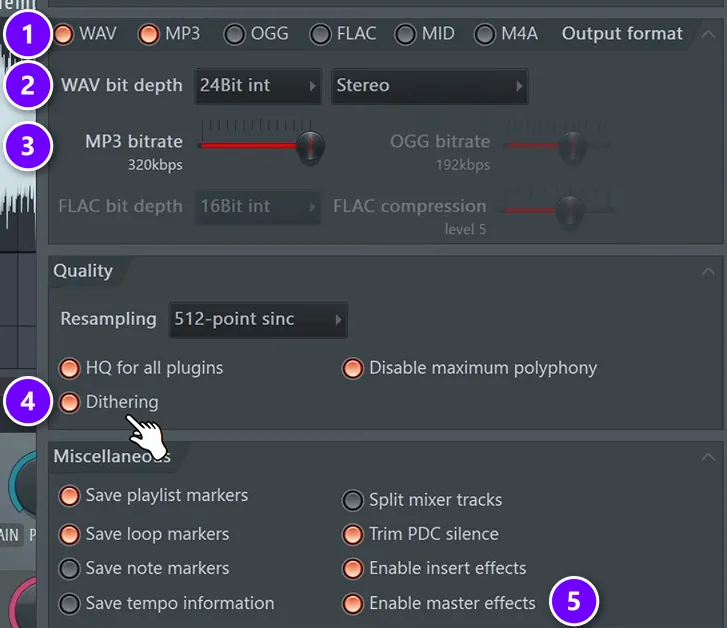
In FL Studio, export the whole song with File > Export > Wave file (Ctrl + R). The screenshot shows release-ready settings: WAV and MP3 ticked (1), a 24Bit int WAV (2), a 320kbps MP3 (3), Dithering on (4) and Enable master effects on (5). Then click Start. You get a small MP3 for quick listens and a full-quality WAV for anyone who asks.
- The song. Share a private link that plays without a download, and put a version in the file name, like “Night Drive v3”.
- One reference track. A released song in your style that sounds the way you want yours to sound.
- The stage. Idea, arrangement, rough mix or final mix. People judge a rough mix differently from a finished one.
- Your goal. Releasing it, sending it to a label, playing it out or just learning. One line is enough.
- Two or three questions with timestamps. “Does the kick get lost under the bass at 0:45?” gets a real answer. “Thoughts?” gets “sounds good.”
Mix Elite Academy‘s feedback portal asks for almost the same things: your track, a reference track and a few things you’d like to improve.
What to ask
Ask about one area at a time, and match it to the song’s stage. Narrow questions get useful notes.
Arrangement and energy
- Where does it start to drag?
- Does the drop hit harder than the verse?
- Is it always clear which sound is the main one?
Mix
- Is the kick clear under the bass?
- Is the vocal too loud or too quiet?
- Does anything sound harsh, muddy or thin?
- How does it sound on your phone or in your car?
Feel
- What three words would you use to describe it?
- Would you skip it on a playlist, and where?
Ask people to put timestamps in their notes, too. “The vocal gets buried at 1:12” is a fix you can find in seconds. “The mix is muddy” sends you hunting.
A message you can copy
Hi! I’m working on a [style] song and I’d love your ears on it.
Track: [private link] (rough mix, v3)
Reference: [artist, song title]
Two questions: Does the kick get lost under the bass at 0:45? Does the drop at 1:30 feel bigger than the verse?
Happy to give you notes on one of yours too. Thanks!
Keep it short and specific. Say thank you even when the notes sting, because people who feel thanked are happy to listen again next time.
Should you get feedback on a work in progress or a finished song?
Both, at different times. Get notes on the music itself, meaning the chords, melody and arrangement, while it’s still easy to change, and notes on the mix once the song is finished. Polishing a mix before the music works wastes your evenings.
Max is blunt about why the order matters: “One wrong note playing, bad chord progression, cheesy melody, and no amount of side chaining and correct reverb settings will fix this.”
- Idea or loop. Ask a producer about the chords, melody and groove. Friends can’t judge a loop yet.
- Arrangement. Ask anyone where it drags and whether the drop lands. Our guide to how to finish a song shows how to get from loop to full song.
- Rough mix. Ask producers about the balance, the low end and the vocal.
- Final mix. Play it for real listeners and on other speakers, and get one last check from a pro before mastering.
What does feedback catch most often?
Mostly settings and habits, not talent. In Max’s one-on-one sessions with Academy members, the same problems keep coming up: a limiter on the master, weak mids, a crowded low end, guessed reverb settings and musical problems no mix can fix.
Max walks through all of them in the video above. Here they are as a checklist, in the order to fix them. Run it before you ask anyone for notes, and the feedback you get will be about bigger things.
- Take the limiter off your master. FL Studio’s default master plugin works like one, and it turns the whole song down every time the kick gets loud. Mix into a hard clipper instead, and switch it off before you export the final mix for mastering.
- Give the mids back. Big lows and bright highs feel exciting, but a mix with a hole in the middle sounds small. Mix each sound while the rest of the song plays, not in solo.
- Let one sound own the sub. That’s the kick and one sub bass, like an 808, taking turns. Put a low cut at 100 Hz on every other low sound.
- Duck the bass under the kick. Sidechain the bass to the kick, so it dips for a split second on every hit.
- Clear out what’s under 250 Hz. If a sound has nothing useful down there, push its low cut up to about 250 Hz.
- Set reverb on purpose. A snare’s reverb should fade before the next snare hit, a melodic sound’s reverb should last one bar at most, and the reverb’s own low cut belongs at 700 to 800 Hz or higher.
- Check the notes before the mix. Right bass notes, chords that aren’t too thick, everything in one scale. Max calls the arrangement of your instruments 90% of the mix.
Every fix, with the exact FL Studio clicks and screenshots, is in our guide to beginner mixing mistakes. For the full path from first idea to finished song, start with how to produce music.
How do you handle harsh or conflicting feedback?
Sort every note into a problem or a taste. Fix the problems that two or more people point at, let pure taste and insults go, and ask a follow-up question when a note is vague. Then change the top two or three things and send the next version.
- A problem: “The vocal disappears in the chorus.” Listen for it, and fix it if you hear it too.
- Taste: “I’m not really into this style.” Thank them and move on.
- Vague: “The mix needs work.” Ask where, at what time and compared to what.
- Rude: skip it. Nothing in it helps your song.
Keep a short notes file for each song with the note, who said it and what you changed. Patterns show up fast, including your own blind spots, like the reverb you always overdo.
Don’t rewrite your whole song because of one comment. One person’s note is a clue. When two people point at the same spot, that’s a problem worth fixing.
Your next step can be small. Export your newest song tonight, write two questions with timestamps and send it to one place from this list. Then keep going after the first round of notes, because Max calls giving up too early the number one mistake of all.
Get a pro’s ears on every song you make
Mix Elite Academy gives you unlimited 1:1 feedback on your music from our pro team, weekly live coaching calls where your projects get fixed in real time, a private community and 600+ trainings. It’s lifetime access for 3 payments of $137, with a 60-day money-back guarantee.
Frequently asked questions
Where can I get feedback on my music for free?
Post one song in a feedback thread, such as the weekly thread on r/WeAreTheMusicMakers or a feedback channel on a Discord server for your genre, and comment on other people’s songs too. Ask friends where they got bored, compare your mix with a reference track at the same loudness, and use an AI chat tool to explain notes you don’t understand.
How do I find a music production mentor?
Look for a working producer in your style who will hear your songs again and again, not just once, and answer your follow-up questions. A school built around feedback is the easiest way to get that. Mix Elite Academy gives you unlimited 1:1 feedback from its pro team, weekly live coaching calls and a community, with lifetime access for 3 payments of $137.
Is it worth paying for feedback on your music?
It’s worth it when the person is better than you in your style and you can act on the notes. One paid critique helps one song. Ongoing feedback is worth more, because each round builds on the last one and someone checks whether your fixes worked. Start with the free options, then pay for ears you can come back to.
How often should you get feedback on your tracks?
Get notes at each stage of every song you mean to finish: once on the idea or arrangement, once on the rough mix and once before you release it. Asking about every loop slows you down, and waiting until the song is done means you find big problems late. If you make music most nights, a weekly rhythm works well.
Why do my friends always say my music sounds good?
Because they like you and don’t want to hurt your feelings, and most people can’t name what’s wrong in a mix even when they feel it. Ask them easier questions instead: where they got bored, what they remember and whether they’d play it again. Save the technical questions for producers.