

“Try to leave out the part that readers tend to skip.”
To write a pop song, pick one feeling and a short title you can sing, loop four simple chords, and hum a melody over them until a few words stick. Build the chorus around that title, write verses that tell the story, and lay it out as verse, pre-chorus, chorus, verse, chorus, bridge and a final chorus.
You’ve had a melody stuck in your head on the drive home, maybe with half a line of words attached. Then you sit down at the computer, open a blank project, and the song that felt finished in the car falls apart in ten minutes.
That’s normal. A pop song isn’t one flash of genius. It’s a handful of small decisions made in the right order, and Max, the founder of Mix Elite, teaches that order in Mix Elite’s free 4.5-hour FL Studio course. The steps below go from four chords to a rough demo, with real screenshots from the course. You’ll also get the song map and the lyric rules almost every pop chorus leans on.
Table of Contents
What makes a song a pop song?

Pop is short for popular, so the sound changes every few years. The build barely changes. A pop song is made to be remembered after one listen and sung back by people who have never touched an instrument.
Almost every pop hit you know shares these six things:
- A short title that the chorus repeats, so it sticks.
- A chorus that shows up early, often within the first minute.
- Four chords, sometimes only two, that loop through most of the song.
- A melody built from a short idea that repeats with one small change.
- Simple, everyday words about one feeling.
- Sounds that feel current, because pop production follows the trends of its year.
Each of those is a skill. None of them depends on luck, and you can learn all six by finishing a few songs, one decision at a time.
What is a hook in a pop song?
A hook is the short part of a song that sticks after one listen, usually a bit of melody and a few words together. In most pop songs it’s the title, repeated in the chorus and placed in its first or last line. A catchy groove from the chords can work as a hook too.
Berklee’s songwriting school agrees. So build your chorus around it.
How to write a pop song in 7 steps
This is the order that works for most beginners, because each step gives the next one something to stand on. You can start with lyrics if words come to you first, but if you make music in FL Studio, starting with chords and a melody is usually the fastest way to a finished song.
- Pick one feeling and a title.
- Loop four chords.
- Hum a melody over the loop.
- Build the chorus around your title.
- Write verses that tell the story.
- Copy the structure of a song you love.
- Record a rough demo.
Step 1: Pick one feeling and a title
Before you touch a key, decide what the song is about in one short sentence. Keep it small. Not a big theme like love, but a moment: you’re finally over someone and you want them to know it, or you feel free after a hard year.
Then find a title that says it in two to five words, something you can picture a crowd singing. Most pop songs talk from “I” to “you”, which makes them feel like a private conversation. Write three or four plain lines about who is involved, what happened and how it feels, and keep them next to you while you work.
Ideas show up in the car, in the shower or in the middle of a meeting. Hum them into your phone’s voice memo app right away, even if it sounds silly. A melody you only half remember is very hard to get back.
Step 2: Loop four chords
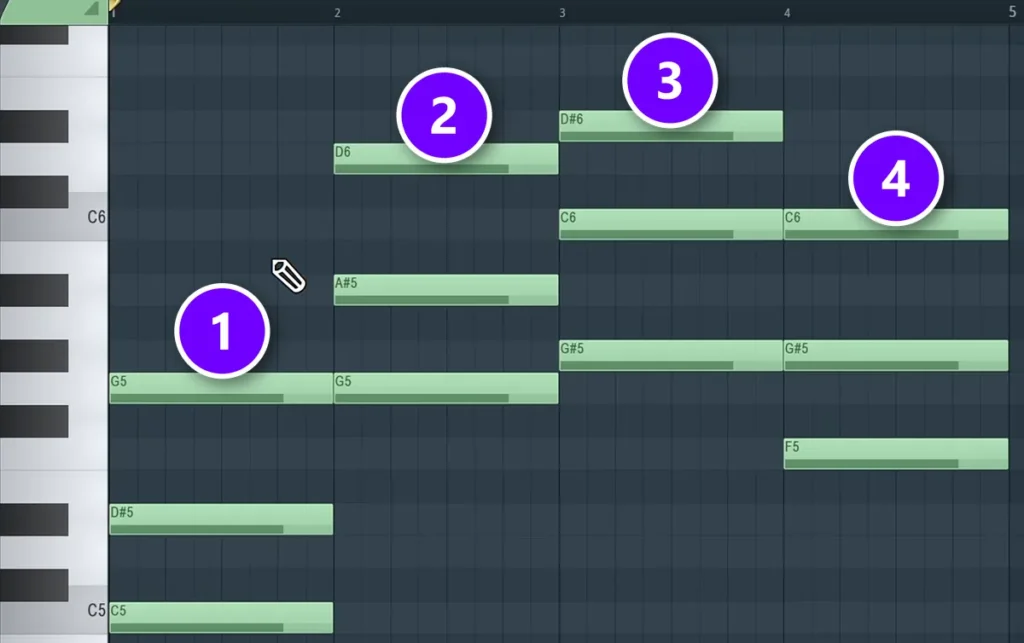
The chords are the floor the whole song stands on. In FL Studio, load a piano and open its piano roll, then right-click the scale button (the note icon in the toolbar) to highlight a scale. Now you can see which notes belong together, and Mix Elite’s chord method needs no theory at all:
- Place one root note per bar on the highlighted rows. Count them by their place in the scale: the first note is 1, the fifth is 5, and so on.
- On each root, stack two more notes: skip one highlighted note, place one, skip one, place one. That’s a chord.
- If the chords jump around, select the top notes and press Ctrl + ↓ to drop them an octave, so the chords flow into each other.
- Copy each root an octave lower to make the chords sound fuller.
That’s the whole method. In the screenshot from Mix Elite’s free FL Studio course, the key is C minor and the chords sit on steps 1, 5, 6 and 4: C minor (1), G minor (2), A-flat major (3) and F minor (4). Use the same four steps in a major key and you get I–V–vi–IV, the loop behind countless pop hits (in C major: C, G, A minor, F).
Don’t waste nights hunting for a secret progression. Max puts it plainly: “Pros working with god-tier artists don’t find better chord progressions than you. They just know what to do with them.” In Mix Elite’s chord video, the difference comes from small moves: a softer piano sound, two chords nudged half a beat, and one chord switched from minor to major.
What are the best chord progressions for a pop song?
The safest catchy choice is I–V–vi–IV, which is C, G, A minor and F in C major. Start the same chords on the minor one and the loop turns moodier. Here are four loops worth trying first:
- I–V–vi–IV (C, G, Am, F): bright and hopeful.
- vi–IV–I–V (Am, F, C, G): the same chords starting on the minor one, so it feels more emotional.
- I–vi–IV–V (C, Am, F, G): the classic 1950s loop, still used in ballads.
- 1–5–6–4 in minor (Cm, Gm, A♭, Fm): the darker version from the screenshot.
If you want the full method with voicings and sevenths, our guide on writing chords in FL Studio walks through it click by click.
For more loops to try, Mix Elite’s Genesis MIDI chord pack has 205 chord progressions and harmonies as MIDI files that play with any sound.
Step 3: Hum a melody over the loop
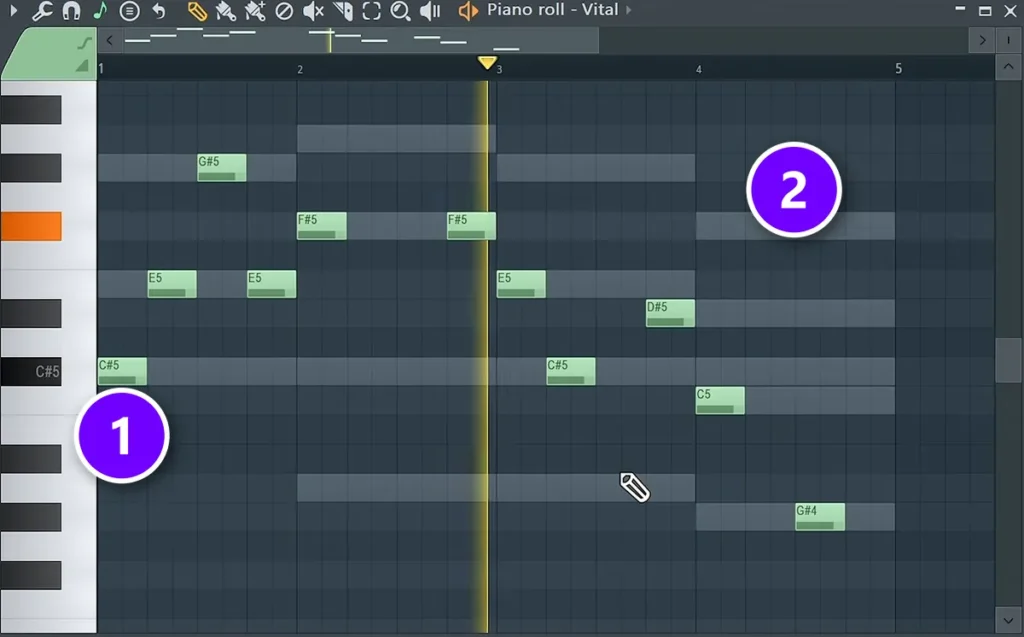
Loop your four chords and hum over them before you write anything down. Humming is faster than any mouse. Your voice also finds lines that a singer can actually sing.
Then get the idea into FL Studio. Set up your computer keyboard so it only plays notes in your scale: right-click the Typing keyboard to piano keyboard button and pick the same root and scale as your chords. Every key you hit is now in key, so you can play without worrying about wrong notes.
In the screenshot, the green notes (1) are the melody and the gray bars (2) are the chords, shown as ghost notes with Alt + V. Most melody notes land right on a chord note, which is why the line sounds like it belongs. The course’s melody methods:
- Write the melody from notes that are already in your chords.
- Write a short idea, copy it two or three times, then change the last bar, like a question and an answer.
- Change the rhythm from bar to bar, so the line never feels stiff.
- Improvise on the computer keyboard while the loop plays. If you forgot to record, Tools > Dump score log to selected pattern brings back what you just played.
Some of the best lines come by accident. About the melody in the course project, Max admits: “This is something I played by accident on a typing keyboard.” That’s the point of setting up the scale first: you can play freely and keep the happy accidents. When a line almost works, change one note at a time instead of starting over.
Step 4: Build the chorus around your title
The chorus is the part people sing back, so it gets your title, your simplest words and your biggest notes. Put the title in the first or last line, or both. Then repeat it. Repeating yourself feels lazy while you write, but it’s exactly what makes a chorus stick.
Make the chorus feel bigger than the verse. Move the melody higher, hold the notes longer and bring in the full drums and bass at the same moment. If your verse melody already sits high, the chorus has nowhere left to go, so keep the verse lower.
This part has its own guide: how to write a chorus covers finding the one line your song is about, the lift into the hook and stacking harmonies.
Step 5: Write verses that tell the story
The verses are where the details live. If the chorus says how you feel, the verse shows why: the place, the time, the thing they said. One concrete picture, like “your jacket still on my chair”, does more than a whole line about being sad.
Keep the verse melody lower and busier than the chorus, with more words per line. Then use the pre-chorus, a short section of two to four lines, to build tension. The chords can change, the melody climbs and the drums often pull back for a moment, so the chorus lands harder.
A few rules keep pop lyrics easy to sing:
- Write like you talk. If you wouldn’t say it to a friend, don’t sing it.
- Use “I” and “you”, so the listener can step into the song.
- Stick to one feeling per song, because two big ideas fight each other.
- Rhyme when it comes naturally, but a clear line beats a forced rhyme every time.
- Sing every line out loud. Words that look good on paper can trip up your mouth.
- Cut filler words like “just” and “really” when they only fill space.
Step 6: Copy the structure of a song you love
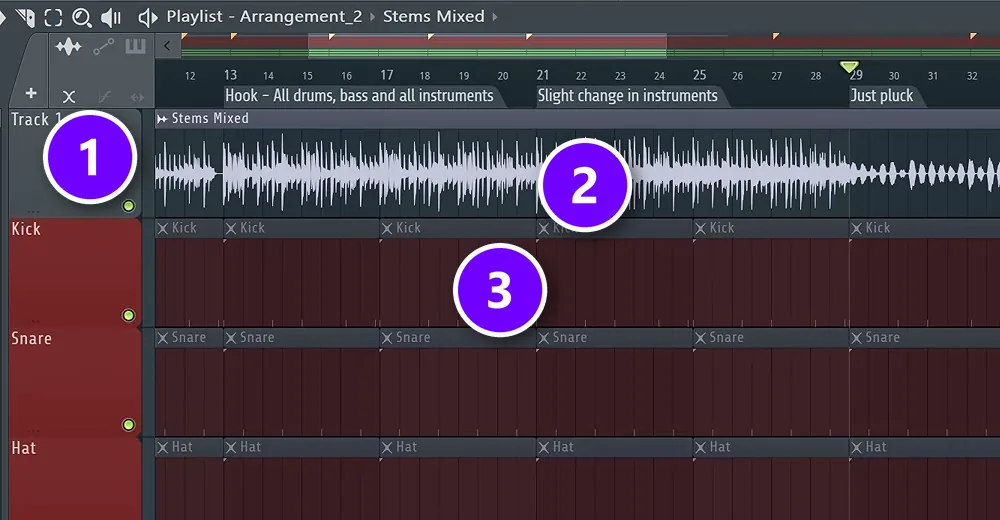
You don’t need to invent a structure. Pick a song you love in the same style and borrow its map. Max calls a reference track “one of the most powerful strategies to level up quickly,” and adds: “A reference track can be any track that you like a lot that’s in the same style as the track you’re making.” Here’s how to do it in the FL Studio Playlist:
- Make a new arrangement so you don’t mess up your own, and drag the song onto its own track (1).
- Set your project to the song’s tempo. Search the song’s name plus BPM, or tap it in with the Tempo tapper.
- Add a time marker (Playlist options > Time markers) everywhere something changes (2): the intro, more hats, the full drums at the hook, a drop down to one instrument.
- Mute your own parts (3) while you listen, then remove the reference, set your tempo back and build your song along the markers.
You copy the shape, never the notes or the sounds. Thousands of songs share the same map, and borrowing it saves you hours of guessing where the chorus should come in.
Step 7: Record a rough demo
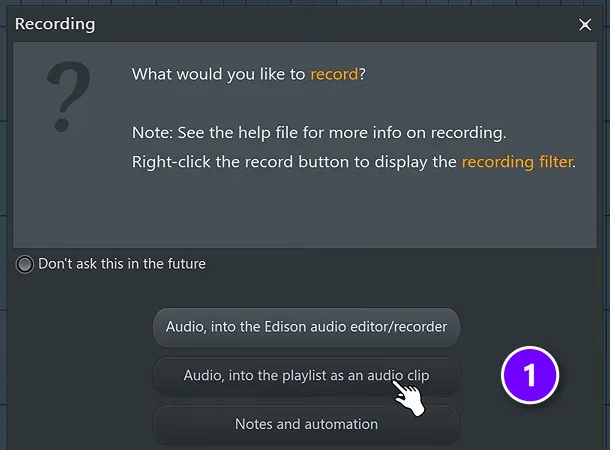
A song becomes real once you hear it with a voice on it. Add simple drums and a bass that follows the root note of each chord, then sing a guide vocal, even if you don’t love your voice yet. A rough demo tells you what works much faster than reading lyrics off a page.
In FL Studio, choose your audio interface’s ASIO driver under Options > Audio settings. Then click the record button and choose Audio, into the playlist as an audio clip (1). Record several takes with the countdown and metronome on, then cut the best parts together. FL Studio’s recording guide covers the input settings.
Then sleep on it. Fresh ears catch the weak line in seconds, and playing it for one person you trust tells you more than another night of tweaking. When the song is ready to become a finished track, our step-by-step guide on how to finish a song picks up from here.
What is the structure of a pop song?
Most pop songs follow this map: intro, verse, pre-chorus, chorus, verse, pre-chorus, chorus, bridge and a final chorus. The verses tell the story, the chorus repeats the title and the hook, and the bridge brings something new before the last chorus. Here’s the job each part does:
- Intro (4 to 8 bars): sets the mood, often with a piece of the chorus melody.
- Verse 1 (8 to 16 bars): tells the story, lower and calmer.
- Pre-chorus (4 to 8 bars): builds tension and lifts toward the hook.
- Chorus (about 8 bars): the title, the hook and the most energy.
- Verse 2 and pre-chorus: new details over the same melody.
- Chorus 2: same as before, sometimes with an extra layer.
- Bridge (4 to 8 bars): something new, like a different chord or a quiet moment, so the last chorus feels fresh.
- Final chorus and outro: often the chorus twice, then a short ending.
Pop also gets to the point fast. A common rule is to reach the first chorus within the first minute, and many modern songs open with the hook or a piece of it. It’s the songwriting version of the opening quote from the novelist Elmore Leonard: leave out the part people skip.
Bars make this easy to plan. At 120 BPM, one bar of 4/4 lasts two seconds, so an 8-bar intro, a 16-bar verse and a 4-bar pre-chorus put your first chorus at 0:56. Mix Elite’s rule for arranging fits pop well: introduce the mood first, then add something every few bars instead of throwing everything in at once. If you have a loop and no song yet, see how to arrange loops into a full song.
How do you turn a chord loop into a full pop song?
Keep your loop and change what plays over it. The chorus gets the full loop with every layer, the verse gets a thinner version, and the bridge brings something new, like a chord you haven’t used yet. Then add or remove one element every 4 or 8 bars, so the song keeps moving.
Here’s how that looks section by section, using the time markers from step 6:
- Chorus: everything plays: the full chords, the drums, the bass and the hook.
- Verse: mute a few layers, or hold one bass note under the changing chords so the verse feels like it’s waiting for something.
- Pre-chorus: bring back one element at a time, like a kick or a snare, instead of going all in at once.
- Bridge: Berklee’s guide to bridges suggests starting on a new chord, changing chords faster or slower, or moving the melody higher or lower.
- Final chorus: everything comes back, often with one extra layer.
You’re not writing a new song for each section. You’re muting and unmuting parts of one loop. That’s why four chords are enough.
Mix Elite’s Arrangements & Music Storytelling course walks through this loop-to-song process in Pop, Trap, Hip-Hop, EDM and House, over 30 lessons.
Why does my chorus feel weak compared to the verse?
Because the verse is already doing the chorus’s job. If the verse is just as busy, high and full, the chorus has nowhere to lift to. Keep the verse lower, thinner and wordier, then give the chorus higher, longer notes, a doubled vocal and more instruments.
The fix is contrast. iZotope’s tips on verse and chorus contrast come down to the same idea. Try these five fixes on your demo:
- Give the verse fewer instruments. Then the chorus can add more, like a new percussion groove or a brighter synth.
- Lift the chorus melody. Sing it higher than the verse and hold the notes longer.
- Double the vocal. Keep one vocal in the verse, then record the chorus two or three times and pan the extra takes left and right.
- Go all in at the hook. Bring in the full drums and every layer right as the chorus starts.
- Simplify the chorus words. Cut them down to a few plain words, a short phrase or even a sung syllable.
Is there a formula for a hit pop song?
No formula can promise a hit. Not even a big label’s. What you can control is the craft, and songs that get played again and again tend to share a few choices:
- The hook arrives early and comes back often.
- The verse and the chorus sound clearly different, so the chorus feels like a reward.
- Every section adds or removes something, so the song never sits still.
- The sounds are picked with care, from the first piano to the last vocal layer.
The rest is how many songs you finish. Professional writers throw away far more ideas than they release, so your tenth finished song will teach you more than polishing your first one for a year. If you want to see where songwriting fits in the whole process, from idea to release, start with our guide on how to produce music, and brush up on scales and keys with music theory for producers.
THE 7-DAY MUSIC PRODUCER COURSE
Turn your song idea into a finished track in 7 days
The 7-Day course walks you through a whole song in the right order. Day 2 covers chords and melodies, with the 3-step chord progression formula, 4 easy ways to write melodies and a download of 30+ chord progressions. Day 3 turns your idea into a full song, Day 5 covers recording and mixing vocals, and on Day 7 a pro gives you feedback on your finished track. It’s made for EDM, house, trap, hip-hop and pop, taught in FL Studio (the free trial works), about 45 minutes a day. It’s $27, with a 60-day money-back guarantee.
Frequently asked questions
What is the most common chord progression in pop music?
I–V–vi–IV. In C major that’s C, G, A minor and F, one chord per bar, looped. Start the same chords on the minor one (vi–IV–I–V: Am, F, C, G) for a moodier feel. In Mix Elite’s chord method you count the steps of the scale, so the same 1–5–6–4 pattern also works in a minor key.
How do I make my chorus stand out from the verse?
Make the verse smaller first. Keep its melody lower and wordier, with fewer instruments and one vocal. Then give the chorus higher, longer notes, a doubled vocal panned left and right, the full drums and every layer. The jump between the two sections is what makes the hook feel big.
Should you write the lyrics or the melody first?
Either works. If you make music in a DAW like FL Studio, it’s usually faster to loop four chords, hum a melody and let a few words fall out of it. Then you write the rest of the lyrics to fit the melody you already like.
Can you write a pop song without playing an instrument?
Yes. Max says it directly in Mix Elite’s free FL Studio course: “Spoiler alert: you also don’t need any real instrument.” In FL Studio you can draw notes in the piano roll, or set your computer keyboard to a scale so every key plays a note that fits. You can write the whole song this way and add a real singer at the end.
Do you need music theory to write pop songs?
Not to start. Mix Elite’s chord video opens by saying you don’t need to know anything about music theory: the piano roll’s scale highlighting shows which notes fit, and a simple rule (skip one note, place one) builds the chords. Theory helps later, when you want to understand why a progression works.