


“Good order is the foundation of all good things.”
Copy each preset into its folder in ~/Music/Audio Music Apps: .patch files into Patches, .cst files into Channel Strip Settings, and .pst files into Plug-In Settings, inside a folder named after the plug-in. Restart Logic Pro, select a track of the same type, and press Y to find your patches under User Patches.
You unzip a new preset pack and find a pile of files ending in .patch, .cst and .pst. Figuring out how to install Logic Pro presets shouldn’t feel like a puzzle. Every step below was checked against Apple’s own Logic Pro user guide in October 2026, on Logic Pro 12 (the newest version is 12.4). You’ll also see how the same job works in FL Studio, straight from Mix Elite’s free 4.5-hour FL Studio course.
Table of Contents
What kind of Logic Pro preset did you download?
Check how the file name ends. A .patch file is the whole sound of a track, a .cst file is the chain of plug-ins on one channel strip, and a .pst file holds the settings of one plug-in. Each type has its own folder in Logic, so the ending tells you where it goes.
A preset is a saved sound. Someone dialed in the settings, saved them to a file, and now you can load that sound in one click. So before you copy anything, unzip the download and look at the endings:
- .patch is a patch: the whole sound of a track. It holds the instrument, the effects and the routing (where the sound is sent). Many vocal preset packs for Logic come as patches.
- .cst is a channel strip setting: the chain of effects on one mixer channel, saved as one file. Lots of vocal presets come this way too.
- .pst is a plug-in setting. It stores the knobs of one plug-in only, like one EQ or one reverb.
- .exs is a Sampler instrument, a playable instrument built from recorded sounds.
- .logicx is a whole Logic project or template. You pull the tracks you want out of it.
- Anything else, like .fxp or .vitalbank, belongs to a third-party plug-in. Those install inside that plug-in, not in Logic’s folders.
One more thing trips people up. Apple’s guide says a track can only use patches made for its track type. So a vocal patch shows up when an audio track is selected, and a synth patch shows up on a software instrument track. If you look for a vocal preset while a synth track is selected, you won’t find it.
What’s the difference between a channel strip preset and a synth patch?
A synth patch is a preset inside one synth, so it only changes that synth’s sound. A channel strip preset loads the whole channel at once: Apple says a channel strip setting can contain a software instrument and effect plug-ins. A Logic .patch goes one step further and can also bring routing and Smart Controls.
That’s why they install in different places. Synth patches go inside the synth itself, through its own import button or preset folder, like the Vital steps further down. Channel strip settings and Logic patches go in Logic’s own folders, as shown next. And watch the word “patch”: in synth talk it means one synth sound, but in Logic a .patch file is a whole track.
How to install Logic Pro presets, step by step
This is the folder method. It works for patches, channel strip settings and plug-in presets, and it installs a whole pack in one go.
- Quit Logic Pro if it’s open. Preset makers tell you to restart Logic after copying files, so it picks up the new ones.
- Unzip the download. Double-click the .zip file in Finder and it turns into a normal folder.
- Open your Logic folder. In Finder, choose Go > Go to Folder (Shift + Cmd + G), type
~/Music/Audio Music Appsand press Return. This is where Logic keeps your own sounds. - Copy the files into the matching folder, using the list below. If a folder isn’t there yet, make it, and spell the name exactly as shown.
- Open Logic Pro, select a track of the same type (an audio track for vocals) and press Y to open the Library.
- Click User Patches and click your preset. For channel strip settings and plug-in presets, use the steps in their sections below.
- PATCHPatches > Audio for vocals, Instrument for synthsUser Patches
- CSTChannel Strip Settings > Track for audio, Instrument for synthsSetting menu
- PSTPlug-In Settings > a folder named after the plug-inPlug-in menu
- EXSSampler Instruments, with the sounds in SamplesSampler
Where do .patch files go?
Patches go in Music > Audio Music Apps > Patches. Put vocal and other audio-track patches in the Audio folder, and synth or instrument patches in the Instrument folder. Preset makers’ install guides list these same folders, and the patches then show up in Logic’s Library under User Patches.
Not sure you’re in the right place? Let Logic show you. Select a track, open the Library and click Save. Apple’s guide says the save window opens in the User Patches folder, so you can see exactly where your own patches live. Cancel, then copy your files there in Finder.
Give each pack its own subfolder inside Patches > Audio or Patches > Instrument, named after the pack. Your sounds stay sorted, and you can find a pack again in seconds.
Where do channel strip settings (.cst) go?
Channel strip settings go in Music > Audio Music Apps > Channel Strip Settings. Use the Track folder for audio and vocal channels, and Instrument for software instruments. They show up as User Channel Strip Settings.
To load one, click the Setting button at the top of the channel strip and pick it from the menu. Or select the channel and click the small blue triangle to the left of the Setting button in the inspector (the panel on the left). The Library then lists your channel strip settings instead of patches.
Where do plug-in presets (.pst) go?
Plug-in presets go in Music > Audio Music Apps > Plug-In Settings, inside a folder named exactly like the plug-in. Apple’s own example is Quick Sampler, whose presets sit in Plug-In Settings > Quick Sampler. Once the files are there, open the plug-in and pick them from the Settings menu at the top of its window.
Sampler instruments (.exs) have their own folder, Sampler Instruments, also inside Audio Music Apps. The sound files they play go in the Samples folder next to it.
How do you load a single preset without copying files?
If you only have one or two plug-in presets, skip Finder. Logic can open a preset file from anywhere and then save its own copy where it belongs. These are the steps from Apple’s guide.
- Open the plug-in on your track by clicking its slot on the channel strip.
- Click the Settings menu at the top of the plug-in window and choose Load Setting.
- Find the preset file in the window that opens and choose it.
- To keep it for every project, open the Settings menu again and choose Save Setting As. If you make a new folder for it, Apple notes it has to sit inside that plug-in’s own folder.
- Want that sound every time you open the plug-in? Choose Save Setting As Default.
Click the left and right arrows in the plug-in header to step through presets while your track plays. It’s the fastest way to hear a whole pack in a minute.
How do you bring presets in from another Logic project?
Some packs come as a Logic project or template instead of preset files. You don’t have to copy the plug-ins one by one. Logic can pull whole tracks, with their plug-ins and settings, into the project you have open.
- Choose File > Import > Logic Projects.
- Select the pack’s project and click Import. The Browser switches to the Track Import view.
- Tick Plug-ins for the tracks you want. Tick Sends too if the preset puts its reverb or delay on a separate channel.
- Click Add. The tracks land below the track you had selected.
- Select the new track, open the Library and click Save. Now it’s your own patch, ready for every project.
Leave Keep Bus Number unticked if your project already uses the same bus numbers. A bus is a shared path for effects like reverb. With the box unticked, Logic moves the imported buses to free numbers, so nothing gets crossed.
How to install vocal presets in Logic Pro

Vocal presets are patches or channel strip settings built for a voice, so the steps above cover them. Here’s the short version for a vocal pack.
- Unzip the pack and check the file endings.
- Copy .patch files to Music > Audio Music Apps > Patches > Audio. Copy .cst files to Channel Strip Settings > Track.
- If the pack was built with third-party plug-ins, install those first. A preset can only use plug-ins you have.
- Restart Logic Pro and select the audio track with your vocal on it.
- Press Y and open User Patches, or load a .cst file from the Setting button at the top of the channel strip.
Then use your ears. A preset was built on someone else’s voice, mic and room, so treat it as a starting point. Max, the founder of Mix Elite, says the same about EQ presets in Mix Elite’s free FL Studio course: “You don’t want to ever copy someone’s EQ presets or EQ shapes, because what works for me will not definitely work for your specific track.” Turn the preset on and off, and fix the level and the brightness until your vocal sits right.
How do you get Apple’s free sound packs in Logic Pro 12?
Logic Pro 12 added a new Sound Library: a free, growing set of sound packs from Apple, with patches, Apple Loops and drum kits inside. Want new presets without buying anything? Start here.
- Choose Logic Pro > Sound Library.
- Click a pack to read about it, and click Preview to hear it.
- Click Get to download it. To grab every pack at once, click Manage Packs, then Get All.
To see only one pack’s sounds, use the View menu at the top of the Library. Since Logic Pro 12, Apple keeps all of its own sounds in one big file called Logic Pro Library.bundle in your Music folder. Your own presets still live in Audio Music Apps, so the folder steps above don’t change.
Patches missing after updating to Logic Pro 12? Apple’s fix is to update to 12.2 or later, open Logic Pro > Sound Library, search for Logic Pro Legacy and install the Legacy Patches, Legacy Instruments and Legacy Loops packs.
How do you save your own Logic Pro preset?
Select the track, press Y and click Save at the bottom right of the Library to save the whole track as a patch. To save only the chain of plug-ins, choose Save Channel Strip Setting as from the Setting button. For one plug-in, choose Save Setting As from its Settings menu.
Once you’ve shaped a sound you like, save it, so you never have to build it twice. Apple’s steps for a patch:
- Select the track and get the sound right.
- Open the Library (Y).
- In the inspector, make sure the blue triangle on the left channel strip points at the Setting button.
- Click Save at the bottom right of the Library and give the patch a name.
Your first save creates a User Patches folder in the Library, and Apple says you can use those patches in any Logic Pro project. To load one later, select a track of the same type, press Y and click User Patches.
Logic Pro presets not showing up? 6 fixes
- Wrong track type. Select an audio track for vocal presets and a software instrument track for synth sounds.
- Wrong folder name. Check the spelling: Audio Music Apps, Patches, Channel Strip Settings, Plug-In Settings. A plug-in preset folder must match the plug-in’s name exactly.
- Logic was open when you copied. Quit Logic Pro and open it again.
- The files are still zipped. A .zip file inside the folder won’t show up. Unzip it first.
- A plug-in is missing or turned off. Third-party plug-ins (Audio Units) must be installed on your Mac. Apple’s guide says to open the Plug-in Manager and check that each one is active.
- The Library is filtered. Set the View menu at the top of the Library to show all patches, not one sound pack.
One more: Logic Pro only runs on Apple computers and iPads. If you’re on a Windows PC, here’s what to use instead of Logic Pro on Windows.
Why aren’t my channel strip settings showing up in the menu?
Because channel strip settings only show on the kind of channel they were made for. Apple’s guide says .cst files are specific to each channel strip type, so an instrument setting won’t appear on an audio channel. Put each file in the matching subfolder of Channel Strip Settings, then quit and reopen Logic Pro.
- Check the subfolder. Audio and vocal settings go in Channel Strip Settings > Track, and synth settings go in Channel Strip Settings > Instrument.
- Check the file type. Only .cst files appear in the Setting menu. A .patch file shows up in the Library under User Patches, and a .pst file shows up in its plug-in’s own Settings menu.
- Restart Logic Pro. Quit it fully with Cmd + Q and open it again, so it finds the new files.
How do you install presets in FL Studio?
In FL Studio, synth presets install inside the synth itself: open the synth’s menu, import the preset file or bank, and the sounds show up in its preset list. The steps below use Vital, a free synth, and other synths usually have a similar import or load option.
The idea is the same as in Logic: put each file where the app, or the plug-in, looks for it. Mix Elite’s free 4.5-hour FL Studio course shows it with Vital: install it, then import a preset bank, which is one file holding a whole pack of presets.
On the paid versions of Vital, Max says: “There’s no need to upgrade to Plus or Pro. They mainly just differ in the amount of presets that come by default pre-installed.” So the free version plus a preset pack is plenty to start with.
- Get Vital Basic, the free version, from Vital’s website. Make a free account, then download and install it.
- In FL Studio, open Options > Manage plugins and click Find installed plugins. Pick the VST3 version, the newest plug-in format.
- Click the + at the bottom of the Channel Rack and choose Vital.
- Click the preset name at the top of Vital (it says Init) to open its preset browser.
Step 5: Import the bank from Vital’s menu
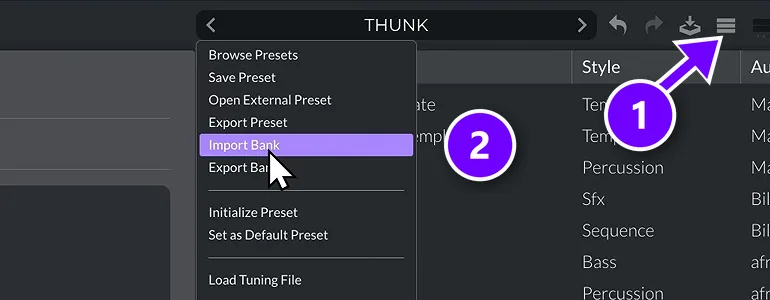
Click Vital’s menu button, the three lines at the top right (1), and choose Import Bank (2). A normal file window opens.
Step 6: Pick the .vitalbank file
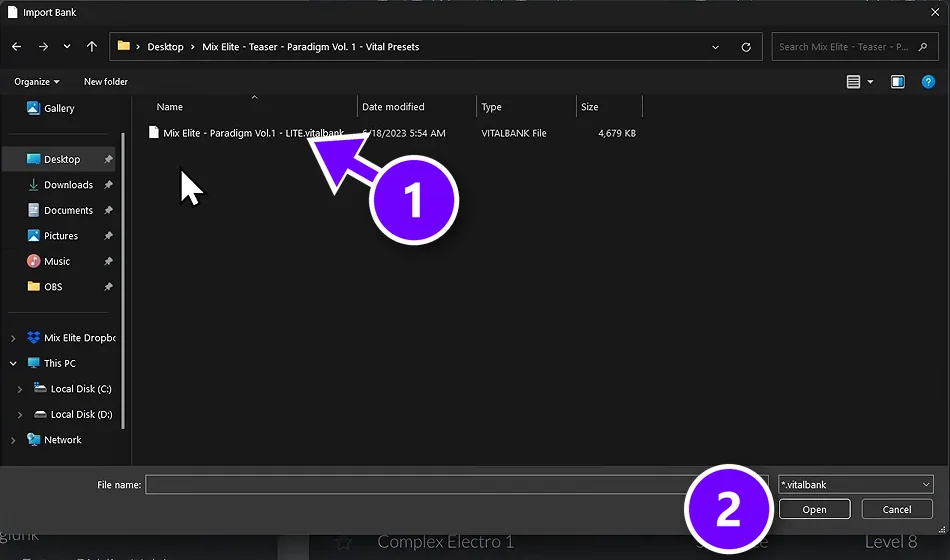
Choose the bank file (1) and click Open (2). In the course video, the new presets show up in Vital’s preset list right after clicking Open.
Third-party synths in Logic work the same way: install the plug-in first, then load its presets from the plug-in’s own browser or import button. The full Vital install starts at 46:41 in Mix Elite’s free FL Studio course, which is embedded below.
Sample packs work a little differently. You don’t import them; you point FL Studio at the folder. Max’s rule: “Place them somewhere on your computer where you know you’ll not be touching them anymore, because if you do change the path, FL will not know where to look for them.” Then you drag the folder into FL’s Browser. Our guide on how to add sample packs to FL Studio has every click, and how to install VST plugins in FL Studio covers plug-ins.
Where do FL Studio and Ableton Live keep your presets?
FL Studio keeps your files in its User data folder, which is Documents > Image-Line unless you moved it. Image-Line’s tip is to save a test preset and see which folder it lands in. Ableton Live uses its User Library: Music > Ableton > User Library on a Mac, or Documents > Ableton > User Library on Windows.
You can check or change FL Studio’s folder in Options > File settings (F10). Ableton’s Live 12 manual says the User Library starts with five folders: Clips, Defaults, Grooves, Presets and Samples. You can move it in Live’s Library settings, so look there first if your presets aren’t where you expect.
Where can you get Logic Pro presets?
Start with what you already have, then add packs only when you know what you’re missing.
- Apple’s Sound Library. It’s free and built into Logic Pro 12 (Logic Pro > Sound Library).
- Your own saved patches. A sound you built for one song is a preset for the next one.
- Preset makers. Buy from the maker’s own site. Check that the pack says Logic Pro, which file types are inside, and which plug-ins it needs.
- Free packs. They’re worth a try, but the quality varies a lot, so only download from sites you trust.
Still choosing your software? Our Pro Tools vs Logic Pro comparison covers price, platform and who each one suits. Whichever one you pick, the same rule holds. Presets are a shortcut, not a skill. The skill is knowing what to change after the preset loads.
THE 7-DAY MUSIC PRODUCER COURSE
Presets installed. Now learn the DAW around them.
Day 1 of the 7-Day course covers setup and workflow: choosing the music software and hardware that suit you, and the top 4 features of any DAW you need to understand to find your way around, even the first time you open it. It’s taught in FL Studio, and the techniques apply in any DAW, Logic Pro included. The course is $27, and you have 60 days to decide if it was worth it.
Frequently asked questions
Where are Logic Pro presets stored?
Your own presets are in Music > Audio Music Apps in your home folder: Patches, Channel Strip Settings, Plug-In Settings and Sampler Instruments. Apple’s own sounds are kept in one file, Logic Pro Library.bundle, in your Music folder. Logic Pro > Settings > General > Sound Library shows where that file is.
How do I install vocal presets in Logic Pro?
Unzip the pack. Copy .patch files to Music > Audio Music Apps > Patches > Audio, or .cst files to Channel Strip Settings > Track. Restart Logic Pro, select an audio track and press Y. Pick the preset under User Patches, or load a .cst file from the Setting button at the top of the channel strip.
Why aren’t my channel strip settings showing up in Logic Pro?
Channel strip settings only show on the channel type they were made for, so put .cst files in the matching subfolder of Channel Strip Settings (Track for audio, Instrument for synths) and select that kind of channel. Unzip any .zip files, then quit and reopen Logic Pro. If a preset uses third-party plug-ins, check they’re installed and active in the Plug-in Manager.
What’s the difference between a channel strip preset and a synth patch?
A synth patch is a preset inside one synth and only changes that synth’s sound. A channel strip setting (.cst) loads the instrument and effects on one channel, and a Logic patch (.patch) can also hold routing and Smart Controls. Install synth patches inside the synth, and .cst or .patch files in Logic’s Audio Music Apps folders.
How do I install Vital or Serum presets in Logic Pro?
Install them inside the synth, not in Logic’s folders. In Vital, click the menu button, choose Import Bank and pick the .vitalbank file, as Mix Elite’s free FL Studio course shows. Other synths have their own import button or preset folder, so follow the synth maker’s guide.