

“Grab ’em by the throat and never let ’em go.”
Song arrangement, also called music arrangement, is the plan for which parts play when, from the first bar to the last. To keep a track moving, change something every 4 to 8 bars, like bringing a part in, taking one out or opening a filter, then build tension before your biggest section and release it on the first beat.
You copied your best eight bars out to three minutes. The sounds are good and the mix is fine, and still, by the second chorus, even you want to skip ahead. Nothing is wrong with the parts. They just never change, so the ear stops listening. The fix isn’t more sounds or a new plugin. It’s a handful of small moves, and you can learn all of them in one evening.
Table of Contents
What is song arrangement in music production?
Song arrangement, also called music arrangement, is the plan for which parts play when. Composing gives you the parts: the chords, the melody, the bass and the drums. Arranging decides the order of the sections, which parts play in each one, how they change along the way, and how the track starts and ends. In FL Studio all of this happens in the Playlist, the timeline where you lay your song out from left to right.
The word has a second meaning too. Arranging can also mean turning an existing song into a new version, like a pop hit rewritten for a string quartet or a ballad turned into a dance track. Writing the parts for an orchestra has its own name: orchestration. This guide is about the first meaning. It’s about arranging your own track so it holds attention from the first bar to the last.
What are the elements of an arrangement?
Arrangement comes down to three things: the structure (which sections come in what order, and how long each one runs), the instrumentation (which parts play in each section) and the space (where each part sits, so two parts don’t fight). Shaping those three over time is what moves a song’s energy up and down.
Why does my track sound great as a loop but boring as a full song?
Because the loop is your fullest section: every part plays at once, so pasted across three minutes there’s no contrast and nothing new to notice. Mute parts to build quieter sections around it, then change something every 4 to 8 bars. Mix Elite’s free course puts it this way: take the listener by the hand instead of hitting them with everything at once.
Your brain tunes out anything that doesn’t change. That’s handy when you’re ignoring the hum of a fridge. It’s deadly for music. A loop that felt great the first eight times turns into background noise by the sixteenth. Most stale arrangements have one of three problems:
- Everything plays from bar one, so there’s nowhere left to go.
- Nothing changes for 16 bars or more.
- The second chorus is a copy of the first, so the song peaks early and then repeats itself.
The fixes are small, and the rest of this guide walks through them, from tiny changes inside a bar to big ones between sections. Still stuck on an eight-bar loop? Start with how to turn a loop into a full song, then come back here to make it move.
That stuck-loop problem is what Mix Elite’s Arrangements & Music Storytelling course is about. Its 30 lessons turn loops into full songs in Trap, Hip-Hop, EDM, House and Pop.
The 4-to-8-bar rule: change something, all the time
The most useful arrangement habit fits in one sentence: every 4 to 8 bars, change something. It doesn’t have to be big. Max, the founder of Mix Elite, uses this idea at three sizes in Mix Elite’s free 4.5-hour FL Studio course. Inside a drum pattern, he changes something every four beats, like a quick hi-hat roll at the end of a bar. Inside a melody, he repeats an idea two or three times and changes it in the fourth bar. And across the song, he builds the intro the same way: “usually after four or eight bars we introduce some change.”
Why does it work? The repeats teach the ear a pattern, and the change breaks it just enough to make you notice. Max says the change is there to “tickle the ears.” A change can be any of these:
- Add a part: a percussion loop, a pad, a counter melody or a vocal chop.
- Take a part out: drop the drums, the bass or the chords for a few bars.
- Switch the drums: a new hi-hat rhythm, a half-time beat or a fill at the end of a phrase.
- Move a part up or down an octave.
- Open or close a filter, so a sound gets brighter or darker over time.
- Add a one-off sound: a crash, a reverse cymbal, a riser or a short vocal shout.
- Change a part’s rhythm: long chord notes become short stabs, or the bass doubles its speed.
How to plan the energy of a song

Before you move a single clip, give each section an energy level from 1 to 10. Energy is how full, loud and busy a section feels. A typical pop song might look like this, though some songs flip the start and open with a piece of the chorus to hook you in the first seconds:
- Intro: 3
- Verse 1: 4
- Pre-chorus: 6
- Chorus 1: 8
- Verse 2: 5
- Chorus 2: 9
- Bridge: 4
- Final chorus: 10
- Outro: 2
Three things stand out. Every chorus is bigger than the section before it, because loud only feels loud next to something quieter. The second chorus beats the first. And the song breathes, dropping down in the second verse and the bridge so the last chorus has room to be the biggest moment. Then the outro lets the listener down gently. The outro in the free course keeps just the pluck and the bass, so the track eases out instead of stopping dead. A slow fade works too, or one last hit followed by silence.
What are the best song structures for beginners?
Borrow a proven map. A pop song runs verse, pre-chorus, chorus, verse, pre-chorus, chorus, bridge and a final chorus. EDM runs intro, build-up, drop, breakdown, a second build-up and drop, then an outro. A beat runs intro, hook, verse, hook and outro, with most sections 8 or 16 bars long.
The beat in Mix Elite’s free course uses that last map with 16-bar sections, and it stops at about two minutes, which the course says is enough for a track like it. Electronic music and beats follow the same energy curve as the pop map above, just with different names. For section-by-section maps with bar counts, see our EDM song structure guide and how to structure a beat.
Easier still, copy the map of a song you love. The course drops a reference track, any song in the same style as yours, straight into the project and arranges along with it. Max shows the same trick in the video below: he marks each section of a reference track, deletes it, then builds his own track along the markers.
How to add and take away parts
Most arranging is switching parts on and off. The free course’s favorite way is to build up: copy the loop across the whole song, mute everything, and bring parts back one at a time as the song needs them. Its intro starts with the core of the track, a piano, then adds the pluck in bar 8 and the bass in bar 13. The full lesson starts at 1:25:42 in the free course.
Two small details make this version work. Right before the hook, a single drum sound comes in, like a hat or a rim, so the drums are teased instead of slammed in all at once. And for the verse, the course suggests keeping one extra part in the first half and dropping it in the second, so even the verse has a change inside it.
Taking a part away is a change too, and often the stronger one. A chorus hits harder when the bar before it is thinner. Try cutting the drums for the last two bars of a verse and listen to how the chorus lands.
To study a full map up close, open a finished project. Mix Elite’s Lift progressive house template is the whole 4:05 track as an FL Studio 20 project with 26 tracks, made with FL Studio’s stock sounds.
How to make a repeated chorus feel new
Repeating your chorus is good. People want to hear it again. Repeating it note for note is where songs go flat, so change at least one thing each time it comes back:
- Add one new layer, like a harmony, a counter melody or a pad.
- Switch up the drums with a busier hi-hat, extra percussion or a fill into the second half.
- Move the lead or the chords up an octave.
- Strip the first bar back to just the vocal or the hook, then let everything crash in.
- Change the bass rhythm, for example from long notes to bouncing eighth notes.
- Save one part for the last chorus, so the end is the biggest moment of all.
- Lift the last chorus up a key, a classic pop move, if the vocal can take it.
If the chorus itself feels weak, no arrangement trick will save it. Start with how to write a chorus, then come back to dress it up.
How do you keep the second verse from losing energy?
Don’t paste verse 1 again. Make verse 2 different, not just louder: give it a little more than verse 1 had, like the hi-hats or a percussion loop from the chorus, and change something halfway through. If someone sings or raps over it, vary the rhythm of the lines and move the story forward.
- Add one part verse 1 didn’t have, like a harmony, a counter melody or a pad.
- Take one part out halfway through the verse, so it has a change inside it.
- Switch the drums with a new hi-hat rhythm or extra percussion.
- Change how the vocal moves: a new rhythm in the lines, a new detail in the lyrics.
- Or skip it: the beat in the free course goes intro, hook, verse, hook and outro, and stops there.
How do you transition smoothly between song sections?
Build tension in the last bars of a section and release it on the first beat of the next. Sweep a filter up, wash a part in reverb, squeeze the sound to mono, or leave a short gap or a drum fill. Then give the new section something new right away, like a crash or the full drums.
Tension is the feeling that something is about to happen. The first three tricks below come from two Mix Elite lessons, the free FL Studio course and the future bass drop tutorial, all with FL Studio’s own plugins.
Sweep a filter up into the drop
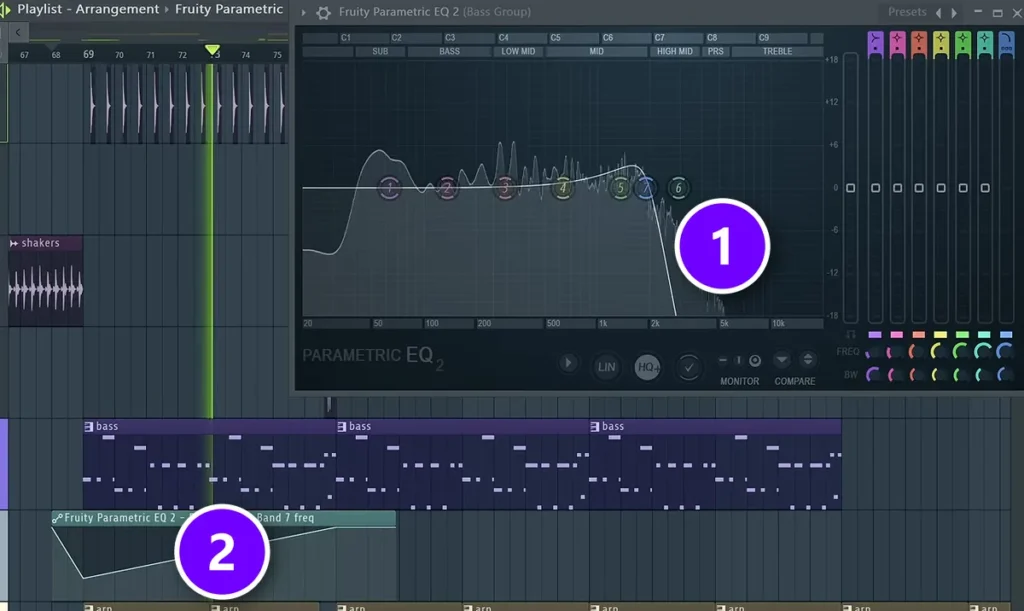
A filter that slowly opens is the classic build. The course uses one on a bass line that plays alone before the drop:
- Put Fruity Parametric EQ 2 on the bass’s mixer track and turn its last band into a high cut, a filter that removes everything above a set point. Make it steep, with a little resonance, a small boost right at the cutoff (1).
- Right-click the band’s frequency knob and choose Create automation clip. You can also move the knob, then pick Tools > Last tweaked > Create automation clip.
- In the Playlist, shape the clip so it climbs from about 20% to the top (2), and reaches the top just before the drop.
- Keep it at the top after the drop, so the bass plays fully open.
Wash a part in reverb, then cut it dry
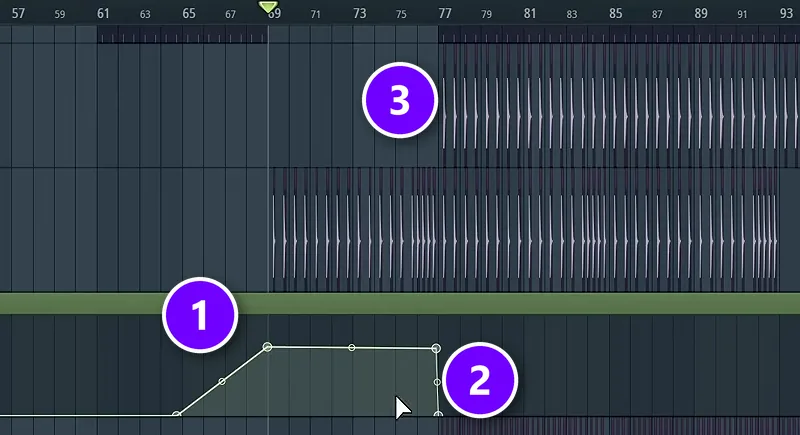
This one works on claps, snares or vocals. Put Fruity Reeverb 2 on the part’s mixer track, turn up the decay so the tail runs long, and automate the wet level, which is how much reverb you hear. Let it rise to about 70% as the build goes on (1). Then drop it to zero the moment the drop hits (2), when the full drums come back dry and punchy (3).
Before an automation clip starts, FL Studio can leave the knob wherever it was last set, so the reverb may already be on early in the song. The quick fix: stretch the clip back to the very start of the song and draw the shape only where you want it.
Squeeze it to mono, then let it go wide
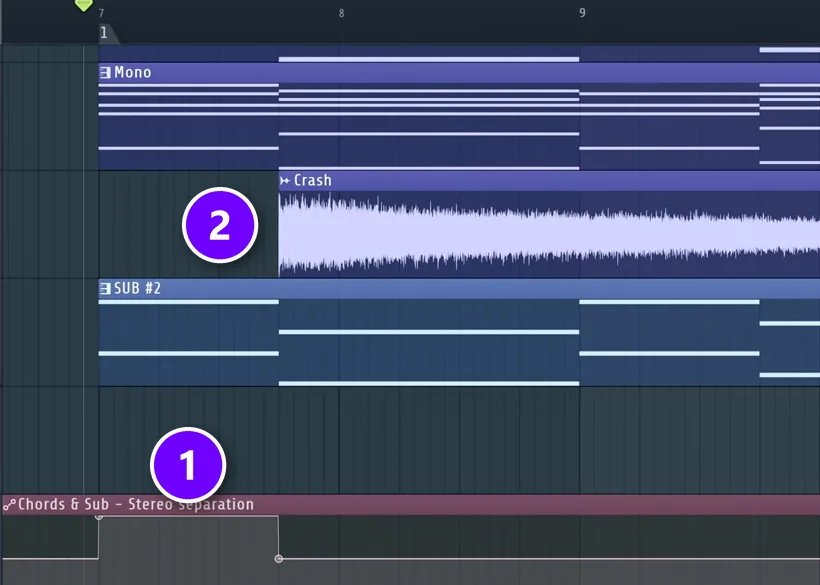
Stereo width can build tension too. In Mix Elite’s future bass drop, the stereo separation of the chords and the sub is automated. They play in mono for the first beats of the drop (1), then open up to full stereo the moment the delayed crash lands (2). It’s a subtle move, but it works.
Take something out right before the hit
The quickest build is a gap. Mute the kick, or everything except the vocal, for the last beat or the last bar before the chorus, and the return feels huge. A drum fill does the same job from the other side. It packs the last bar with energy and points straight at the next section. Mix Elite has a short video on FL Studio’s automatic drum fills if you’d rather not program them by hand.
How to make the drop hit harder
Tension needs a payoff. Two habits make the first beat of a big section land.
Don’t start everything on the first beat
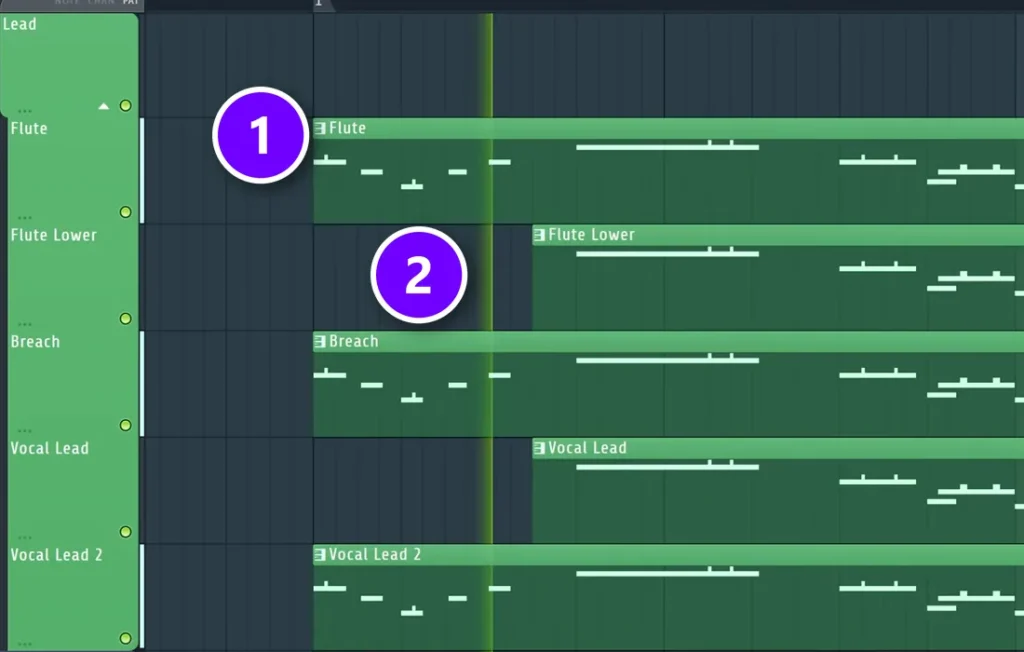
It sounds backwards, but it works. Max’s advice for the drop: “Do not start your drop with everything at the first beat. Delay something a little bit.” In the future bass drop, three lead parts start right on the drop (1), while two more wait a couple of beats before they come in (2). The crash waits with them, so the drop arrives in two steps and the second one lifts it again.
Whatever you hold back, give the first beat of a new section something it didn’t have before: a crash, the full drum kit or the bass coming back. A new section should sound new within one beat.
How to keep parts from fighting
Arrangement isn’t only about time. It’s about space, too. A song sounds full when its parts cover different ranges, as the course explains. A band usually has three to five parts: the bass in the lows; keys, guitar and vocals in the mids; and cymbals on top, while the drums touch a bit of everything. When two parts do the same job in the same range at the same time, they blur into one.
So let them take turns. When the vocal sings, the lead melody rests, and when the vocal breathes, the lead answers. Musicians call it call and response. If two parts must play together, move one up or down an octave, or give one long notes and the other short ones.
A song arrangement checklist
Play your track from start to finish without touching anything. Then check it against these seven questions:
- Does something change at least every 8 bars?
- Does the intro hold something back for later?
- Is the chorus or drop the fullest section, with a thinner section right before it?
- Is the second chorus different from the first?
- Is there tension in the bar before each big section, like a filter, a riser, a gap or a fill?
- Do the vocal and the lead take turns instead of talking over each other?
- Does the ending ease out instead of stopping dead?
Then listen once more and note the first moment your attention drifts. That’s where your next change goes. Arranging your very first track? Our step-by-step guide on how to produce music shows where arrangement fits between writing and mixing, and how to finish a song helps you get it out the door.
DAY 3 OF THE 7-DAY MUSIC PRODUCER COURSE
Turn your next idea into a full song
Day 3 of the 7-Day Music Producer Course is about writing drums and arranging your track: how to build drum patterns in seconds, even if you have no feel for rhythm, and one simple tactic for turning ideas into full songs in minutes, not days. You also get the 2025 Producer Toolkit sound pack. It’s taught in FL Studio (the free trial works), about 45 minutes a day, and on day 7 a pro gives you feedback on your finished track. It’s $27, and you get 60 days to decide if it was worth it.
Frequently asked questions
What is arrangement in music production?
Arrangement, or song arrangement, is the plan for which parts of a song play when: the order of the sections, which instruments play in each one, how they change over time, and how the song starts and ends. Composing creates the parts, and arranging decides how they unfold from the first bar to the last.
Why does my loop sound good but the full song boring?
Because the loop is your fullest section, with every part playing at once. Pasted across a whole song, there’s no contrast and nothing new to notice, so the ear tunes out. Mute parts to build quieter sections around it, make each chorus or drop bigger than the part before it, and change something every 4 to 8 bars.
What is the best song structure for beginners?
Use a proven map. Pop: verse, pre-chorus, chorus, verse, pre-chorus, chorus, bridge, final chorus. EDM: intro, build-up, drop, breakdown, build-up, drop, outro. Beats: intro, hook, verse, hook, outro, with most sections 8 or 16 bars long. Easiest of all, copy the section map of a song you love in the same style.
How do you keep the second verse from losing energy?
Make it different, not just louder. Give verse 2 a little more than verse 1 had, like the hi-hats or a percussion loop from the chorus, add one new part such as a harmony or counter melody, and change something halfway through. With vocals, vary the rhythm of the lines and move the story forward.
How do you transition smoothly between sections of a song?
Build tension in the last bars before the new section and release it on its first beat. A filter sweep, a reverb wash, a short gap, a drum fill or a riser all work. Then make the new section sound new within one beat, with a crash, the full drums or the bass coming back.