

“Be so good they can’t ignore you.”
To get signed to a record label, finish a few release-ready songs, release them yourself and build real listeners, then send your best track to labels that put out your style, the exact way each label asks. Some big labels, like Atlantic Records, don’t accept unsolicited demos at all, so they only listen to music they asked for.
Maybe you’ve pictured it: you send a track, somebody at a label presses play, and the phone rings. That’s the dream. The real path is slower but much simpler, and most of it happens at home, long before you email anyone. Here it is step by step, with the demo rules of real labels, checked on their official pages in October 2026.
Table of Contents
What does a record label actually do?
A record label pays for a release, gets it out into the world and pushes it so people hear it. Max, the founder of Mix Elite, describes two ways a finished song can go in Mix Elite’s free 4.5-hour FL Studio course. On the label route, he says: “You’ll be contacting labels. If you have a manager, they will be doing it for you, and labels will take care of all the publishing and promoting the track for you.”
That help comes at a price. The label is investing in you and expects a return. That’s why the best deals go to artists who bring something the label can’t make on its own: great songs and people who already want to hear them.
What do record labels look for?
Labels are betting money on you, so they look for signs that the bet will pay off. Here’s what makes a label stop and listen:
- Finished songs that sound ready to release. Not a loop, not a rough idea. A track they could put out next month.
- A sound that fits their catalog. A house label wants house. Sending trap to it wastes everyone’s time.
- Proof that people listen. Streams, fans who comment and share, shows, an email list. Real numbers beat big promises.
- More than one good song. One great track is luck. Five good ones show you can do it again.
Monstercat puts it in one line on its contact page: send only your best and original work. Every other point on that list is how you get there.
Step 1: Finish songs that sound release-ready
This is where most demos fail, long before anyone at a label hears them. If your track sounds like a rough demo next to the songs on their playlists, it doesn’t matter how good the idea is. So the first job is the music. You control that part completely.
Mix Elite’s free FL Studio course lays out how long the last steps really take. A good mix takes about 5 to 10 hours on average, and more for a complicated track. Mastering, the final polish, is the last 5% of preparing a song for release.
If you have a pile of unfinished loops, start with how to finish a song. Once you have a few, how to make an album shows how to shape them into an EP or album that feels like one body of work.
Mix Elite’s free course above takes you from an empty project to a mastered song, and the release step comes right at the end.
How to export your demo in FL Studio
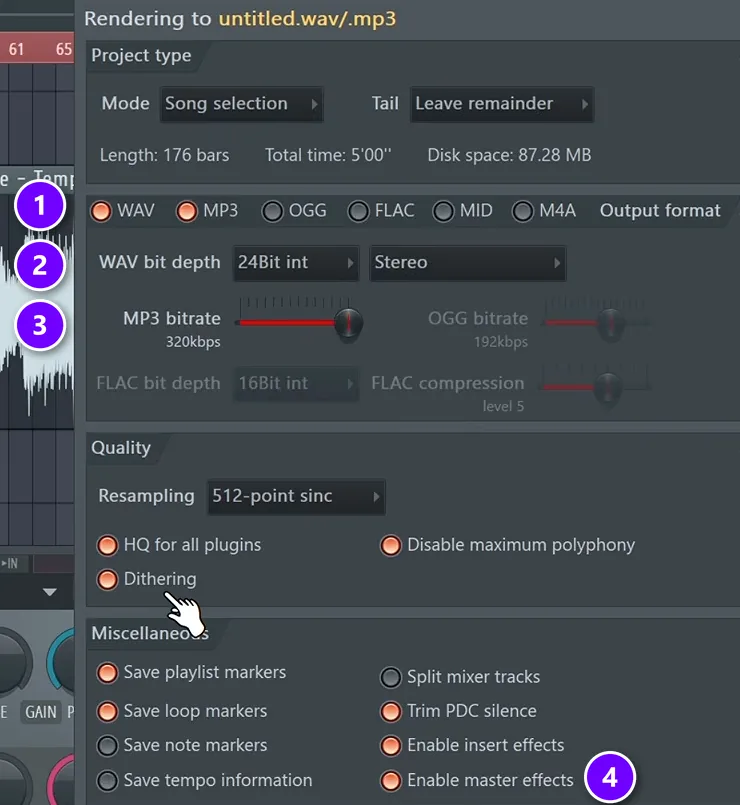
Some labels ask for a WAV file, which is the full-quality version of your song. Defected, for example, only takes WAVs. Here are the export settings from the course:
- Tick both WAV and MP3 (1).
- Set the WAV bit depth to 24-bit (2). The course calls it the most popular choice for releasing music online.
- Push the MP3 bitrate all the way up (3).
- Switch on Enable master effects (4) and click Start.
How do you know if your mix and master are ready for a label?
Compare your track with two or three recent releases from that label at the same volume. If yours sounds smaller, muddier or quieter, it isn’t ready yet. Then play your master on headphones, a laptop, in the car and on a Bluetooth speaker, and fix anything that sounds wrong before you send it.
That’s the check Mix Elite’s free FL Studio course teaches. It treats a reference track, any song you love in the same style as yours, as one of the fastest ways to improve. To compare loudness fairly, use a LUFS meter, which shows how loud a track feels to our ears rather than how high its peaks go. The course uses the free Youlean Loudness Meter. Then ask a producer you trust to listen too.
Step 2: Release your music yourself first
You don’t need anyone’s permission to put a song out. Max says it plainly in the same course: “You can also release your music on all platforms like Spotify or YouTube by yourself.”
A distributor does the delivery for you. TuneCore, for example, sends music to more than 150 stores, including Spotify, Apple Music, YouTube and TikTok, and CD Baby covers more than 150 streaming and download services for a one-time fee per release. Our step-by-step guide on how to release music compares the main distributors, prices and timelines.
Releasing first does two things for you. Your songs start earning listeners right away, and when you do contact a label, you can send a link to music that’s already out and already played.
Step 3: Build real listeners before you pitch
Give a label a reason to say yes before you ask. That means real listeners, not bought followers. A few hundred people who save your songs and come back for the next one say more than thousands who scrolled past once.
- Release on a steady rhythm, so listeners have a reason to follow you.
- Share how you make your songs. Short clips of your process give people a reason to care about the music.
- Play live if you can, even small rooms.
- Start an email list from day one. It’s the one audience no app can take away.
- Work with other artists in your style, so their listeners find you too.
None of this needs a big budget. It needs time and consistency, and both are easy for a label to see when it checks your page.
Step 4: Find labels that already release your sound
Don’t send your track to every label you can find. Look at the songs you love that sound like yours, and check which label released them. Streaming apps show the label at the bottom of the album or single page. Make a short list of 5 to 10 labels that already put out your kind of music.
Then study those releases. A tip from Max’s arrangement video works here too: “there’s nothing wrong in learning straight from the tracks of our favorite artists.” Put a label’s recent release next to your track as a reference and compare. Listen to how fast it gets to the main idea and how full its biggest section is.
Listen to the label’s last ten releases before you pitch. If your track would sound out of place in that list, it’s probably not the right label yet.
Step 5: How do you send a demo to a record label?
Through the label’s own demo page or portal, exactly the way it asks. Send one or two finished tracks as private streaming links, not file attachments, with a short note: who you are, why the track fits that label, and the link. Then give it one to two weeks before a polite follow-up.
Every label has its own rules, and breaking them is the quickest way to get ignored. Here’s how three dance labels say they want demos, checked on their official pages in October 2026:
- Defected Records: streamable links only (SoundCloud, Dropbox or WeTransfer), WAV files only and no artwork or extra promo material. Submissions that don’t follow the rules are deleted automatically.
- Toolroom Records: you upload demos on its demo page. Toolroom says it can’t reply to every submission, but it listens to everything and gets in touch if it’s interested.
- Monstercat: demos go through LabelRadar, with one portal for its Uncaged and Instinct labels and another for Silk. It says it listens to every demo.
What should a demo email include?
Keep it short, and write it for one label only. Mass emails look like spam, a label founder warns in Spotify for Artists‘s guide to sending demos. A good one includes five things:
- Your artist name and the track title, in the subject line and on every file.
- A private streaming link, like SoundCloud or Dropbox. No attachments.
- One or two finished tracks, never a folder of ideas, with your strongest one first.
- Whether each track is a demo, mixed or mastered.
- Two or three sentences about you and why the track fits this label’s sound.
Then wait. Small labels often run on a tiny team whose members have other jobs too, so give them time. Silence usually means no, and one polite follow-up after one to two weeks is plenty.
How can you get noticed by labels with a small following?
Let the music do the work. None of the demo pages we checked, from Defected, Toolroom and Monstercat, asks for a follower count. Monstercat says it listens to every demo, and Toolroom says it reviews every submission. Send a finished, original track to labels that already release your sound, and keep releasing in between.
Start with small labels that put out your exact style. And make music with other artists in your scene, so their listeners, and sometimes their labels, hear you too. Each release adds one more thing a label can check when your demo lands.
Do record labels hold auditions?
Most don’t. At a record label, your demo is the audition: you send a finished track through the label’s demo page or a portal like LabelRadar, and the label listens. Open auditions belong mostly to TV talent shows and K-pop companies, which cast singers, rappers and dancers for new groups.
YG Entertainment, for example, lists ongoing auditions for vocal, rap, dance and acting on its official audition site. If you make your own songs, you skip all that and follow steps 1 to 5 above.
Be careful with anyone who asks you to pay for an audition, a submission or a place on a label. The demo pages of Defected and Toolroom don’t mention any fee.
How do big labels find new artists?
Big labels work differently. Atlantic Records states on its contact page that it doesn’t accept unsolicited music demos, which means it only listens to music it asked for. So the way in is through people the label already knows and trusts.
That’s often a manager, a music lawyer or a producer with label contacts. At a label, the people who find and sign new artists are called A&R, short for artists and repertoire. The best way onto their radar is music that’s already out and being played, which is what steps 2 and 3 build.
What to check before you sign a record deal
Got an offer? Slow down. Never sign a record contract without a music lawyer reading it first. Ask these questions before you agree to anything:
- Who owns the recordings, and for how long?
- What share of each sale and stream do you get?
- Is there an advance, money paid up front, and is it paid back out of your earnings?
- How many songs or albums do you owe the label?
- What happens if the label never releases your music?
- Can you get your rights back, and when?
A good offer still looks good after you ask hard questions. A bad one usually comes with pressure to sign fast.
Do you even need a record label?
Not to release music, and not to grow. Mix Elite’s free course treats it as two routes to the same place: a label that handles publishing and promotion, or releasing everything yourself. Many producers start alone, build an audience, and only then talk to labels, with far more to bargain with.
Whichever route you pick, the first step is the same. Finish a song you’re proud of, release it, and get honest feedback on what to fix in the next one. That’s how you become the artist a label notices.
DAY 7 OF THE 7-DAY MUSIC PRODUCER COURSE
Finish your first song, release it, and hear what a pro thinks
The 7-Day course takes you from setup to a mastered track, one step a day, and Day 7 is about releasing it: the best way to put your music on all streaming platforms for free, how to avoid platforms that take your money, and in-depth personal feedback on your track from our team. It’s taught in FL Studio (the free trial works), about 45 minutes a day. It’s $27, and you get 60 days to decide if it was worth it.
Frequently asked questions
Do record labels hold auditions?
Most record labels don’t hold open auditions. Your demo is the audition: you send a finished track through the label’s demo page or a portal like LabelRadar. Open auditions are mostly for TV talent shows and K-pop companies such as YG Entertainment, which cast singers, rappers and dancers. Be wary of anyone who charges you a fee to audition or submit music.
How do you send a demo to a record label?
Use the label’s own demo page or portal and follow its rules exactly. Send one or two finished tracks as private streaming links, not attachments, and say whether each one is a demo, mixed or mastered. Keep the note short: who you are, why the track fits that label, and the link. Wait one to two weeks before a polite follow-up.
How do you know if your track is ready to send to a label?
Compare it with two or three recent releases from that label at the same volume, using a LUFS meter. If yours sounds smaller, muddier or quieter, keep working. Then play the master on headphones, a laptop, in the car and on a Bluetooth speaker, and fix anything that sounds wrong before you send it.
How many followers do you need to get signed by a record label?
There’s no official number. None of the demo pages we checked, from Defected, Toolroom and Monstercat, mention a follower count. Monstercat asks for your best and original work. What helps is proof that real people listen: saves, shares, repeat listeners and fans who come to shows, not a big follower count with no activity.
Do record labels accept demos?
Many do, through their own demo page or a portal. Toolroom Records takes uploads on its demo page, Monstercat uses LabelRadar, and Defected Records asks for streamable links to WAV files. Some big labels, like Atlantic Records, don’t accept unsolicited demos at all, so check each label’s official page before you send anything.