


“I just build the car, I don’t drive it down the wrong side of the road.”
The best free autotune plugin is Graillon 3 Free Edition by Auburn Sounds. Pick your key, turn the Smooth knob, and it does natural tuning or the hard robot effect on Windows, Mac and Linux. PitchCure, Spoton, Vox Tune Auto Pitch and GSnap are the best free alternatives.
You sing a take you love, then play it back and hear the one note that’s slightly flat. Or you want that hard, robotic sound from your favorite rap records. Either way, the big-name autotune plugins cost real money, and your first vocal chain shouldn’t have to.
We checked every free autotune plugin below on its maker’s own site in October 2026. Old favorites that are now paid, or haven’t been updated since 2013, sit in a short skip list at the end. You’ll also see the autotune FL Studio already has, free apps for your phone, and the exact settings Max, the founder of Mix Elite, uses for natural or robotic vocals.
Table of Contents
What does an autotune plugin do?
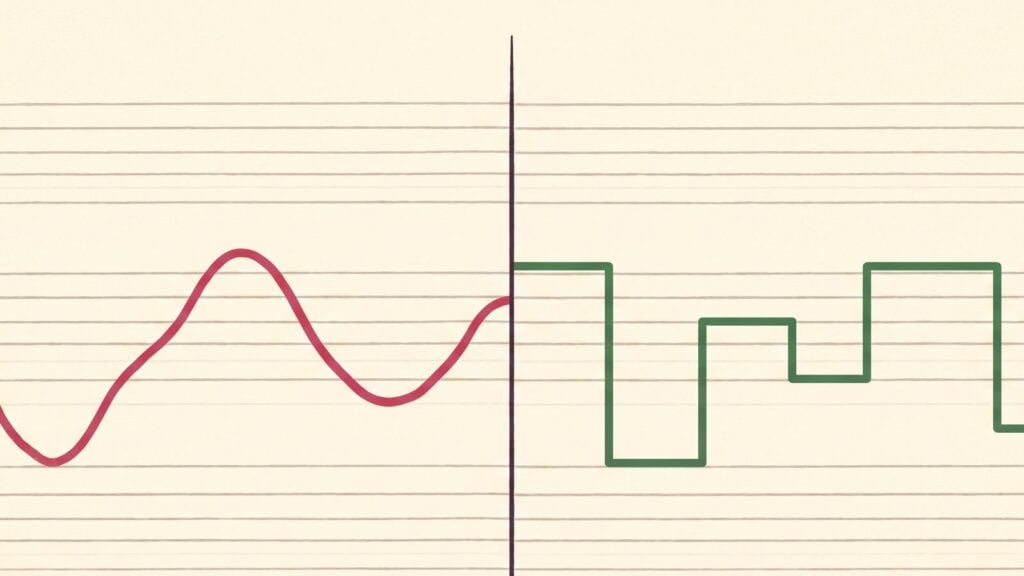
An autotune plugin listens to a voice and pulls each note to the nearest note in your song’s scale. A scale is the set of notes that sound right in your song’s key, for example C minor. If the singer lands a little flat or sharp, the plugin nudges the note back in tune.
Two settings do most of the work. The key and scale tell the plugin which notes are allowed. The retune speed, which Graillon calls Smooth, sets how fast it grabs each note.
Retune speed controls how quickly the plugin pulls your singing to the closest note in the scale. On Antares Auto-Tune, the industry standard, the default of 20 milliseconds is already quick. Go down to 5 or 0 milliseconds and the voice jumps from note to note like a robot. That stepped sound is the famous autotune effect from rap and pop records.
Autotune is not the same as editing pitch by hand. In a pitch editor like Newtone or Melodyne you move notes one by one. Autotune works on its own, in real time, so you can even hear it while you record.
The 7 best free autotune plugins in 2026
For most beginners, the best free autotune plugin is Graillon 3 Free Edition: set the key, turn one Smooth knob, and you get natural tuning or the hard robot effect. PitchCure is the pick for natural tuning that keeps vibrato, Spoton and Vox Tune are the simplest, and GSnap can force a vocal onto MIDI notes.
Each pick has what it does, what it runs on, where to get it, and how to use it in FL Studio. To install any of them, follow our guide on how to install VST plugins in FL Studio. The steps are the same for all seven.
1. Graillon 3 Free Edition (Auburn Sounds)
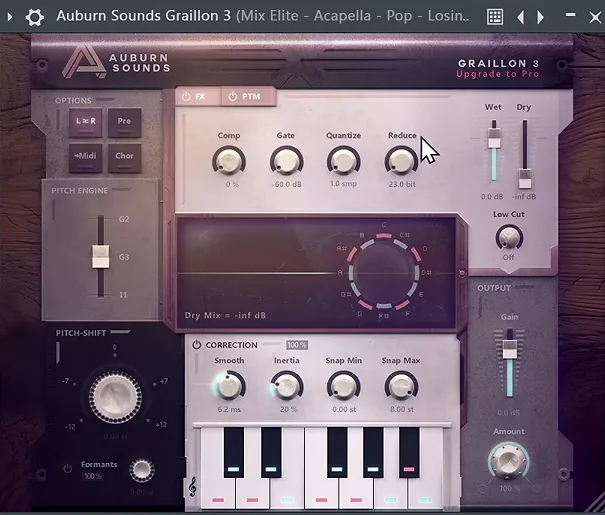
Graillon is the free tuner Mix Elite recommends. “The best free autotune is called Graillon,” Max says in Mix Elite’s free 4.5-hour FL Studio course, where he installs it on camera and tunes a pop vocal with it.
The free edition of Graillon 3 (version 3.2) includes pitch correction for natural or hard-tuned sound, a pitch shifter, formant shifting, three pitch engines, and a compressor, gate, chorus, preamp and bitcrusher. The full edition was $29 when we checked, down from $38.67. It adds pitch-tracking modulation, a vocal doubler and keyboard tuning outside normal scales.
It runs on Windows, macOS and Linux as VST, AAX, AU and LV2, and the installer includes a VST3 version. The download is a plain zip file from auburnsounds.com. No account, no email.
In FL Studio: load it on the vocal’s mixer track, click the clef to pick your scale, and turn Smooth. The full setup is in the steps below.
It isn’t the most polished-sounding tuner out there, and the course says so: the more professional ones cost money. But it’s plenty to work with and learn on, which is why it’s first here.
2. PitchCure (Saint Mike DSP)
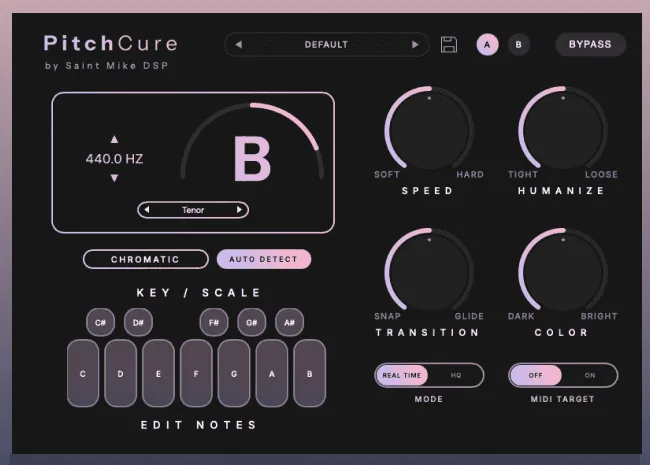
PitchCure is a free vocal tuner from Saint Mike DSP that aims for natural tuning, not the robot sound. Its knobs will look familiar if you’ve seen Antares Auto-Tune. Speed fixes bad notes, soft to hard. Humanize keeps the emotion and the natural vibrato. Transition smooths the slides between notes, and Color shapes the tone.
It can find your key with one click (Auto Key), lets you build your own scales, and has a MIDI Target mode that forces the vocal to follow the chords or melodies you play on a keyboard. Real Time mode has almost no delay for recording, and HQ mode is for the final mixdown.
It runs on Windows 10 and 11 (VST3, AAX) and on macOS 11 or newer, Intel or Apple Silicon (VST3, AU, AAX). Click Get Free on the PitchCure page. A paid PitchCure Pro ($59.95) also exists.
In FL Studio: load the VST3 on the vocal’s mixer track, click Auto Key or set the key yourself, then turn Speed toward Soft for natural tuning or toward Hard for the effect.
3. Spoton (Sixth Sample)
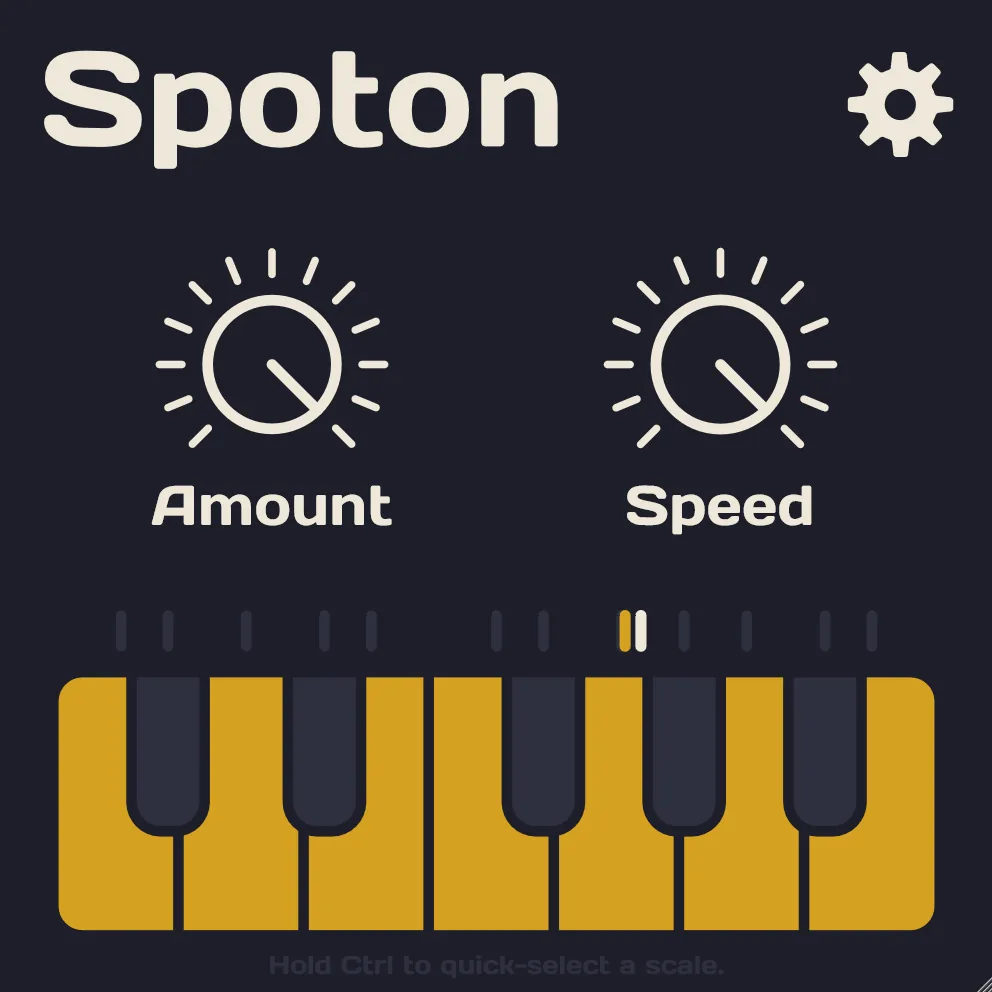
Spoton is the simplest tuner on this list. Sixth Sample calls it a free automatic pitch correction plugin with a clean sound and low latency. Latency is the small delay between singing and hearing the result.
The whole plugin is one octave of keys plus two knobs. Click the keys to choose the notes of your scale, then set Amount (how much it corrects) and Speed (how fast). You can also select and automate single target notes. It runs on Windows 10 or newer (64-bit VST3, AAX) and macOS 10.13 or newer (AU, VST3, AAX).
In FL Studio: load it on the vocal’s mixer track, light up the notes of your key, then set Amount and Speed while the beat plays.
4. Vox Tune Auto Pitch (Vox Samples)
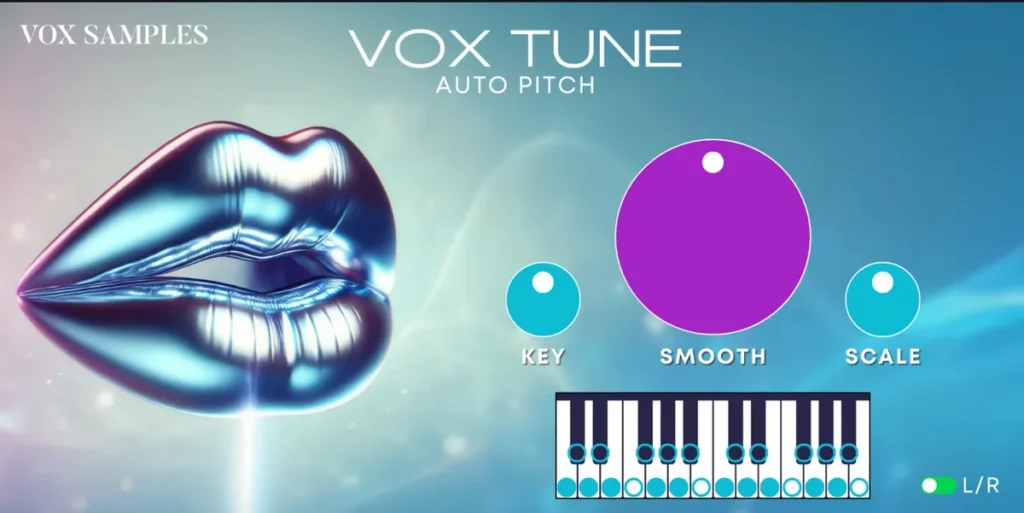
Vox Tune Auto Pitch has three controls: Key, Scale and one big Smooth knob. Vox Samples’ own tip is simple. Set Smooth to 0% for the classic autotune effect, or to 20% and above for a more natural sound.
A keyboard at the bottom lets you switch single notes on or off. Vox Samples says it works best on a clean, single-voice (monophonic) recording, and it tunes one track at a time. It’s free on the maker’s site, where you add it to the cart and check out at no cost. It runs on 64-bit Windows (VST3, AAX) and macOS (AU, VST3, AAX).
In FL Studio: set Key and Scale to match your beat, start Smooth around 20%, and turn it down toward 0% for the hard effect.
5. GSnap (GVST)
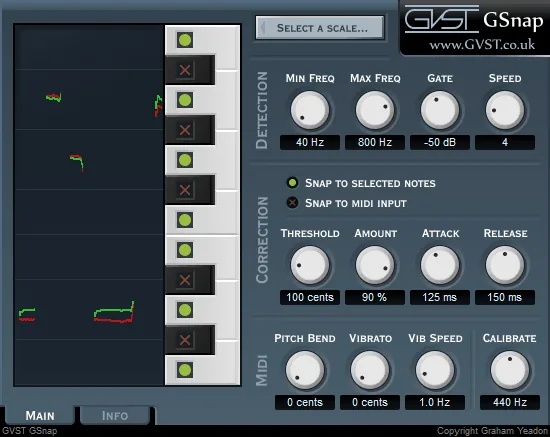
GSnap has been around for years, and GVST still gives it away. Use it on one voice at a time, not on chords. It has two modes: snap to the notes of a scale you choose, or snap to MIDI notes you play, which can force a vocal onto a new melody.
Downloads cover 64-bit and 32-bit Windows, macOS including Apple Silicon, and Linux. The catch: it’s VST2 only, and the window looks its age.
In FL Studio: click Select a scale and pick your key (on Mac and Linux, click the notes on its keyboard instead). GVST’s manual says a very fast Attack gives a clearly artificial snap, while longer Attack and Release times sound more natural. Lowering Amount from 100% also keeps more of the natural voice.
6. MAutoPitch (MeldaProduction)
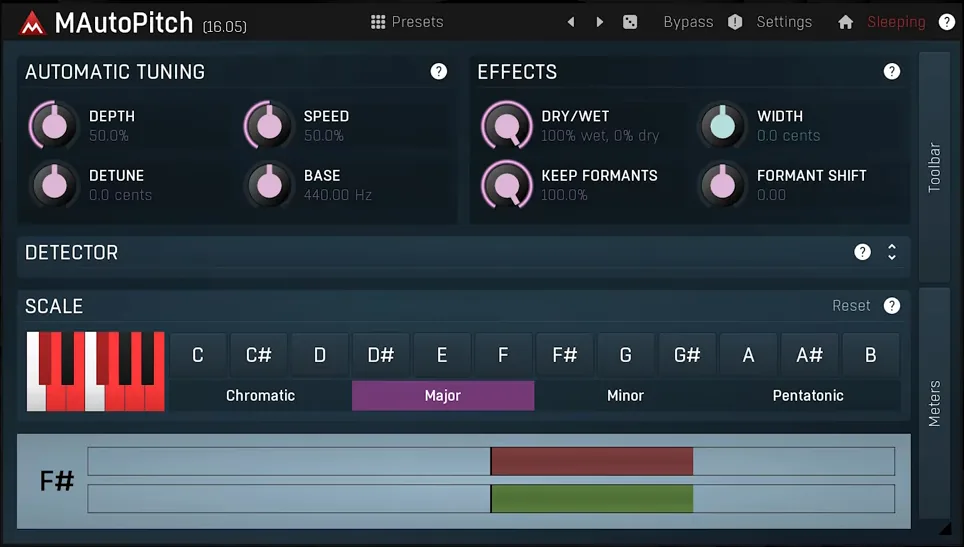
MAutoPitch is part of MeldaProduction’s free MFreeFXBundle, and you’ll find it on almost every free plugin list. Our take is mixed. In Mix Elite’s autotune video, Max says it’s “good for formant shifting, but its autotune algorithm just does something weird with the waveform.”
Where it shines is everything around tuning. Keep Formants and Formant Shift change the size and character of a voice without changing its notes, and Width spreads the vocal out in stereo. Our free pitch shifter guide shows how to use those for doubles and deep voices.
Since version 17, Melda plugins install only through the MPluginManager app, where you log into a Melda account. It runs on Windows 10 and 11 (VST, VST3, AAX) and macOS 10.14 or newer, Intel or Apple Silicon (VST, VST3, AU, AAX).
In FL Studio: pick your scale first. If you don’t know the key, a site like tunebat.com can find it. Then balance Depth (how exact the tuning is) and Speed (how fast it corrects).
MAutoPitch settings for natural vocals: start from the defaults, Depth 50% and Speed 50%, leave Keep Formants at 100% and Formant Shift at 0, and raise Depth and Speed only until the off notes sit right. MeldaProduction’s manual says 100% Depth usually sounds machine-like, and a higher Speed can sound less natural. A Mix Elite short says the same: both knobs all the way up gives perfect pitch that sounds very unnatural.
7. TrapTune (United Plugins)
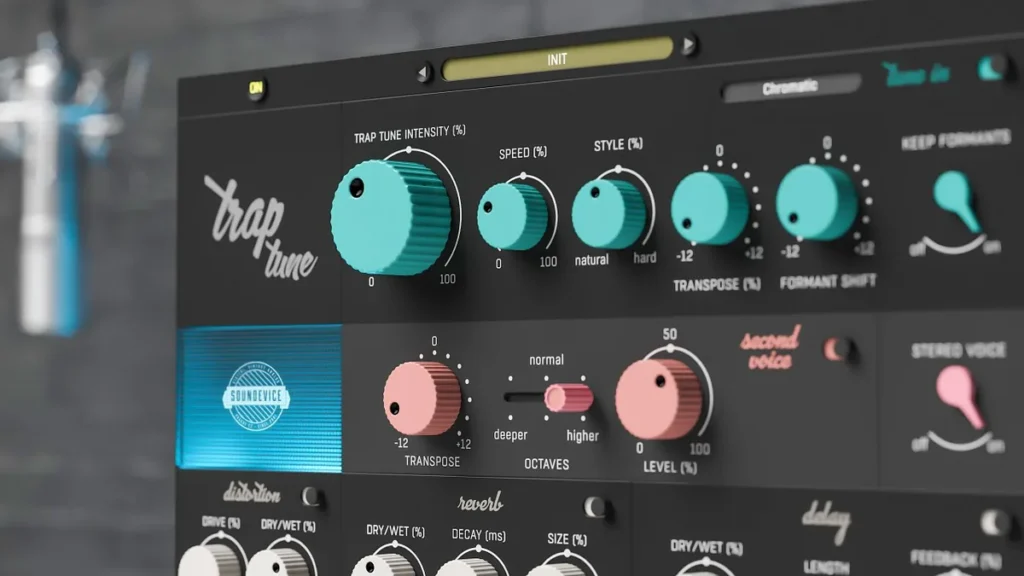
TrapTune by United Plugins is a paid vocal tuner and effects strip (€79 when we checked) with a free second life. You get a full 15-day trial with no limits. When it ends, the plugin keeps working with limited access to several features, which United Plugins calls its free second-hand edition.
It’s made for natural tuning, hard tuning and bigger vocal effects, with a plate reverb and a delay built in. It needs Windows 10 or 11 (64-bit) or macOS 10.14 or newer, Intel or Apple Silicon.
In FL Studio: load it on the vocal’s mixer track like any effect and start from a preset. Use the trial to hear what the full version can do before you decide.
How do you set up a free autotune plugin in FL Studio?
Load the tuner first on the vocal’s mixer track, before any reverb or delay, and set your song’s key and scale. Then set the speed: in Graillon 3, about 20 ms of Smooth sounds soft, 10 ms suits a pop vocal, and 1 ms gives the robot effect.
These steps come from Mix Elite’s free 4.5-hour FL Studio course, using Graillon 3. The same steps work for any free tuner on this list. Only the knob names change.
- Download Graillon 3 Free Edition and install the VST3.
- Scan for it with Options > Manage plugins > Find installed plugins.
- Put the vocal on its own mixer track and load Graillon 3 in a free slot.
- Click the clef and choose your song’s key and scale.
- Set Smooth: about 20 ms for soft, 10 ms for a pop vocal, 1 ms for the robot.
- Automate Smooth with Tools > Last tweaked where the vocal needs more or less.
Step 1: Download the free edition and install the VST3
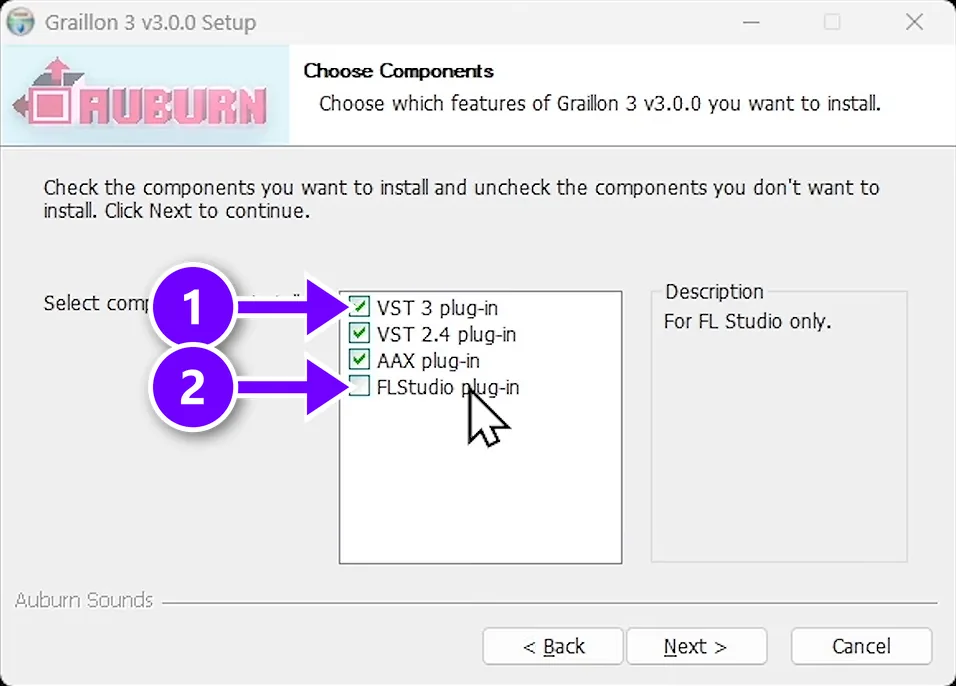
On the Graillon page, click Free Edition. You don’t need the full one. When the installer asks which versions to install, keep VST 3 plug-in checked (1) and leave the FLStudio plug-in unchecked (2).
Skip the FL Studio version, because projects can fail to open when one person used it and the other didn’t. Install only the VST3. Leave out AAX too, which is for a different DAW, Pro Tools. A DAW is the app you make music in, like FL Studio, Ableton or Logic.
Step 2: Scan for it in FL Studio
Open Options > Manage plugins and click Find installed plugins. If it doesn’t show up, our guide on how to add a VST to FL Studio covers the plugin folders and fixes. You don’t have to star it as a favorite: click the arrow on an empty mixer slot and choose More plugins to see everything you’ve installed.
Step 3: Load it on the vocal’s mixer track and pick your scale
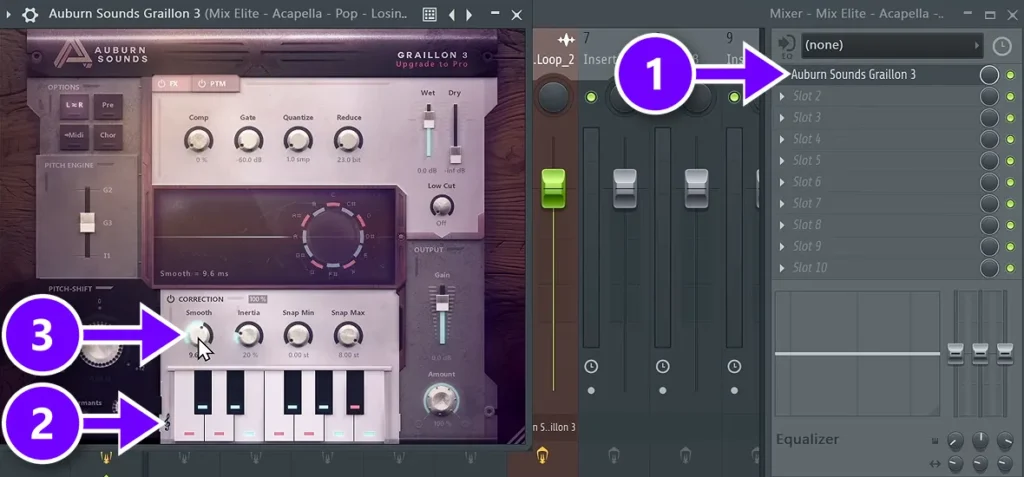
Give the vocal its own mixer track first. Select its channel and press Ctrl + L, or double-click the clip and set the track number in its settings, which is quicker. Then load Graillon 3 in a free slot (1).
Correction is the only section you need. Click the clef next to the keyboard (2) and choose your song’s key and scale. Skip this and it will try to stick the vocal to every single note. Not sure of the key? Drop the vocal into a key finder like tunebat.com’s analyzer.
Step 4: Set Smooth for a natural or robotic sound
Smooth (3) works like Auto-Tune’s retune speed, and lower numbers correct faster. About 20 ms gives a soft effect, around 1 ms a very robotic one, and 10 ms sounds right on the pop vocal in the course.
Put the autotune first on the vocal’s mixer track, before reverb or delay. In Mix Elite’s vocal setup, the vocal presets go after the autotune on every layer, so the tuner hears the plain, dry voice.
Step 5: Automate Smooth where the vocal needs more or less
An autotune can’t fix single notes the way Newtone can, but you can change it over time. Turn the Smooth knob, then go to Tools > Last tweaked > Create automation clip. Now draw more tuning into the parts that need it and less where the singer is already in tune.
Does FL Studio have a free autotune?
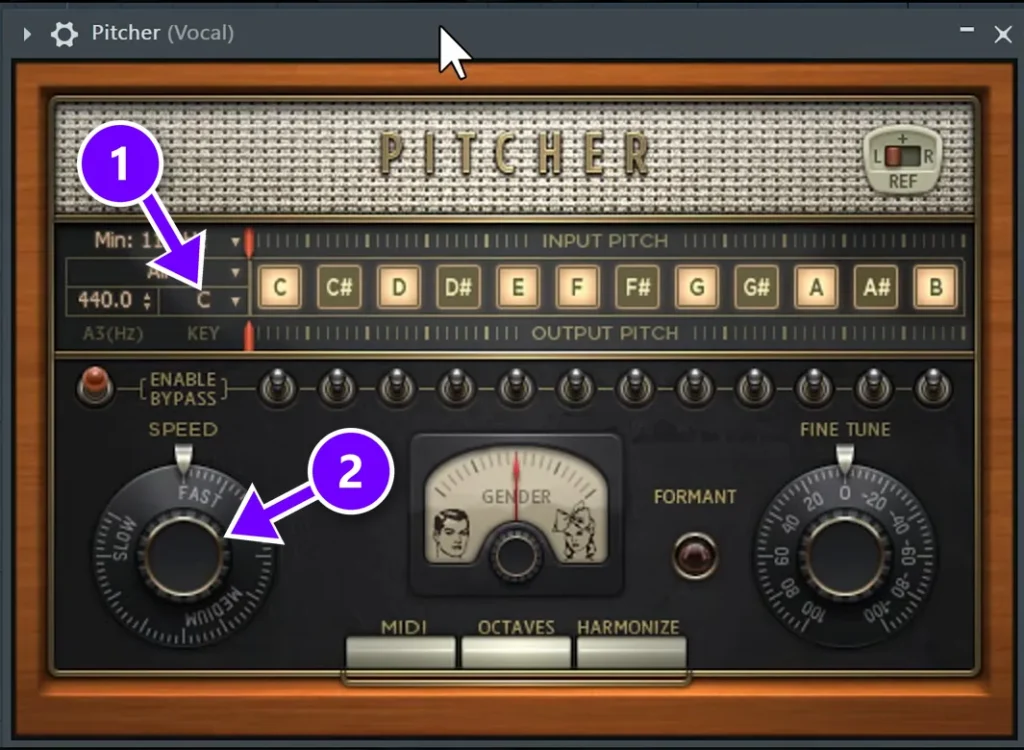
Not in every edition. FL Studio’s own tuners, Pitcher (automatic, in real time) and Newtone (where you fix notes by hand), come with the Signature Bundle and up, not with Fruity or Producer Edition. The free FL Studio trial includes them, but it can’t reopen saved projects.
Pitcher is simple. Set the key (1) and turn Speed (2). It only has that one speed knob, though, and Mix Elite’s autotune video doesn’t recommend it when you want quality results. Any free plugin above does the same real-time job in every edition.
Newtone is a different story: manual tuning takes more work, but it always sounds more natural. Our guide on how to tune vocals in FL Studio covers Newtone step by step.
Other DAWs have one built in too. Logic Pro has a Pitch Correction plugin, Ableton Live 12.1 and later include Auto Shift in every edition, and GarageBand has a Pitch Correction slider (more on that below).
How do you make free autotune sound natural?
Set the right key and scale, then slow the correction down. Antares’ own guide suggests starting at 20 to 30 ms of retune speed for most vocals, and 30 to 50 ms for natural tuning that keeps vibrato. On a free tuner, that means more Smooth or less Speed, plus Humanize on long notes.
The video above, Mix Elite’s guide to recording vocals with free autotune, walks through these settings on Antares Auto-Tune. The same ideas work in any free tuner:
- Get the key right first. With the wrong scale, the plugin drags good notes onto wrong ones.
- For a natural sound, let the tuner react more slowly. In Graillon that’s a higher Smooth number. On tuners with a Speed knob, turn Speed down. Go too slow and some notes start to sound off again, so find the balance part by part.
- Use Humanize on long notes. Singers miss most at the very start of a note. Humanize keeps correcting the start but backs off on long, held notes, so natural vibrato stays. PitchCure has it too.
- Fix one bad spot without more tuning. Draw a very slight pitch automation on just that moment, with the clip’s stretch mode set to Stretch Pro.
- For the robot sound, go fast. Set the speed to 0 to 5 milliseconds and let the notes jump.
And if nobody should hear any autotune at all? Max’s answer: “The best way to hide your autotune is not using it at all.” Use a manual editor like Newtone or Melodyne instead.
Set the scale before you judge the sound. With the wrong key, or no scale at all, autotune pulls notes onto the wrong pitches and the vocal sounds worse than before you started.
Tuning is only the first step. Once the notes sit right, our guide on how to mix vocals shows how to make the voice sit in the beat. Want the full robot choir instead of a tuned voice? That’s a vocoder, and here are the best vocoder plugins.
Why does my free autotune sound glitchy or robotic?
Usually it’s one of three things. The correction is too fast, the key is wrong, or the tuner can’t hear one clean voice. Slow the speed down, set the right key and scale, and feed it a dry, single vocal with no reverb, harmonies or background noise in front of it.
- The speed is too fast. A retune speed of 0 to 5 ms is the hard robot effect by design. Move it toward 20 to 50 ms for a natural sound, or turn Graillon’s Smooth up.
- The key or scale is wrong. The tuner then pulls good notes onto wrong ones. Check the key with a key finder before you touch any other knob.
- It hears more than one voice. These tuners are built for one melody line. GVST’s manual says GSnap only works on monophonic input, a single melody rather than chords, and Vox Tune tunes one track at a time. Give doubles and harmonies their own track and their own tuner.
- Noise and breaths confuse it. MeldaProduction’s manual says the noise-like gaps in a vocal can confuse the pitch detector. Raise MAutoPitch’s Threshold, or GSnap’s Gate, until it ignores them.
- The tracking doesn’t suit the take. In Mix Elite’s autotune video, Auto-Tune made a weird clicking on a clean vocal until its Tracking knob came down from the 50% default to about 20 to 30%. Setting the voice range helps too, like PitchCure’s range setting or GSnap’s Min Freq and Max Freq.
What’s the best free autotune app?
Voloco is a free autotune app for iPhone, iPad and Android, with over 50 million downloads on Google Play. BandLab’s AutoPitch works free in its app and in a web browser, and on a Mac, GarageBand’s Pitch Correction slider is free too.
Here’s what each one gives you.
- Voloco (iPhone, iPad and Android): a vocal recording app with auto voice tune and effects. It’s free to download with in-app purchases, and on iPhone it needs iOS 18.6 or later.
- BandLab AutoPitch (phone and web): BandLab’s pitch correction. Six of its 24 AutoPitch effects are always free, including Classic and Robot. The other 18 need a paid BandLab membership, which you can try free for 3 days.
- GarageBand (Mac, free on the Mac App Store): select an audio track, open the Audio Editor with Track selected in its inspector, and drag the Pitch Correction slider. Tick Limit to Key to keep notes in your song’s key. Apple says it works best on single-note parts like a lead vocal.
For a full song in FL Studio, though, a plugin on the vocal’s mixer track gives you far more control.
Is Auto-Tune free?
No. Antares sells Auto-Tune as a one-time purchase or as part of AutoTune Unlimited, its monthly subscription, and offers a free trial on its site. The free plugins above do the same core job: a key, a scale and a speed knob for natural or robotic tuning.
When is paid autotune worth it?
When you need more than automatic tuning. Paid tuners like Antares Auto-Tune, the industry standard, add things like a graph mode for fixing single notes by hand inside the plugin. Waves Tune Real-Time is a much cheaper paid option that Mix Elite’s autotune video also rates highly.
Start with Graillon 3, learn what each knob does, and you’ll know exactly what you’d be paying for if you ever upgrade.
Free autotune plugins to skip in 2026
- KeroVee (g200kg): last updated in April 2013 (version 1.61). It’s Windows only, a single KeroVee.dll file, and its download page doesn’t mention a 64-bit version. The free tuners above are newer and safer bets.
- Voloco plugin (Resonant Cavity): the desktop plugin is no longer free. It costs $14.99 a month or $99.99 a year after a 14-day trial. The phone app is still a free download.
- Autotuna (Ableton’s Max 7 Pitch and Time Machines pack): Ableton now lists this free Max for Live pack as discontinued, so it’s no longer sold or maintained. Ableton Live 12.1 and later have Auto Shift built in instead.
The best free autotune plugins at a glance
Here are all seven in one place, from Mix Elite’s pick to the specialists. All of them come in 64-bit versions, which is what FL Studio and other modern DAWs expect.
| Plugin | Best for | The catch |
|---|---|---|
| Graillon 3 Free Windows, Mac, Linux | Natural tuning and the hard robot sound. | The doubler and a few extras are paid. |
| PitchCure Windows, Mac | Natural tuning that keeps vibrato. | VST3, AU and AAX only (no VST2). |
| Spoton Windows, Mac | The simplest setup: two knobs. | No formant or effects. |
| Vox Tune Auto Pitch Windows, Mac | Quick tuning with one big knob. | You check out on the maker’s site to get it. |
| GSnap Windows, Mac, Linux | The classic hard-tune and a MIDI mode. | VST2 only, and it looks dated. |
| MAutoPitch Windows, Mac | Formant shifts and a wider vocal. | Installs through Melda’s app, with an account. |
| TrapTune (free mode) Windows, Mac | Trap and hip-hop vocal effects. | All features only during a 15-day trial. |
Every price, version and download link in this guide was checked on the maker’s own site on October 12, 2026.
DAY 5 OF THE 7-DAY MUSIC PRODUCER COURSE
Tuning is step one. Day 5 shows you the rest.
Day 5 of the 7-Day course is about recording and mixing vocals: setting up your room, the V.O.C.A.L. mixing formula, and the mistakes that make vocals sound amateur. You also get 10 copy-and-paste vocal processing chains, practice acapellas, and a list of the best free VST plugins for mixing vocals. It’s taught in FL Studio (the free trial works), about 45 minutes a day, and on day 7 a pro gives you feedback on your finished track. It’s $27, and you get 60 days to decide if it was worth it.
Frequently asked questions
What is the best free autotune plugin?
Graillon 3 Free Edition by Auburn Sounds. It’s the free tuner Mix Elite installs in its free 4.5-hour FL Studio course. It does natural or hard-tuned correction plus pitch and formant shifting, on Windows, Mac and Linux, with no account needed. PitchCure, Spoton and Vox Tune are good free alternatives.
Is Auto-Tune free?
No. Antares sells Auto-Tune as a one-time purchase or in its AutoTune Unlimited monthly subscription, with a free trial. For a free tuner that works the same way, use Graillon 3 or PitchCure. Both have a key and scale setting and a speed control for natural or robotic tuning.
Is there a free autotune for FL Studio?
Yes. Every plugin in this guide loads in FL Studio, and Graillon 3 is Mix Elite’s pick. FL Studio’s own tuners, Pitcher and Newtone, come with the Signature Bundle and All Plugins editions, not with Fruity or Producer. Load a free tuner first on the vocal’s mixer track, set the key, then adjust the speed.
Why does my autotune sound robotic or glitchy?
Usually the retune speed is too fast, the key is wrong, or the tuner hears more than one clean voice. Slow the speed to around 20 to 50 ms, set the right key and scale, and put the tuner first on a dry, single vocal. Raise Humanize so long notes keep their vibrato.
Is there a free autotune for Mac, Logic or Ableton?
Yes. Graillon 3, PitchCure, Spoton, Vox Tune, GSnap and MAutoPitch all have Mac versions. GarageBand has a free Pitch Correction slider, Logic Pro has a Pitch Correction plugin, and Ableton Live 12.1 and later include Auto Shift, a pitch-correction device, in every edition.